A desert river in winter

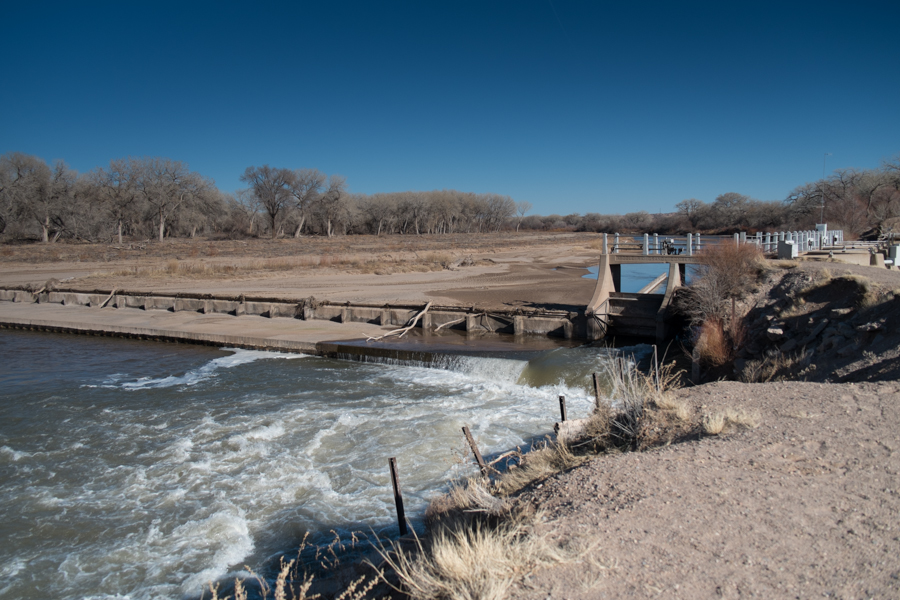
Here’s the entire Rio Grande right now, which easily fits through the slot on the east edge of the Angostura diversion dam north of Albuquerque. No water is being diverted. That’s the whole river you see. This is not unusual. The flow measures about 600 cubic feet per second at the San Felipe gauge a few miles upstream. The median at this time of year is in the mid-700s.

Angostura Diversion Dam, Rio Grande, Sandoval County, January 2014, John Fleck

Angostura Diversion Dam, Rio Grande, Sandoval County, January 2014, John Fleck

Shortage on the Colorado River

I was reminded at a talk last night that farmers in the Elephant Butte Irrigation District in southern New Mexico got less than 10 percent of a full irrigation allotment last year.

I say that by way of a preface to noting Juliet McKenna’s observation that there’s a 50-50 chance of a formal shortage declaration in the Lower Colorado River Basin in 2016. We’ve already heard a lot about the risk of the Colorado River’s first shortage, and we’ll hear a lot more. But it’s worth remembering that lots of arid climate water users, especially in the ag sector, deal with shortages with some regularity. This is only interesting on the Colorado River because it’s unprecedented. As I’ve pointed out before, in the midst of the worst drought in the instrumental record, everyone in the Lower Basin has gotten a full allocation, every single year.  The notion of the sort of rock solid, reliable 100 percent allocation is the exception rather than the rule in arid climate western irrigation.

The impacts of a Colorado River shortage declaration will be modest compared to what many arid climate irrigation systems cope with routinely as a result of climate variability.

Rivers and plumbing

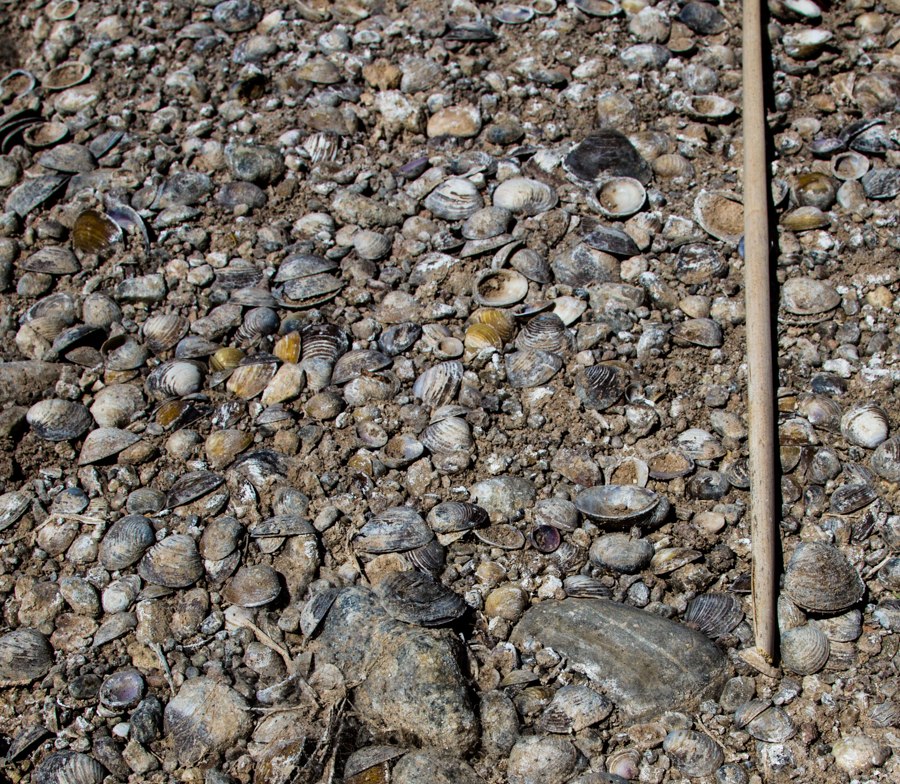
Filing some pictures this evening, I came across this, taken in the bed of the Rio Grande beneath the Hatch bridge in southern New Mexico on April 29, 2013:

Dead River Clams, Rio Grande, Hatch New Mexico,  April 29, 2013, by John Fleck

Dead River Clams, Rio Grande, Hatch New Mexico, April 29, 2013, by John Fleck

This is the sort of thing Jack Schmidt of the  Grand Canyon Monitoring and Research Center was talking about at a conference in Boulder last August when he said:

Talking about water, and talking about water as a commodity, is not the same as talking about a river.

 
Beginning in the 1950s, according to USGS data, they’ve been shutting the river down south of Elephant Butte Reservoir most winters. This conserves irrigation water, which is important to grow food and support the economy among those who have chosen to make their livings growing said food. Last year was the longest shutdown in history. They turned the river off around the end of August 2012 and didn’t turn it back on until late May.

This seems to be the sort of thing Schmidt was getting at.

The Sandias

“To say Albuquerque is located in a valley,” Paul Bauer and his colleagues wrote in Albuquerque: A Guide to Its Geology and Culture, “is geologically imprecise.” From Colorado to Texas, the river we today call the “Rio Grande” follows the path of what the geologists call “the Rio Grande rift”. As earth’s crust pulled apart, the crustal blocks in the midst of the path dropped, while the blocks on either side (but especially in the Albuquerque reach on the east side) rose. Sediment followed, dragged by water from up to down.
So, rather than excavating this enormous valley, the Rio Grande actually helped to fill a gigantic depression.

Duly noted, though “valley” seems a practical word nevertheless, imprecision notwithstanding.

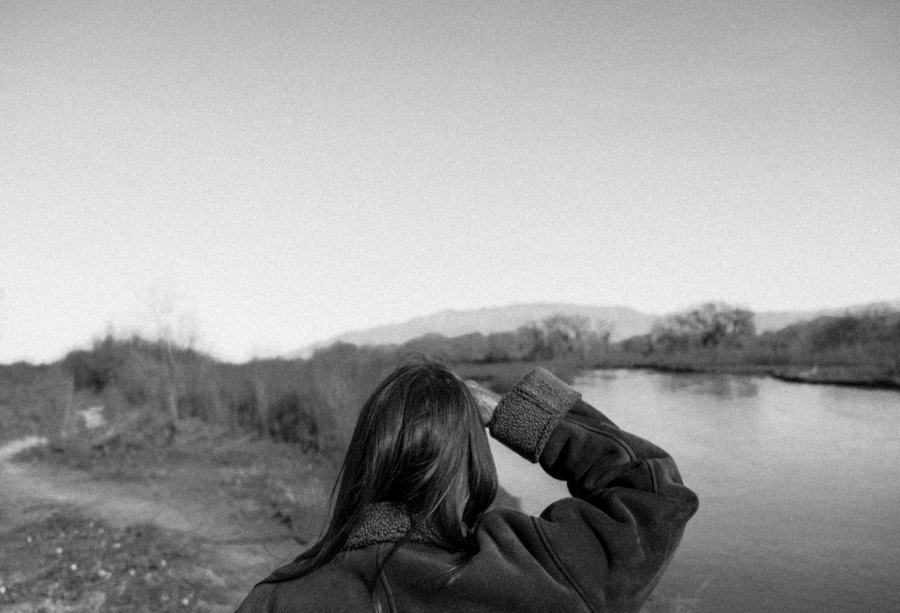
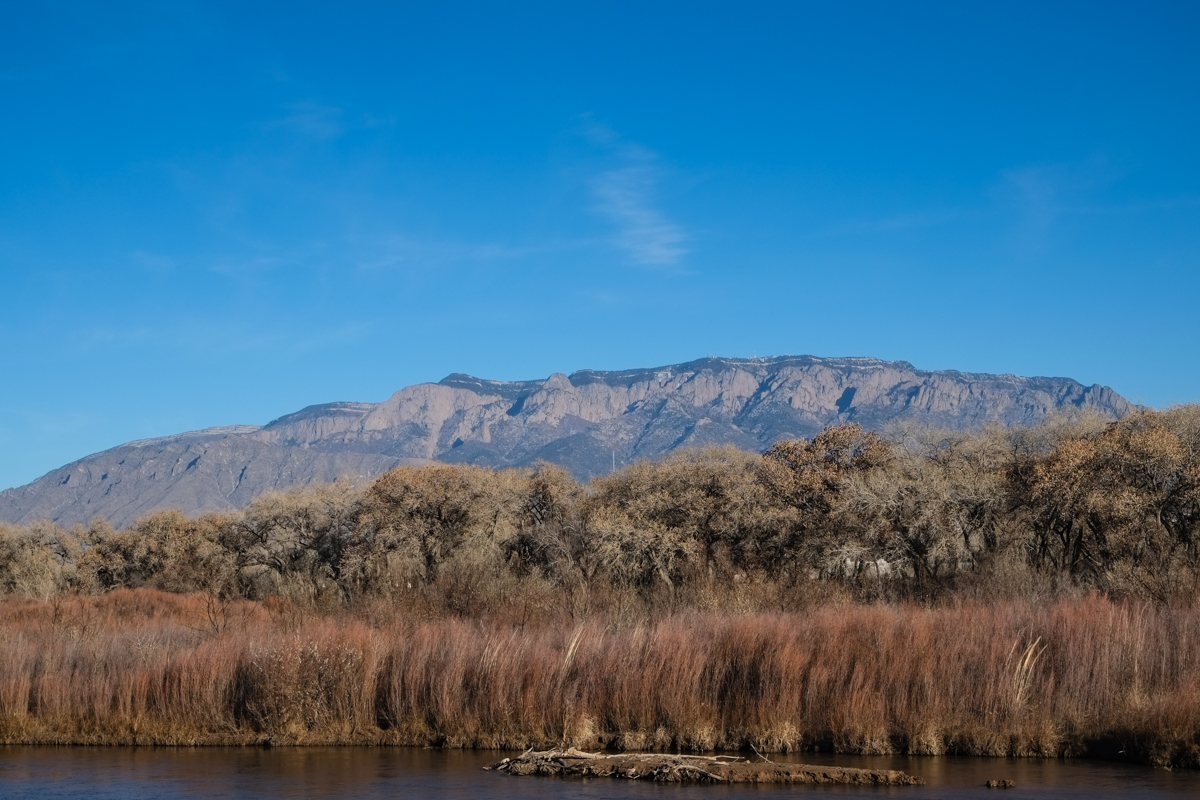
The mountains to the east, the Sandias, are visually as well as geographically defining. Geographically, the city bumps up to their feet and stops. Visually, they show up in a lot of pictures, especially the iconic (cliché?) shot of river in foreground, cottonwoods in midground and mountains as the city’s defining backdrop. Inevitably, the cliché (like the one below) focuses on the characteristic hump of the Sandias’ northern reach. As Lissa points out, it’s the more visually interesting piece of the mountain range.

Lissa Heineman, Rio Grande, Sandia Mountains, January 2014, by John Fleck

Lissa Heineman, Rio Grande, Sandia Mountains, January 2014, by John Fleck

For the record, she’s not actually looking at the mountains. She’d just heard a bird, which we later identified as a Townsend’s solitaire, high in a cottonwood. (The Bauer et al. book is a a great thing to have on the shelf for your own reference, or as a gift to the curious who might be visiting or live here.)

Spring winds

Sandias over the Rio Grande, John Fleck, January 2014

Sandias over the Rio Grande, John Fleck, January 2014

If it’s too intense and too early in the spring, it can blow all the snow and moisture away in the mountains as if winter had never happened. Then there’s no snow to become water to drain into the rivers, to come into the fields.

That’s from Stacia Spragg-Braude’s new book If There’s Squash Bugs in Heaven, I Ain’t Staying, about Corrales, New Mexico, and an old farmer named Evelyn Losack. I’m very much enjoying the book.
For now, some breathing room on the Colorado River

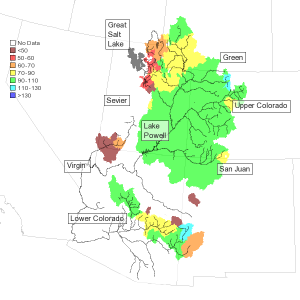
January Forecast, courtesy CBRFC

January Forecast, courtesy CBRFC

I suppose it’s a sign of the times on the Colorado River that a January forecast of 95 percent of average flow into Lake Powell counts as good news. Since green on the Colorado Basin River Forecast Center map runs from 90 to 110 percent, we get green. It’s only a little bit below average!

Last year, per the U.S. Bureau of Reclamation’s final numbers (pdf) was dismal:

The Colorado River total system storage experienced a net decline of 4.09 maf (5,040 mcm) in water year 2013. Reservoir storage in Lake Powell decreased during water year 2013 by  3.00 maf (3,700 mcm). Reservoir storage in Lake Mead decreased during water year 2013  by 0.773 maf (953 mcm). At the beginning of water year 2013 (October 1, 2012), Colorado River total system storage was 57 percent of capacity. As of September 30, 2013, total system storage was 50 percent of capacity.

The grim state of affairs on the Colorado River brought front page attention earlier this week from the New York Times which, as Jennifer Pitt pointed out yesterday, can’t hurt:

The article helped to elevate the reach and understanding of Western water issues, but for those of us in Colorado and other basin states, this reality is one we must face every day.

I mostly liked Michael Wines’ NYT piece. He went beyond the usual “there’s not enough water” teeth-gnashing to talk about some of the solution space, including examples of municipal and agricultural water conservation. That’s a step beyond what even some of the in-basin journalism (including some of my own, mea culpa) gives us. Given the way I’m currently lost in Colorado River minutia, it was instructive to see a pro come in from afar and nicely sum up the basics for an outside audience, and Wines was smart to pick up on some of solution space. Even some water nerds don’t fully grasp the importance of the whole “return flow” concept:

There may be ways to live with a permanently drier Colorado, but none of them are easy. Finding more water is possible — San Diego is already building a desalination plant on the Pacific shore — but there are too few sources to make a serious dent in a shortage.

That leaves conservation, a tack the lower-basin states already are pursuing. Arizona farmers reduce runoff, for example, by using laser technology to ensure that their fields are table flat. The state consumes essentially as much water today as in 1955, even as its population has grown nearly twelvefold.

Working to reduce water consumption by 20 percent per person from 2010 to 2020, Southern California’s Metropolitan Water District is recycling sewage effluent, giving away high-efficiency water nozzles and subsidizing items like artificial turf and zero-water urinals.

Southern Nevada’s water-saving measures are in some ways most impressive of all: Virtually all water used indoors, from home dishwashers to the toilets and bathtubs used by the 40 million tourists who visit Las Vegas each year, is treated and returned to Lake Mead.

But I agree with Pitt’s critique that Wines missed the river itself, which is an increasingly important part of the regional conversation about the basin’s future:

It is the lifeline of the American West. It is a river of legends, with awe-inspiring canyons that have for centuries seduced people to explore their depths. Citizens of the West and the rest of the globe alike love the Colorado River for the thrill of its rapids, the shade of its riverside forests that make for epic fishing, and the serene calm of a morning view from a houseboat on one of its large reservoirs.

Getting this piece right will have to be part of the grand bargain and cultural shift needed to cope with our water future.