“Developed Land”

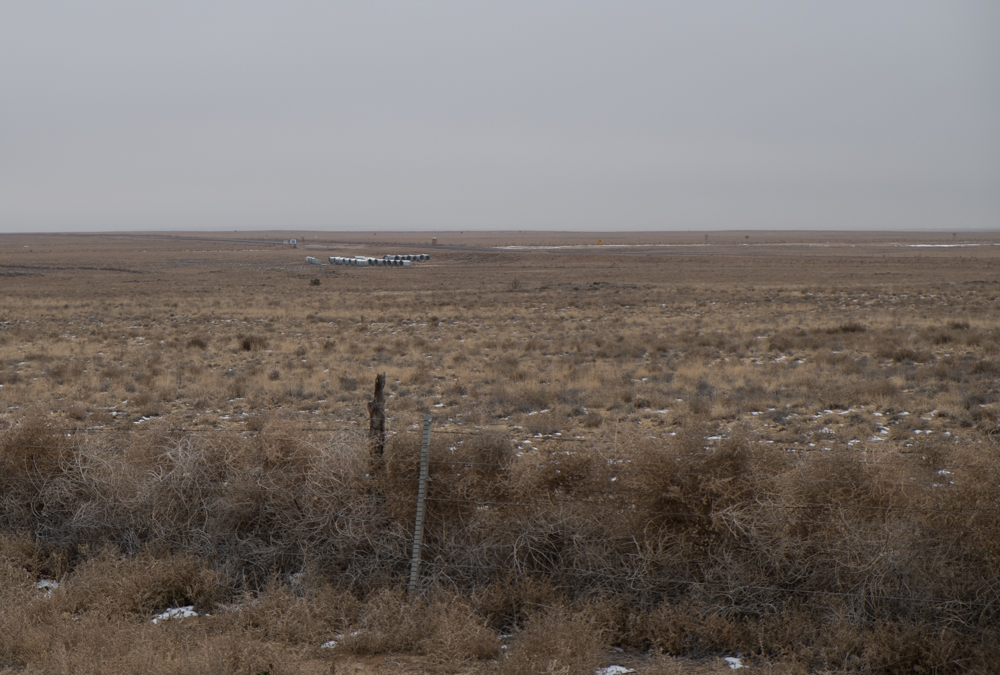
Tumbleweeds, Albuquerque's west side, December 2013, John Fleck

Tumbleweeds, Albuquerque’s west side, December 2013, John Fleck

This open land on Albuquerque’s west side, a 20 mile drive from downtown but probably half of that as the crow flies, is getting a newly improved four-lane road and drainage. It’s currently home to a cluster of shooting ranges, the place where we turn our post-sewage plant poop into compost, and a small airport. And beef on the hoof. If you look on the Albuquerque metro area’s long term planning maps, this chunk of land is colored a bright orange for “Developed Land, 2035”.

I’m reading Justin Hollander’s Sunburnt Cities, which argues that we in the sunbelt cities need to prepare for a rustbelt-like population decline. I’m not yet prepared to buy Hollander’s argument in total. After post-Economic Shitstorm declines in the years after 2008, places like Phoenix (one of Hollander’s case studies – he doesn’t deal with Albuquerque directly) are seeing their population curves turn back up.

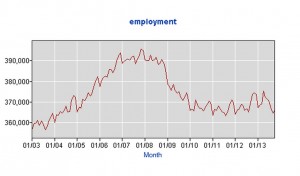
But when you look at graphs like this, showing Albuquerque’s post-ES employment, it’s pretty clear that Hollander’s nevertheless onto something significant in terms of the planning assumptions that lead people to color land like this a bright orange for “developed land” on their planning maps:

Albuquerque employment, Bureau of Labor Statistics

Albuquerque employment, Bureau of Labor Statistics

Dad always had a camera

I got a new camera.

Lissa and I have always had a family camera, but it’s been mostly her thing. She’s the artist, I’m the word guy. She lets me use it whenever I want, so I’ve always taken a lot of pictures, but I never took it terribly seriously. At the newspaper, I work with some really talented shooters, and between Lissa’s artistic vision and the skills of my coworkers, I’m acutely aware of the modesty of my ability to use a camera to identify and then convey a thought.

But taking pictures is fun, and I’m always interested in learning different ways to tell stories, so I got a new camera. I’d been using Lissa’s big DSLR camera  lately. It’s a great camera, but it’s a lot of camera, so I settled on a little one that would be easier to just slip in a bag and have with me all the time.

Going through a bunch of my old pictures last night, I came across a set I’d taken back in 2007 when we took Mom and Dad on a joyride on the Railrunner, central New Mexico’s commuter train. What had never really occurred to me until I looked at those pictures was the way Dad always had a camera. I’ve written before about my father’s life in art:

Art was intrinsic to our lives, not a thing separate.

I’ve not particularly thought about my dad as a photographer (he was a painter!), but there he was – me taking pictures of him taking pictures:
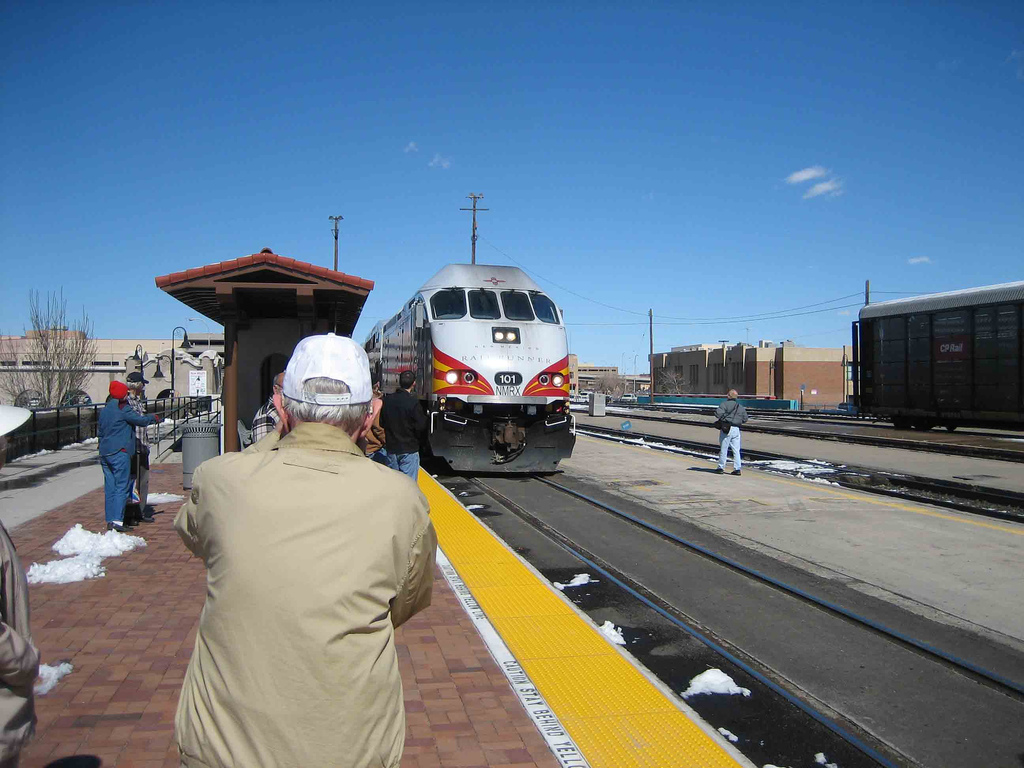
Dad taking pictures I, John Fleck, 2007

Dad taking pictures I, John Fleck, 2007

and this
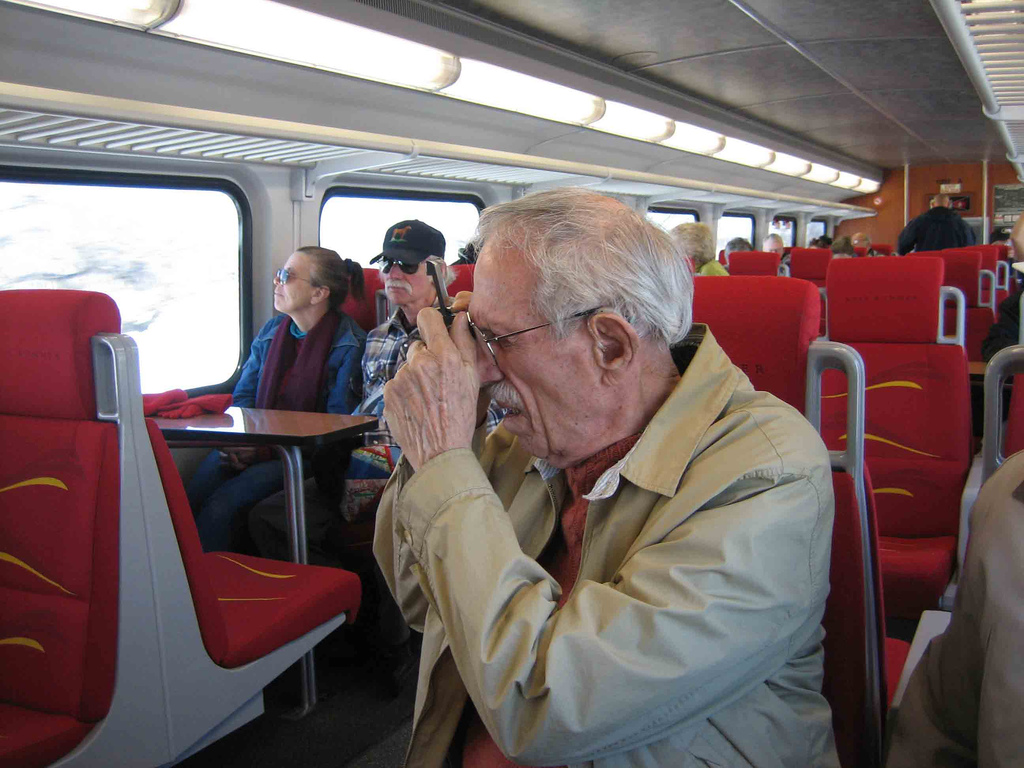
Dad taking pictures II, John Fleck, 2007

Dad taking pictures II, John Fleck, 2007

These pictures are all kinds of complicated for me. This trip was taken shortly after a doctor told us Dad had Alzheimer’s disease, that the forgetfulness we’d been learning to route around was only the beginning. I remember the trip for that reason, for a ghostly picture I also took that day of Dad’s dim reflection in the train window, a blunt metaphor that’s still painful to look at.

But for reasons I don’t remember, I also took pictures of Dad taking pictures. Dad shot slides most of his life, and had a series of serious cameras (I remember light meters), but he was never a gearhead, and in his later years he mostly just used little instamatic-type cameras that he could slip in a bag and have with him all the time. Sound familiar? So obvious in retrospect.
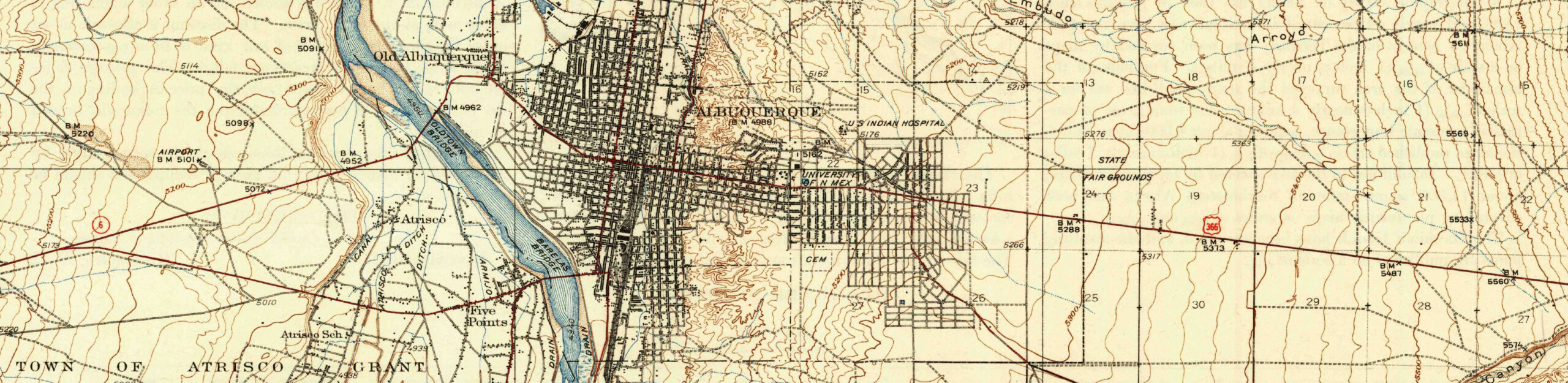
Record Upper Colorado River Basin water use in 2011

According to the U.S. Bureau of Reclamation’s new Consumptive Uses and Losses Report (pdf), consumptive use of Colorado River water in the states of the upper basin (Colorado, New Mexico, Utah, Wyoming and a sliver of Arizona) reached 4.281 million acre feet in 2011, the highest on record.

The previous high was 4.245 million acre feet in 1994. (Source: The Colorado River Documents 2008, page 2-15 up through 2008, consumptive use reports for the rest).

The state of Colorado also had its biggest Colorado River water use year ever at 2.495 million acre feet in 2011.

fifty years of drought

From Jonathan Overpeck last month in Nature (gated):

The complexity of these megadroughts still defies complete explanation and yet it implies that unusually persistent anomalies of sea surface temperature can combine with amplifying changes in vegetation and soil to drive droughts that — if they happened today — would outstrip many of our institutional capacities to deal with such aridity. For example, another tree-ring study highlighted a 50-year drought, with only one normal year of precipitation, in the headwaters of both the Colorado River and the Rio Grande during Roman times. It is hard to imagine how such a drought would play out today, but it would surely prove a much greater challenge to regional water resources and forests than any drought of the past 120 years.

Fifty years of drought, with only one year of normal precipitation. Holy moly. I’d like more discussion of what our “institutional capacities to deal with such aridity” might look like, rather than just a sweeping assertion. We’ve seen our “institutional capacities” able to deal with drought outside of historical experience. But holy moly. Fifty years?


Declining westerlies and Pacific Northwest hydrology: a hypothesis

Charlie Luce from the U.S. Forest Service’s Boise Aquatic Sciences Laboratory and colleagues have a paper in the most recent Science examining the question of whether declining westerlies are behind the changing snowpack in the mountains of the Pacific Northwest:

Decreases in lower-tropospheric winter westerlies across the region from 1950-2012 are hypothesized to have reduced orographic precipitation enhancement, yielding differential trends in precipitation across elevations and contributing to the decline in annual streamflow. Climate projections show weakened lower troposphere zonal flow across the region under enhanced greenhouse forcing, highlighting an additional stressor relevant for climate change impacts on hydrology.

Previous work has found no significant decline in precipitation, but a decline in stream flows. Luce argues that’s because most of the rain and snow measurement stations on which that conclusions is based are at lower elevations, rather than the higher elevations that contribute the bulk of the snowpack.

It’s important to recognize that this is a hypothesis, but luckily for science we’re going ahead with the greenhouse emissions experiment, so we’ll know the answer soon enough. Well, not exactly soon enough if you’re a resident of the Pacific Northwest who has built a society based on the current runoff patterns.

Municipal and agricultural use of Colorado River water: a comparison

Henry Brean reports on lawn removal efforts in Las Vegas, Nev.:

Since the turf rebate program was launched in 1999, it has paid out $189 million in rebates and helped eliminate more than 167 million square-feet of thirsty grass, saving an estimated 9 billion gallons of water per year.

Translated: a reduction of approximately 4,000 acres of lawn, and a bit less than 30,000 acre feet of water per year.

By comparison, the Imperial Irrigation District, Vegas’s downstream neighbor sharing in the Lower Colorado River Basin’s limited allocation of Colorado River water, reports more than 1 million irrigated acres, and will use approximately 2.6 million acre feet of water in 2013 (pdf).

Vegas numbers, impressive on their own, are quite literally a rounding error when you fold then into the Lower Basin’s overall water use.

Volvo Desert

I had a couple of pieces in the newspaper last week about New Mexico’s long term water usage trends. I wrote the stories because the data, a time series I assembled by reviewing state water use reports, surprised me:

Water for household use peaked in 1995 and has been declining ever since, according to state data. Farm irrigation, which makes up the bulk of the state’s water use, has been declining since the 1970s.

The explanation seems to be that we have less water:

“This is about a lack of water resources,” said Sandia National Laboratories water researcher Mike Hightower.

I played a bit with the “peak water” theme, which sounds problematic. A headline writer used the word “grim” to describe the situation, which did not entirely please me, because ultimately, I think this is not necessarily bad news. So I wrote a followup column:

It is easy to single out communities for which declining water supplies are a big problem – farmers this year in the Carlsbad area and the Hatch Valley, for example, or the villages of Vaughn and Magdalena. But perhaps more striking is the grace with which much of New Mexico’s population and economy has made the transition over the past two or more decades to a life with less water.

When one has less water, one uses less water. “We humans are incredibly adaptable,” one water policy wonk wrote me in an exchange following my column.

Two other Albuquerque Journal stories in the past month, one by me and one by my colleague Kiera Hay, tell a similar story, with Albuquerque water use dropping 6 percent this year compared to last and Santa Fe’s dropping five percent.

Early in the research for my book, one of the water community folks helping me asked a pointed question: “Mentioning that you are authoring a book probably rings of ‘Cadillac Desert’. We all have read that. You’re not writing a sequel to that? Are you?” When I started the project, the answer to that question would have been “yes”. As the much-missed OtPR wrote, “It isn’t accurate now (in fact, the book made itself obsolete), but Cadillac Desert fundamentally shaped the lay view of water in CA.” Not just California, but all the West, and it’s where I started. But the more I write about water issues, and the more I work on my book, the more clear it becomes that my friend’s observation about our adaptability is what gets us beyond Marc Reisner’s gloomy implications for our future.

I’ve begun joking that I should call my book “Volvo Desert” instead.


New York Times green shift: the verdict

Last spring, I wrote a half-hearted defense of the New York Times decision to shitcan its Green Blog and related decisions:

A Green blog is a place where environmenty people go to look for environmenty news. If we’re doing it right, that sort of news is embedded in all sorts of stories rather than a category of its own. So I agree with the rationale – both for killing the Green blog and for dismantling the Times’ green pod. I think coverage of the family of issues sometimes called the “environment beat” is best done integrated into a bunch of different beats, not off on its own.

But I called this a “half-hearted defense” because it only works if Baquet and company aren’t bullshitting us here, if they’re really planning to drive the topic(s) out into the newsroom as a whole.

A preliminary verdict, by New York Times public editor Margert Sullivan, is in:

The quantity of climate change coverage decreased…. Beyond quantity, the amount of deep, enterprising coverage of climate change in The Times appears to have dropped, too.

I was aiming at a subtlety that Sullivan’s analysis doesn’t address (doesn’t she read Inkstain?), the importance of incorporating environmental issue reporting into other topics, not writing about it in a stand-alone fashion. That said, however, the Times does not seem to have lived up to its claims when the moves were made eight months ago.