New York Times green shift: the verdict

Last spring, I wrote a half-hearted defense of the New York Times decision to shitcan its Green Blog and related decisions:

A Green blog is a place where environmenty people go to look for environmenty news. If we’re doing it right, that sort of news is embedded in all sorts of stories rather than a category of its own. So I agree with the rationale – both for killing the Green blog and for dismantling the Times’ green pod. I think coverage of the family of issues sometimes called the “environment beat” is best done integrated into a bunch of different beats, not off on its own.

But I called this a “half-hearted defense” because it only works if Baquet and company aren’t bullshitting us here, if they’re really planning to drive the topic(s) out into the newsroom as a whole.

A preliminary verdict, by New York Times public editor Margert Sullivan, is in:

The quantity of climate change coverage decreased…. Beyond quantity, the amount of deep, enterprising coverage of climate change in The Times appears to have dropped, too.

I was aiming at a subtlety that Sullivan’s analysis doesn’t address (doesn’t she read Inkstain?), the importance of incorporating environmental issue reporting into other topics, not writing about it in a stand-alone fashion. That said, however, the Times does not seem to have lived up to its claims when the moves were made eight months ago.

Simon Rifkind’s great mistake and the shortfall on the Colorado River

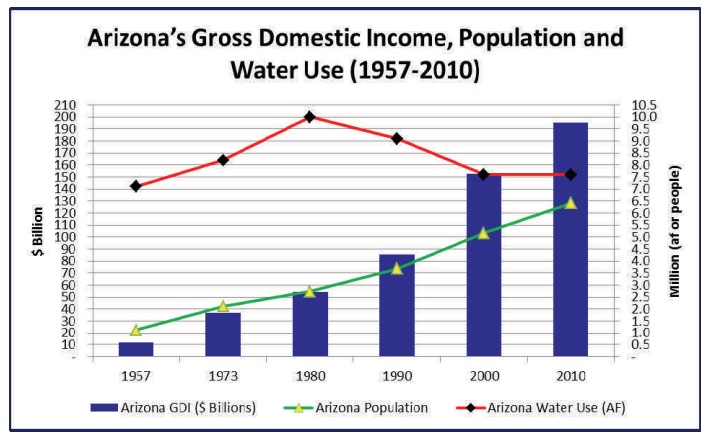
tl;dr – In 1960, U.S. Supreme Court Special Master Simon Rifkind made a fundamental mistake in calculating how much water was then available in the Colorado River Basin, and how much might be available in the future. The court, in its ruling in the case of Arizona v. California, accepted Rifkind’s math. The consequence is a shortage on the Colorado River relative to the expectations of the nine states (seven in the U.S., two in Mexico) that share it.

But it also was a fundamental mistake for the water users in the Lower Colorado River Basin to not recognize the flaw in Rifkind’s math and act accordingly. That second mistake, more than Rifkind’s, is the cause of our current troubles.

Click through for the longer version….

Continue reading ‘Simon Rifkind’s great mistake and the shortfall on the Colorado River’ »

River restoration – it’s all about the groundwater

I’m looking forward to Requiem for the Santa Cruz: An Environmental History of an Arizona River, a forthcoming University of Arizona Press book by Robert Webb, Julio Betancourt and colleagues. While we spend a lot of time talking about how to return water to rivers in the arid southwestern United States, this group of authors is entertaining a more subtle point – it’s not just about the water flowing in the river, it’s about the groundwater beneath:
In prehistoric times, the Santa Cruz River in what is now southern Arizona saw many ebbs, flows, and floods. It flowed on the surface, meandered across the floodplain, and occasionally carved deep channels or arroyos into valley fill. Groundwater was never far from the surface, in places outcropping to feed marshlands or cienegas. In these wet places, arroyos would heal quickly as the river channel revegetated, the thriving vegetation trapped sediment, and the channel refilled. As readers of Requiem for the Santa Cruz learn, these aridland geomorphic processes also took place in the valley as Tucson grew from mud-walled village to modern metropolis, with one exception: historical water development and channel changes proceeded hand in glove, each taking turns reacting to the other, eventually lowering the water table and killing a unique habitat that can no longer recover or be restored. (emphasis added)

Thus, when a river runs low, a shallow water table still leaves refugia, muddy holes that stay wet even as the flow in the river itself dries. As we pump down our aquifers, we lose that, even as environmental restoration efforts focus on adding more flow to the rivers themselves.

Water in the desert: the winter palette

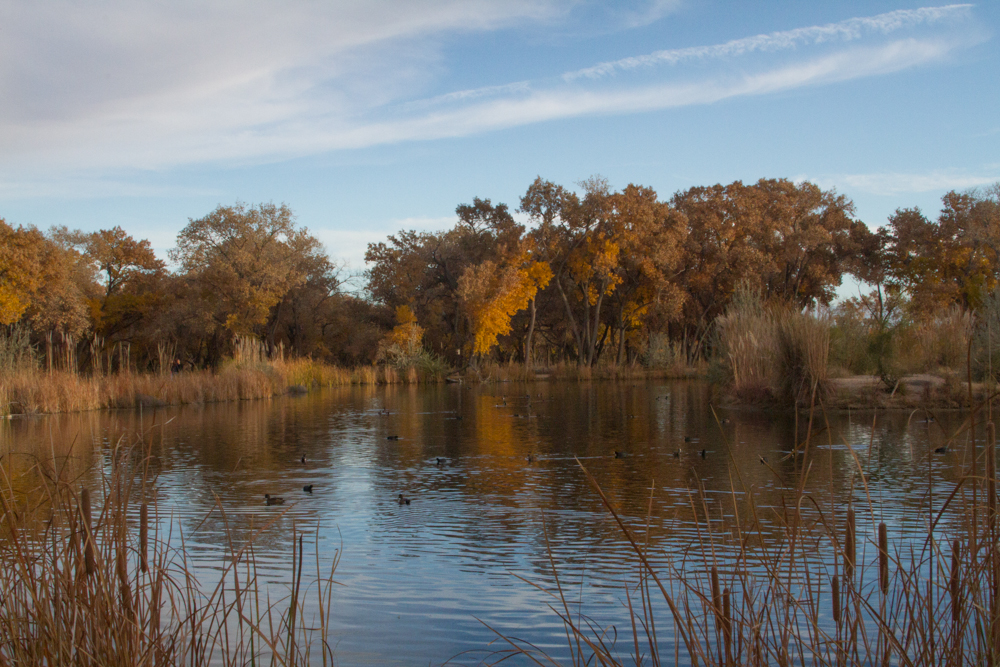
Autumn at the Tingley ponds, John Fleck, November 2013

Autumn at the Tingley ponds, John Fleck, November 2013

Yesterday my sister and I busted Mom out of the nursing home for lunch and a drive down by the river to see the tail end of the fall colors. Down by Tingley Beach, an Albuquerque municipal park adjacent to the Rio Grande, the cottonwoods were still putting on a show, but they’re clearly tiring, getting ready to dump the leaves and be done with it. In the face of creeping blindness and dementia, we can’t be sure any more what Mom sees. When her brain worked, her pride and a certain amount of denial made it hard to get her to share what she could really see as her eyesight was fading over the last 15 years. Now, it’s just hard to get much of anything out of her brain. Best to default to showing her the fall colors, I suppose. Can’t hurt, and she seems to like the idea that she’s seeing them, even if she doesn’t realize she can’t.

Lissa and I went back today for a walk in the woods. Humans created two big ponds near the river, which are popular with the wintering ducks. We saw our first canvasbacks and redheads of fall, along with a single ruddy duck, a single pintail and a mob of wigeons. I’ve always been partial to the winter palette of the Rio Grande woods, the drab grays and browns after the autumn color show is over. There’s a cold quiet that seems to go with the color. It wasn’t quite there yet today – a warm afternoon, some garish yellows of fall still lingering on the cottonwoods, the dog walkers and joggers and bikers taking advantage of one last warm Sunday afternoon, nearly outnumbering the wigeons.

The importance of technology, barbed wire edition

[T]he traditional wooden fences of earlier American frontiers were simply not feasible in a landscape whose most distinctive feature was its lack of trees. Ranchers could of course get any amount of wood they needed from lumber merchants in Chicago and the Mississippi Valley – if they could afford it. Earlier fencing styles were so wood intensive, however, that they were simply too costly for wide use in the open spaces of the High Plains. Large-scale fencing there became possible only in the 1870s, after Joseph Glidden’s invention of barbed wire in 1873 dramatically reduced the amount of wood that went into a typical fence. The railroads that allowed ranchers to ship their animals to Chicago’s market brought in return the fence posts and barbed wire with which to partition the grasslands.

William Cronon, in his book Nature’s Metropolis: Chicago and the Great West.

What is nature, striped bass edition

Men with striped bass, wearing ties, courtesy California Department of Fish and Wildlife

Men with striped bass, wearing ties, courtesy California Department of Fish and Wildlife

Can the decline of an “invasive” species be taken as a sign of an ecosystem’s declining health?

That’s the question raised by an interesting Alastair Bland article in the East Bay Express on the latest numbers for striped bass in the Sacramento-San Joaquin-San Francisco Bay Delta system:

Scientists say the existing population may be as small as 5 percent of historic highs, and even diehard fishermen have given up trying to catch striped bass — once one of the most popular game fish on the West Coast.

Stripers aren’t native. As Bland notes, they were introduced via a small population in the 19th century. By the 1930s, according to Bland, their abundance supported a thriving commercial fishery, and they’ve long been a popular target of sport fishing. But there’s also been pressure to reduce their numbers because of the belief that they prey on endangered and threatened native fish like the delta smelt.

Given the smelt and their colleagues are the Endangered Species Act drivers now pushing delta habitat recovery and restoration efforts, what should we make of the decline of the striper? If what we’re trying to do is reduce jeopardy to specific listed species, shouldn’t we celebrate the decline of the striped bass? Or are we now dealing with such a fundamentally human-altered environment that the striped bass is an intrinsic part of the “social-ecological system” of the Bay-Delta of the 21st century?

Questions of science, questions of values, inextricably entangled at this point such that it’s hard to see where one stops and the other begins.