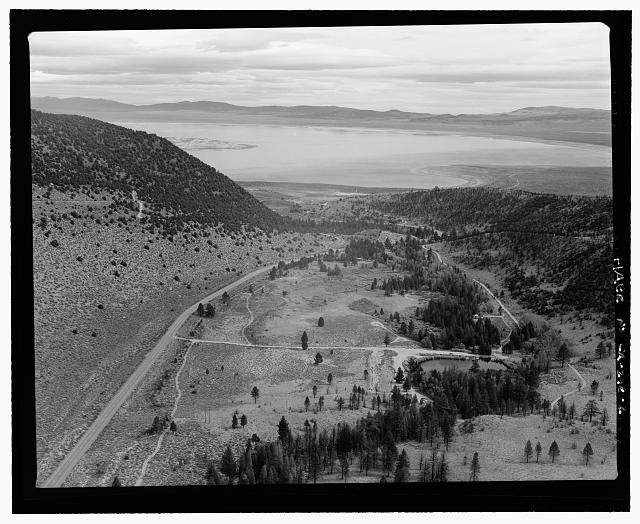
Lee Vining Intake, Los Angeles Aqueduct, Courtesy Library of Congress
On the occasion of the 100th anniversary of the Los Angeles Aqueduct, economist Gary Libecap’s take on “The Myth of Owens Valley“:
The allegations are that Owens Valley water was stolen from farmers by a rapacious Los Angeles and, once it was shipped out of the valley through the Los Angeles Aqueduct, the agricultural economy was ruined and the valley was left a wasteland.
Unfortunately for the development of water markets and the smooth reallocation of water, the story is wrong. The water was neither stolen nor was the farm economy left in ruins. There is another and more useful lesson to be drawn from Owens Valley for promoting the development of water markets: Because water is a complex resource with many interconnected uses (some rivalrous and some not), any water trade is likely to have at least a few third-party effects. Fears of those effects bottle up contemporary water discussions. But the Owens Valley experience reveals that the allocative benefits of moving water from low-valued uses to high-valued ones are so large that they most likely will swamp the distributional concerns.
Libecap argues that the decline of Owens Valley farming, part of the foundation of what he calls the “myth”, is the same trend found in other Great Basin farming valleys, a long term shift to livestock:
The export of water reduced crop production as a share of overall agricultural output and encouraged a shift toward livestock. But this pattern also took place elsewhere in the Great Basin. The comparative advantage of the region ultimately was in livestock, so there likely would have been a gradual shift from crops in Owens Valley, even had the aqueduct not been built. Owens Valley was not left a wasteland as is sometimes alleged.
This conversation matters because so much of the West’s water is currently used in agriculture. We only have a long term shortage in the West if we want our cities and our farms to both continue on their current trajectories. Given the relative economic size and importance of the cities relative to the farms, we need to get the “distributional concerns” about farm-to-city transfer right, which means we need to look carefully at what actually happened in the Owens Valley (and other places where ag->urban transfers are underway).
 , about chess, technology and the hollowing of the American middle class.