The new political economics of moving water

The politics-economics interface is what fascinates me about this new idea kicking around to replenish the rapidly draining Ogallala Aquifer by moving water across Kansas from the Missouri River. As Brett Walton explained last month in Circle of Blue, it’s a modest study at this point, with costs split between the state and federal government. But the scale of the thing being considered is of the same order of magnitude size as the big water-movers of the West – the Central Arizona Project and its ilk:

Economics are foremost in Rude’s mind, because the aqueduct would be a whopper of a project — at least double the estimated $US 3.6 billion price tag from three decades ago and comparable in scale to massive water diversions like the 540-kilometer (360-mile) Central Arizona Project that was approved before the Carter administration and which was built mostly with federal money.

And there’s the rub. Because it seems clear that the days of federal funding for big projects like this are long over. There are examples of non-federal projects of this scale. Los Angeles has done it. But that’s for municipal water supplies, for which one can charge a lot more. Brett touches on the scale of the political-economic problem:

Rude acknowledges that the days of deep federal investment are probably over. Farmers, who now pay only for the energy to pump water, and other local users will have to shoulder the cost, and that represents the chief uncertainty for the project. How much will water cost? Will people pay for it? Are there possible cost-sharing partnerships with cities and industries along the route?

Do you think my premise is correct – that the days of this sort of federal project are over? If “yes”, is state and local financing in Kansas a realistic option?
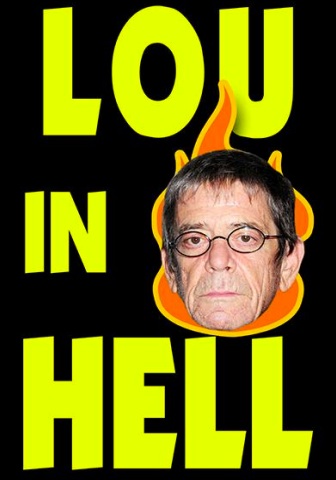
teaching sin and rebellion to generations of brutish American youth

Lou in hell

Lou in hell

Amid the outpouring on the occasion of Lou Reed’s death, a particularly fine epitaph from the folks at the Westboro Baptist Church (pdf):

From his early days as a frontman for the punk band The Velvet Underground and his inclusion as part of Andy Warhol’s infamous Factory, Lou Reed has been teaching sin and rebellion to generations of brutish American youth.

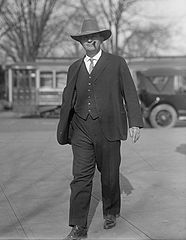
The Cold War “dam gap”

Circa 1958, a unique argument in favor of the development of the next wave of dams in the Colorado River Basin. At the time, the Eisenhower administration had failed to include any “new starts” for U.S. Bureau of Reclamation projects in its Fiscal Year 1959 budget. Sen. James E. Murray, D-Montana, was alarmed:

Your attention is called to the very real threat by Soviet Russia in outstripping the United States in water resources and hydroelectric power development…. We propose to delve into this subject at public hearings for the purpose of alerting the American people to the threat to the economic stability of this country.

Senate Committee on Interior and Insular Affairs, Jan. 23, 1958

update: I found that last little bit while reading Congressional testimony about water and power project development in the Upper Colorado River Basin. Tugging on the thread, I found a remarkable Congressional report written in 1957 (sorry, only found it in the walled-off web, can’t find a public copy) purporting to be a thorough inquiry into this incredibly important question. It concluded that we were still ahead of the commies, but warned against complacency:

While the United States is still the leading producer of hydroelectric power and is still the leading industrial nation of the world and Soviet Russia has not yet outstripped the United States, its rate of progress percentagewise is a warning, against the background of the economic cold war, that this country dare not adopt a complacent attitude that would allow us to drift under a false assumption of unassailable superiority.

Relationships of river and related water resource development programs of U.S., Soviet Russia, and Red China, 12063 S.rp.1926, Committee on Interior and Insular Affairs. Senate; Committee on Public Works, July 23, 1958


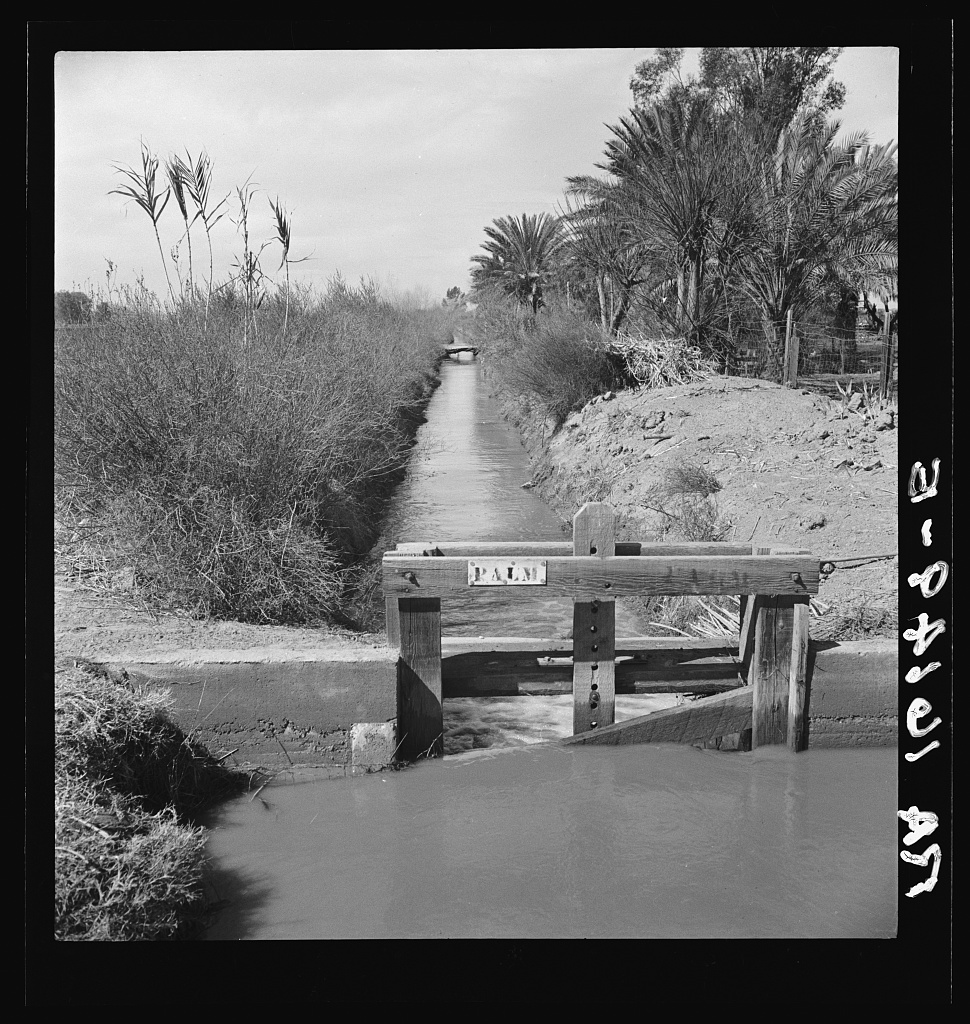
Watering the desert, circa 1937

Imperial Valley, 1937, Dorothea Lange, courtesy Library of Congress

Imperial Valley, 1937, Dorothea Lange, courtesy Library of Congress

Full caption:

Irrigation ditch along the road. Imperial Valley, California; Lange, Dorothea, photographer; 1937 Feb.

Lange’s justly famous for her pictures of the people of the Imperial Valley when she travelled there in the late 1930s as a documentarian for the Farm Service Administration. She also took pictures of water. If you want to get lost for an hour or two, the Library of Congress has quite a collection on line.

Vegas: a race against nature?

With Lake Mead water levels dropping, Pat Mulroy is in a race against Mother Nature.

That’s how the risks facing by Las Vegas, Nev., were framed this week in a piece in The Henderson Press. But as one of the members of my water geek brain trust, Phil King, likes to point out, reservoir levels are a wonderful way of tracking drought and/or plenty in a single indicator because they integrate both how much water nature puts into the lake and how much water humans take out.

Lake Mead is dropping, and Pat Mulroy is racing, in significant part because the people of Las Vegas, Phoenix and Los Angeles, and most especially the farmers of the Imperial Valley, use a lot of water. In fact, as I’ve pointed out previously, Lake Mead’s been getting all the water it’s supposed to get under the Colorado River Compact, year after year, since forever. Sometimes it even gets bonus water above and beyond that. But Lake Mead keeps dropping.

Mulroy’s in part racing against Mother Nature, but in large measure she’s also racing against herself.

Carl Hayden: “water as cheaply as it can be served”

Carl Hayden, 1916, courtesy Library of Congress

Carl Hayden, 1916, courtesy Library of Congress

Here’s a great quote from Carl Hayden. It was June, 1922, still in the early days of the jockeying for development of the Colorado River’s water. Hayden was at the time a relatively junior member of the House, having not yet ascended to the political heights from which decades later, as Arizona’s senior senator, he engineered the construction of the Central Arizona Project:

It seems to me that the irrigator under a reclamation project is entitled to receive his water as cheaply as it can be served to him. I think that is in the public interest.

That’s from the 1922 hearings before the House Committee on Committee on Irrigation of Arid Lands on HR 11449, A Bill to Provide for the Protection and Development of the Lower Colorado River Basin. Hayden didn’t get his way on the provision of irrigation water for Arizona until 46 years later, when Lyndon Johnson finally signed the Colorado River Basin Project Act of 1968. But on this central point – cheap irrigation water to underpin the “public interest” in the West, there seems to have been little disagreement.

That Hayden kept plugging away for the whole 46 years is, in and of itself, a remarkable thing.

(h/t Jack August’s Vision in the Desert for its discussion of Hayden’s comments, though the transcript I found differs in some respects from the version August included in his book.)
Eucalyptus

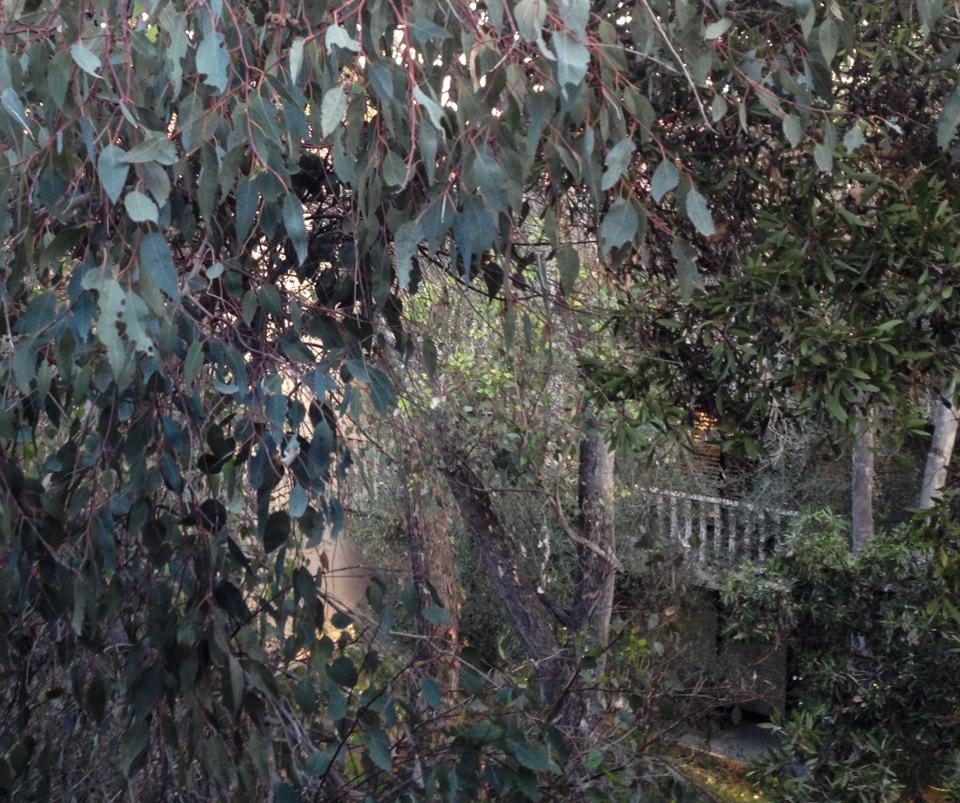
It was dark when I got out of my rental car yesterday evening in Rancho Bernardo, north of San Diego. I couldn’t really see the place, but I could smell the tell-tale scent of eucalyptus. I slept with the window open. There was a eucalyptus outside my window. I slept well.

The eucalyptus outside my window, Rancho Bernardo, CA, October 2013, by John Fleck

The eucalyptus outside my window, Rancho Bernardo, CA, October 2013, by John Fleck

When I grew up in Upland, in the eastern suburbs of Los Angeles, the eucalyptus was ubiquitous, planted as windbreaks along the edges of orange groves. That smell, the mix of eucalyptus and citrus, is my youth. It turns out the story we learned as children – that the tree’s presence was the result of a failed attempt by the railroads to grow a fast-growing tree for use as railroad ties –  is close to bunk. As Nathan Masters wrote earlier this year, the railroad thing played only a minor role. The real story is much richer and more in keeping with Southern Californians’ peculiar penchant for self-invention. Here’s Abbot Kinney (as quoted by Masters), a 19th-century booster extolling the virtues of the fast-growing tree (also known as the “blue gum”):

The introduction of this tree has done more to change radically the appearance of wide ranges of country in California than any other one thing. In the reclamation of many arid plains of the central and southern parts of California the blue gum has worked almost like magic. It modifies the winds, breaks the lines of view all so quickly that one can scarcely realize that a valley of clustered woods and lines of trees was but a year or two before a brown parched expanse of shadeless summer dust.

On the grounds of the conference center/hotel place that I’m staying, there also are pepper trees, which lined Euclid Avenue in Upland when I was growing up, which were another signature tree of my childhood, and which Masters points out are also an import. So this trip is tinged with nostalgia for my youth. But it was fascinating when I snuck away this afternoon for a couple of hours from the conference I’m attending (beach trip, absolute necessity) to also see the chaparral hillsides as the freeway cut through the San Diego hills. They were dry, with no trees, and they also felt like old home week to me, like the foothills above our houses that my chums and I used to clamber up to get a better view.

The conference is about water, and my 54-year-old self can’t help but ponder the water needed to carry out Kinney’s vision of “the reclamation of many arid plains”, and the natural dry of those chaparral hillsides, notions of sustainability, that sort of thing. I’ve written before about my fascination with California’s great invention of itself, and about the sustainability of the results. The grand expanses of tile-roofed homes sprawling up San Diego’s hillsides, far above the high water mark the last time I was here, gives me pause.

But damn those eucalyptus smell good. I’ll leave the window open again tonight.

A reminder that the Endangered Species Act is a really lousy water management tool

Chris Austin reminds us why California’s Bay Delta Conservation Plan may look like a water management plan, but isn’t:

The Bay Delta Conservation Plan (BDCP) is often criticized for not being comprehensive enough because it doesn’t consider other actions that could be taken such as desalination, or other statewide or regional needs such as water storage. Perhaps it’s the huge price tag or the over 40,000 pages that makes it seem like it should be more; however, the Bay Delta Conservation Plan is not supposed to be statewide water plan – it is, after all, a permit application for an incidental take permit that is being submitted under federal and state endangered species regulations.

One can imagine a water management plan for ensuring supply reliability for San Joaquin valley farms and Southern California lawns, developed as a water management plan rather than a plan for avoiding jeopardy to endangered species, that might look much the same. Or one could imagine a whole bunch of different possible solutions cropping up if this wasn’t an ESA-driven planning effort. But we have to imagine, because Chris is right here in pointing out what I think is one of the BDCP’s great shortcomings. It’s not a water management plan.