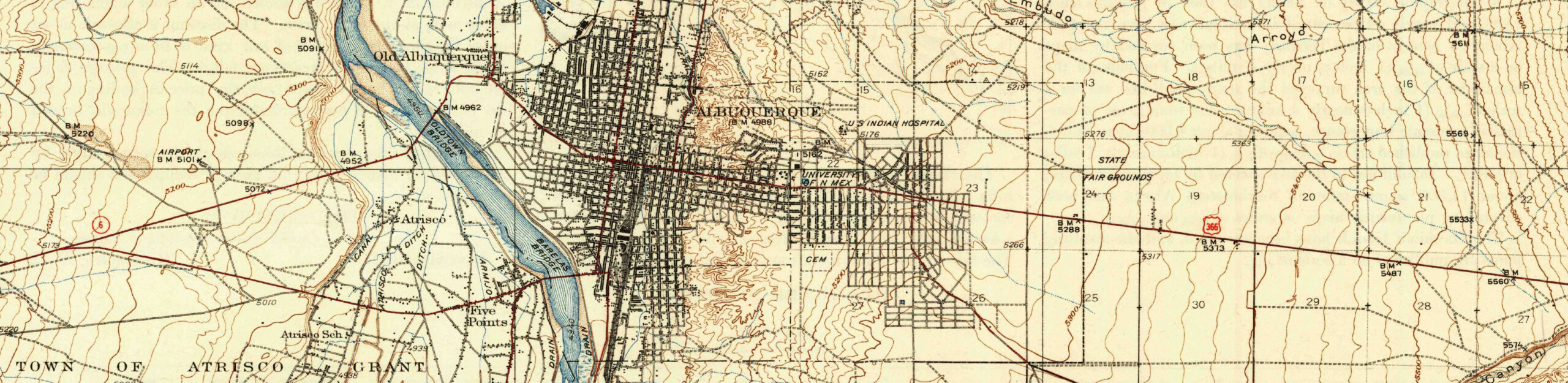
Typo found in my notes: “irritable” where I meant to type “irrigable“. Looking at century-old estimates of possible agricultural land in the desert southwest. Notable mistake.
Note to self: invest in water
From Rakteem Katakey and Manish Modi at Bloomberg:
Shares of water companies are beating those of gold and oil producers as governments from China to India boost spending on basic infrastructure to avert shortages threatening economic growth and political stability.
The arrival of the elk – another “what is nature?” story
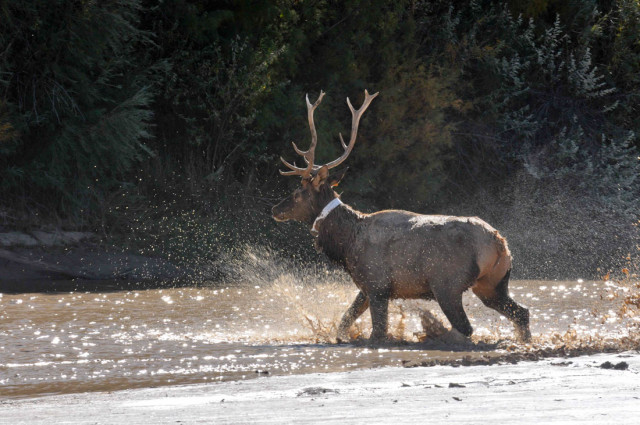
courtesy NM Department of Game and Fish
My Journal colleague Charles Brunt had a fascinating tale in this morning’s Albuquerque Journal about the Bosque del Apache wildlife refuge’s struggle with elk.
Located on the Rio Grande in central New Mexico, the Bosque is famous among birders, a winter home to a flock of some 10,000 sandhill cranes. It’s always been my personal case study for thinking about human efforts to create and manage “nature” – an intensely managed landscape, with a rich and complex plumbing system of fields, ditches and gates designed to mimic an arid landscape riparian flood plain that no longer exists.
The refuge managers grow corn for the birds, and they’ve always had to manage it carefully to draw the right birds (cranes) while tolerating the wrong birds (snow and Ross’s geese, a species with a serious overpopulation problem). Now the corn has drawn a second pest – elk:
Elk in the Bosque del Apache National Wildlife Refuge are devastating the corn crop that feeds the refuge’s migratory birds, leading wildlife managers to begin killing some of the animals for the first time since elk migrated there two decades ago.
And while New Mexico Department of Game and Fish officials and their counterparts at the refuge agree the herd needs to be thinned, there’s disagreement on who should kill the elk, and when they should do it.
Nature’s hard to get right.
I want my atmospheric river!
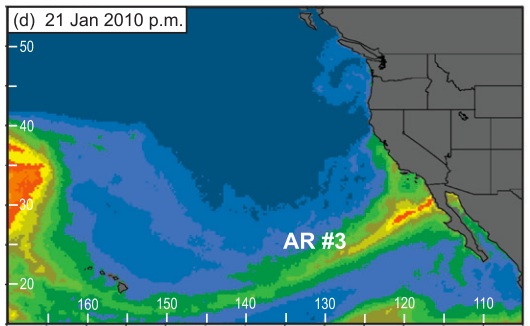
Ever since I first heard about “atmospheric rivers” from Cliff Dahm, the biologist who until recently headed science efforts for the Delta Stewardship Council, I’ve been asking every scientist who I heard talk about them whether they can make it all the way to New Mexico. AR’s are these amazing storms that blast California like a firehose, and they’re getting increasing attention in the climate-policy interface in California because of the importance of their presence, or absence, in determining whether that state has good or bad water supply years.
But they’ve been primarily a California thing. Can they push their moisture past the mountains and make it all the way to New Mexico?
atmospheric river
Mike Dettinger, California’s “Dr. AR”, sent around a paper today (pdf) that pushes the boundary in our direction. It was a memorably impressive January 2010 storm, which came close to setting records (and in some cases set records) for runoff in the high country along the Mogollon Rim in Arizona and in the Gila Mountains of southwest New Mexico:
The AR was oriented nearly orthogonal to the Mogollon Rim, a major escarpment crossing much of central Arizona, and was positioned between the high mountain ranges of northern Mexico. High melting levels during the heaviest precipitation contributed to region-wide ?ooding, while the high altitude snowpack increased substantially. The characteristics of the AR that impacted Arizona in January 2010, and the resulting heavy orographic precipitation, are comparable to those of landfalling ARs and their impacts along the west coasts of midlatitude continents.
Neiman, Paul J., F. Martin Ralph, Benjamin J. Moore, Mimi Hughes, Kelly M. Mahoney, Jason M. Cordeira, Michael D. Dettinger, 2013: The Landfall and Inland Penetration of a Flood-Producing Atmospheric River in Arizona. Part I: Observed Synoptic-Scale, Orographic, and Hydrometeorological Characteristics. J. Hydrometeor, 14, 460–484.
So “playground activists” were a thing
In early twentieth century America, there were playground activists:
Playground activists in cities across the nation, drawing from prevailing theories in psychology and sociology, championed organized play as the path toward stronger bodies and higher morals.
That’s from Matthew Klingle’s fascinating Emerald City: An Environmental History of Seattle (The Lamar Series in Western History)
Groundwater: cooperating in Kansas
Brett Walton’s got another good story about what happens when communities creatively confront coming water shortages and take control over their own adaptation. This one’s out of Kansas, where folks in the Northwest Kansas Groundwater Management District are on the cusp of agreeing amongst themselves to a 20 percent groundwater pumping curtailment, shared, to stretch out their aquifer supplies:
In the past, farmers could call on the chief engineer to administer water rights based on the priority system, in which older users are protected and junior claims are cut off. That course of action, Griggs explained, could enrage neighbors and ripple destructively through the local economy, if pumping were cut off completely. The result, he said, “was economic paralysis” and unchecked declines in the water table.
The LEMA law, however, shifts the power balance. Unlike an earlier law, the chief engineer can only approve, reject, or send back a LEMA management plan for revisions; he cannot make changes himself.
“It deals with the problem of inaction by locals, who want to manage their resource, but who are concerned that a central authority can come in and adopt rules that don’t take notice of local economic conditions,” Griggs said.
the drought’s Obama’s fault
From the Texas Tribune:
“Without immediate and direct action from the White House and U.S. Department of State, Texans along the Rio Grande will continue to suffer from a lack of available water,” Perry wrote.
what newspapers do
Newspaper people don’t become newspaper people because they want to get rich, or because they want to be famous, they do so because they believe in what newspapers do.
TJ Sullivan, in his explanation of why he went to Roger Ebert’s funeral
Why “when the Ogallala runs out” isn’t the right way to think about this
Ogallala Aquifer
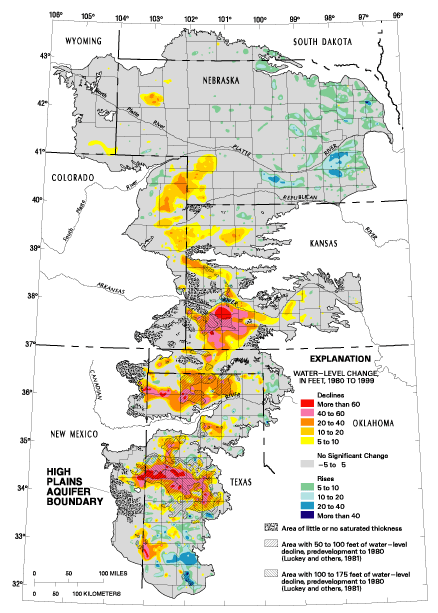
At dinner the other night, one of the people at the table commented about the risk we face when the Ogallala Aquifer, beneath the great plains, runs out, which he’d heard would happen in 20 years. Without taking action now to begin regrowing the native grasses needed to hold the plains in place, he’d heard, we faced the risk of another uncontrolled Dust Bowl like the one in that Ken Burns special.
There’s some science to support this, sort of:
Extrapolation of the current depletion rate suggests that 35 percent of the southern High Plains will be unable to support irrigation within the next 30 y.
But that “current depletion rate” caveat is the big “sort of” that exposes a peeve I’ve got about a lot of simplistic thinking about our water future. One can argue (as my dinner companion later did) that Lake Mead and Lake Powell have an x percent chance of going dry by year y, or that the a big part of the Great Plains is going to become another Dust Bowl in 20 years if one assumes that our behavior will continue “at the current depletion rate.”
But there are some unrealistic assumptions embedded here. One is that water users won’t scale back their use to forestall the aquifer’s decline. The other is that farmers don’t have alternatives when faced with less water.
There are a couple of recent things I’ve read (and one I’ve written) that illustrate the point. First, here’s what Mike Haederle wrote for Texas Climate News about the study I quoted from above, what happens when the water runs out:
If irrigation mostly disappears, “a high percentage of it will still be farmed – not necessarily all of it,” Smith says. “It’ll probably be mostly just cotton. Before they had any irrigation, they farmed cotton and some sorghum and some other crops. It’ll go back to that.”
A regional shift away from irrigation has occurred before. In the 1980s, skyrocketing fuel prices hit West Texas farmers who relied on the water- and labor-intensive irrigation systems common at the time, Smith says. “For a lot of them, it was more profitable to go to dryland farming then,” he says.
There’ll likely be economic dislocation, Mike wrote. Dryland farming is less lucrative. But this is a business management challenge, not an existential threat. If you’re worried about doom here, Mike’s piece will allow you to sleep a bit better this evening.
In a similar vein, Brett Walton at Circle of Blue had a fascinating piece last week about efforts by Texas farmers and ag scientists to prepare for a future with less water to work with. It’s a longish piece, well worth a read if you’re concerned about the Ogallala in the long term, but makes three basic points:
- Texas high plains water districts are beginning to restrict withdrawals
- Conversion from irrigation to dryland farming will cause reductions in farm income and jobs, but not an end to farming on the land (and wind power revenue will offset some of the economic dislocation)
- research is underway to develop more viable crops with less water
A similar point came through during my visit to the Hatch Valley last month. Farmers are adapting to the changing environment.
While thinking about the depletion of the Ogallala is an important exercise, a look at what folks are doing in impacted communicaties shows that an assumption of continued depletion at current rates doesn’t quite work for modeling the future.
Stuff I wrote elsewhere: in the midst of drought, signs of water cooperation
It almost felt like a setup when Steve Harris asked me to talk at a conference about how “water is for cooperating over.” I make a meager but steady living these days writing about water conflict. And yet….
[B]efore I got to Ghost Ranch on Friday afternoon, I took the turnoff to Abiquiu Reservoir. In drought-parched New Mexico, this is the one reservoir that has a lot of water. It glistened blue-green beneath a bowl of rust-red cliffs, shimmering in a brisk afternoon wind.
For fans of cooperation, there is hope in plans for a release beginning today or Wednesday out of Abiquiu, a big slug of municipal water now in storage to try to boost the meager flow of the Rio Grande.