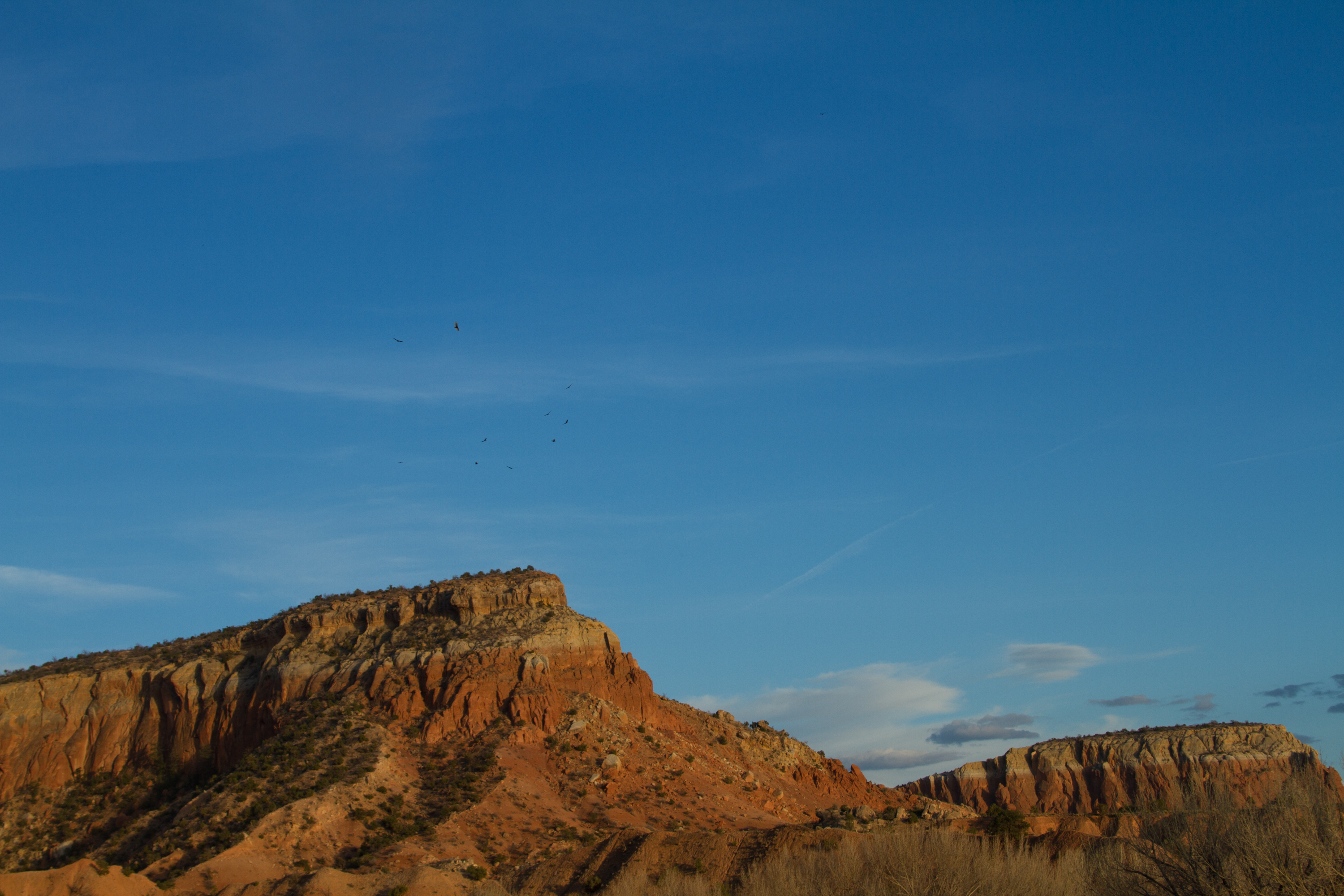
Turkey Vultures over Ghost Ranch, L. Heineman, April 2013
Turkey Vultures over Ghost Ranch, L. Heineman, April 2013
When I left Pasadena nearly 25 years ago, my water mentor Tim Brick was hard at work on the problem of restoring a semblance of riverness to the Arroyo Seco, the channel that defines that Southern California city’s western edge.
Via a visit by our old mutual friend Larry Wilson to the confluence of the Arroyo Seco and the Los Angeles River, I see Tim’s still at it:
I can say that if you dare to walk down a scary ramp just east of Avenue 22 and Figueroa Street in Cypress Park, underneath where the 110 and the 5 freeways meet, you will find yourself at the confluence of two of the sorriest looking bodies of water you could ever hope to see. Everything is paved. Everywhere is trash.
I’m in favor of Confluence Park.
* With a nod to Aldo Leopold, who argued for “thinking like a mountain“, and Jack and Celestia Loeffler, who took it the next step
Drought exposes the fissures in water policy.
In the abstract, you can talk about where the problems look like they might lie, and the measures that look like they’re in place to ensure adaptability and sustainability. Drought tests.
This week’s test is happening down on the Pecos, a relatively small river that flows out of the bottom end of the Rockies, across the plains of eastern New Mexico and into Texas. All hell – OK, maybe just some hell – is breaking loose:
CARLSBAD — The leaders of the Carlsbad Irrigation District voted Tuesday to demand the state of New Mexico shut off groundwater users upstream in the Roswell and Artesia areas to protect Carlsbad-area farmers’ right to Pecos River water.
At its worst, the “priority call” could force many groundwater users — municipalities, farms, dairies and oil rigs — to stop pumping water, at a potential cost of $1 billion to the local economy.
The problem, as viewed from Carlsbad, at the bottom end of the system, is upstream groundwater pumping. The groundwater pumpers are “junior” under the doctrine of prior appropriation – they put in there wells after the downstream users had already put surface water from the Pecos to use on the farms of the Carlsbad Irrigation District. Under the doctrine of prior appropriation, the seniors get their water and the juniors get shut off. But the connection between surface and groundwater is slow and indistinct. The groundwater pumping does reduce river flows, but slowly and over time. That means you can’t just shut off the junior pumpers this year and expect to see the river jump right back. Their effect is already baked into the cake, hard to unwind on short time scales:
State officials have argued that any such effort to curtail pumping would amount to a “futile call.” It takes years for the effects of curtailed groundwater pumping to show up in the river, according to Greg Lewis, Pecos Basin manager for the Interstate Stream Commission. That would mean that a call this year would not likely yield additional water for the Carlsbad farmers in 2013, according to Lewis.
The system is breaking down.
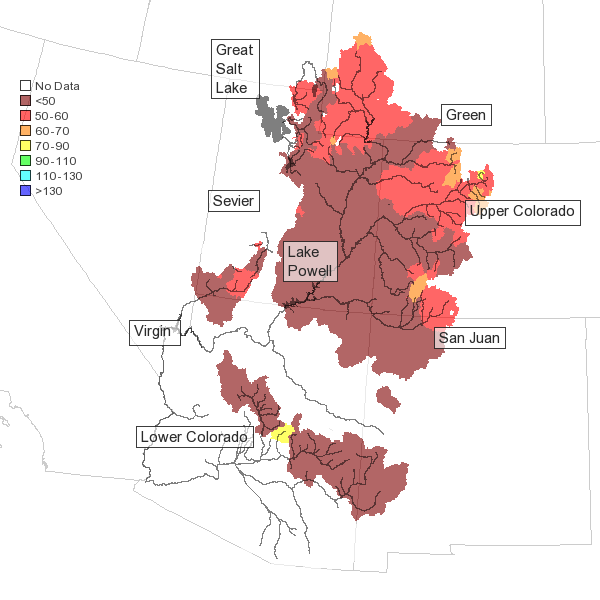
2013 Colorado Basin forecast, courtesy CBRFC
Bill Hasencamp at the Metropolitan Water District (I think it was Bill) asked a question today on the Colorada Basin River Forecast Center monthly briefing call that led to an email exchange that led to this, from the work blog: the forecast for spring inflow into Lake Powell, on the Colorado River, is the lowest since the CBRFC began doing forecasts in 1979. And the two-year sum of spring flows (April-July last year and this), if the forecast verifies, will be the lowest two-year spring total since Glen Canyon Dam was completed in the 1960s.
Meanwhile on the Rio Grande, southern New Mexico water numbers guru Phil King told me (newspaper story) that, if the forecast on the Rio verifies, 2013 will be the driest year by one measure (current flow and available storage reserves) in the history of modern water management, going back a century:
An abysmal March, on top of an abysmal snowpack season, on top of an abysmal 2011 and 2012, means 2013 is shaping up to be the driest year on the Rio Grande in a century of modern water management.
“It’s the worst year ever,” said Phil King, a professor at New Mexico State University and adviser to southern New Mexico’s largest farm water agency.
King had been preparing his farmers for the worst, but that did not make it any easier to take when the forecast showed that the worst case scenario is now happening.
“It hurts to get slugged in the stomach,” King said, “even if you’re expecting it.”
We’ve got a situation here.
The reaction at the office today to the death of newspaperman Roger Ebert was striking. I cannot think of another writer of American English with the same broad, beloved appeal.
One friend, a younger-generation journalist who’s from Chicago, sent around a collection of particularly delicious fragments from Ebert movie reviews, and I was struck by their ease: “Watching ‘Mad Dog Time’ is like waiting for the bus in a city where you’re not sure they have a bus line….” He was the kind of writer whose phrases had a comfortable feel, without pretense, as if we could have written them ourselves. Except we hadn’t.
I am not a movie person. I rarely set foot in a movie theater, don’t do Netflix. But I loved reading Ebert’s movie reviews in the Friday paper. I guess that is my praise – the guy made we want to read things about a subject in which I had no interest, just for the love of his easy way with words.
A writer’s writer.
The US Bureau of Reclamation was known as the US Reclamation Service (USRS) from its formation via the Reclamation Act of 1902 until it was renamed in 1923. This “USRS” was cast in concrete on Mesilla Dam, an irrigation diversion structure on the Rio Grande outside Las Cruces, NM, in 1915. The dam is part of the Service’s/Bureau’s Rio Grande Project, which delivers water from Elephant Butte Reservoir to farmers in southern New Mexico.
As an aside, note the lack of water in the river’s bed. That’s sand, folks.
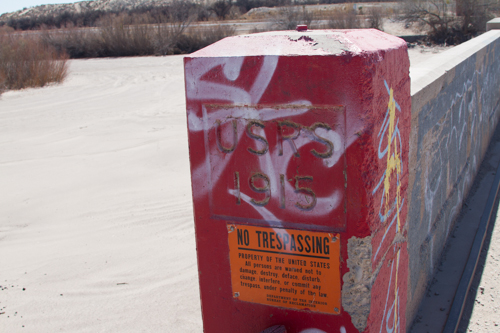
US Reclamation Service sign, circa 1915, with some modern decoration. Mesilla Dam, on the Rio Grande in southern New Mexico, March 2013
It is a strange reality of our modern world that, in the face of a truly remarkable drought here in the Middle Rio Grande Valley of New Mexico, I was able to pour imported Colorado River water on purely ornamental plants in my garden yesterday morning. I’m thrifty with the water – a modest drip directly to the roots of a handful of shrubs in the backyard. But compared to the farmers I’ve been hanging out with of late, this is non-essential water.
The water comes from the headwaters of the San Juan River in southern Colorado, diverted via three small dams to the Azotea tunnel, into Heron, then El Vado and Abiquiu reservoirs, then down to a diversion dam on Albuquerque’s north side. From there, it is treated and mixed with fossil groundwater pumped from beneath Albuquerque so it can be applied to our mountain mahogany and New Mexico olive and a lovel piñon that once served duty as a Christmas tree before transplantation into the backyard.
Here is why I felt compelled to haul my trickling hose from plant to plant yesterday morning:
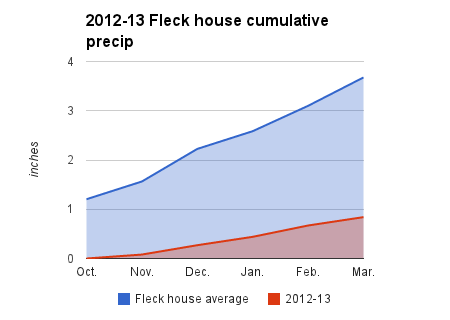
2012-13 Fleck House precip
The total for the first six months of the 2012-13 water year at my house has been 0.84 inches (2.1 cm) of precipitation. That’s less than half of the previous dry year record in my 14 years of data collection, and less than a quarter the long term average of PRISM data for the neighborhood.
If men will fight over water, they will also cooperate to conserve it and the history of water controversies is that, in the long run, the rule of cooperation prevails.
Yet another nugget from my current favorite book, Carey McWilliams’ California: The Great Exception. Do you think he’s right?
The absence of a state policy governing the use of underground waters is, in fact, the outstanding weakness in California’s water conservation program.
Carey McWilliams, California: The Great Exception
To what extent does this still hold today?
Matt Weiser at the Sacramento Bee offered up a fascinating framework in a piece last Sunday for thinking about California’s $23 billion (and counting) proposal to reshape the way water moves in and through the largest estuary on the western coast of North America:
[A]s the process now stands California voters will have no formal say in approving the plan. Nor will the state Legislature.
State officials believe they already have the statutory authority, under laws passed in 1933 and 1960, to do this project.
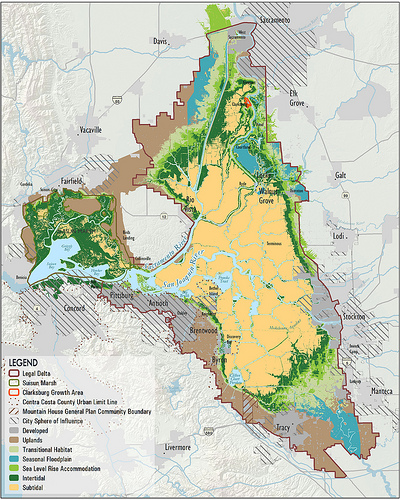
Sacramento-San Joaquin Delta
So we are left, as California slogs forward with this staggeringly important public policy decision, with a strange situation. Under the law, state officials believe the already have the necessary statutory authority, essentially, to remove large quantities of water from the Sacramento-San Joaquin Delta, shipping the water south to farms and cities in the Central Valley and Southern California. The officials Weiser is quoting believe the statutory authority already exists to build two giant tunnels beneath the delta to accomplish these ends. Again, Weiser:
[A]s now laid out, the only real veto power over the project lies with state and federal wildlife agencies: the California Department of Fish and Wildlife, the U.S. Fish and Wildlife Service and the National Marine Fisheries Service. These agencies are responsible for ensuring that the plan satisfies state and federal endangered species acts.
Thus we are in this strange statutory never-never land where what we’re really talking about here with the BDCP is not the development of giant water-moving infrastructure to ensure reliable supplies for water users to the south. Rather, we’re talking about the development of a “Habitat Conservation Plan” to ensure that existing state and federal statutory authorities to move water do not, in their execution, harm endangered species. If, to meet the requirements of that HCP, we have to build giant tunnels to move water, so be it.
I’ve written before about this fascinating conundrum. One could imagine an endangered species management process that concludes that the best habitat conservation approach would be to not move so much water. And yet here we are.
So let’s play alternate histories. What might a California water policy development process look like that was intended to deal with the problems of the delta, but wasn’t carried out within the framework of state and federal endangered species laws. My hunch is we’d still be talking about building a couple of big tunnels?