Stuff I wrote elsewhere: Powell warned us

In 1889, John Wesley Powell tagged along as a group of US Senators toured the western United States in an effort to understand “the irrigation problem”. What Powell reported looks kinda familiar:

“The winds are drifting sands here and there,” John Wesley Powell said of his 1889 visit to the Lower Rio Grande Valley, where the river passes from New Mexico to Texas and Mexico. “The farms, orchards, and vineyards are perishing.”

More in the morning newspaper.

California and the invention of “sportswear”

Catalina Sportswear (United States, founded 1907) United States, California, Los Angeles, late 1940s, courtesy Los Angeles County Museum of Art

Catalina Sportswear (United States, founded 1907)
United States, California, Los Angeles, late 1940s, courtesy Los Angeles County Museum of Art

In the enclosed shopping mall near our home is a Hollister store, which bills itself as “the coolest destination for genuine SoCal style clothes for guys and girls.” They sell surf-themed garments to residents of a landlocked state.

There is history here:

Novel conditions of living, reflecting climatic differences, created a compulsion to invent something new and different in the way of clothing. California manufacturers began to meet the need by designing new types of sportswear, which, being better adapted to local conditions than the standardized products offered by eastern manufacturers, promptly found a market. Certain of these products gradually began to move eastward, carrying the California label, and, here and there, small shops were opened in eastern cities for the sale of “California Sportswear.” In a a rather insidious mannfer, the world “California” became associated in the public mind with the word “sportswear.”

That’s Carey McWilliams in California: The Great Exception, 1949.

in praise of Juan Murrieta

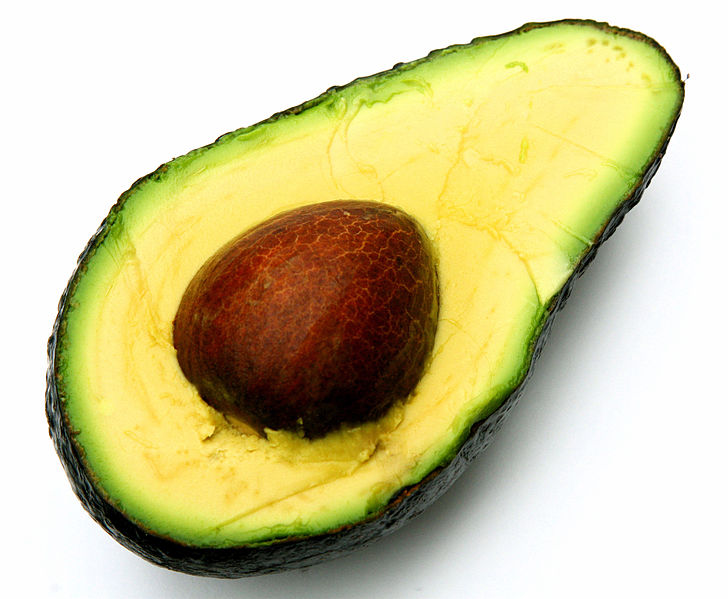
avocado, courtesy

avocado, courtesy Flickr user Muffet, licensed under Creative Commons

Despite growing up a little kid’s walk from an avocado grove, I didn’t discover their blessings until my late teens, when a college classmate from San Diego brought a car trunk load on a drive from Southern California to eastern Washington. We would lay them out on newspaper on our laps in the front seat of the car, slicing them open and sprinkling them with salt. Yum.

Carey Mcwilliam in 1949 explained the story behind California’s avocado industry:

In the early 1890’s, one Juan Murrieta of Los Angeles, imported a variety of avocado trees from Atlixco, Mexico, and from this group of seedling trees came the varieties that were first planted for commercial production. It was in Atlixco that scientists in 1911 discovered the Fuerte variety; today 85 per cent of the trees in Southern California’s 16,000 acres of avocado orchards are ofd this variety.

Juan also, I learn today via what appears to be a short essay written upon the occasion of Juan’s death, that the Spanish immigrant also is alleged to have been the first deputy sheriff of Los Angeles County. Of this claim I would remain skeptical until I saw more careful confirmation, but whatever his law enforcement credentials, for his importation of the first avocado seedlings, I remain forever in his debt.

stuff I wrote elsewhere: drought hits New Mexico’s famed Hatch Valley

From the morning paper, a look at the effect of drought on farmers in southern New Mexico. It’s a more complex story than simply lack of water, and the impact depends a great deal on where you are:

The Franzoys’ problem is not so much the dropping aquifer as the quality of the groundwater. It is laden with salt. To keep his family’s 1,000 acres alive during the drought means to slowly suffocate the land. Drip irrigation can help by pushing salts away from the root zone, but the technology doesn’t solve the problem completely….

“If we don’t have surface water in the Hatch Valley,” Jerry Franzoy said, “it’s gonna die pretty quick.”

That’s in the Rincon/Hatch Valley, in the northern part of the region. To the south, aquifers are deeper and sweeter, but contested:

Compared to the Hatch Valley, the groundwater in the Mesilla Valley beneath Las Cruces and the cities around it looks luxuriously deep.

“In the Mesilla Valley, we’ve got an abundant groundwater source,” Daviet said. Where the aquifer in the Hatch Valley can be as shallow as 80 to 100 feet deep, the Mesilla aquifer extends hundreds of feet down, in some places thousands….

Its depth means it can act like a savings bank, Daviet said. In wet years, when there’s plenty of water from the Rio Grande, surface water is spread across the pecan orchards, with some of it soaking down and refilling the aquifer….

“We’ve applied water to that groundwater source in these years of plenty,” Daviet said….

But hovering over that practice is a lawsuit filed earlier this year by the state of Texas, which has a different view of the situation. The lawsuit charges that groundwater pumping in New Mexico, by lowering the water table during drought years, has effectively reduced what flow there is in the Rio Grande. The result, it charges, is less water available to farms and cities across the border in Texas.

In addition to the word stories, we also shot some video.
 

water conservation diaries: it’s about making more food

Visiting a farm recently, I was reminded that business people for whom water is an input think about water conservation differently than city folk like me. For a given amount of water available, the farmer wants to grow and sell as much food as possible. So it should not be surprising to see water conservation technology push yields up rather than pushing water consumption down. Here’s Randy Fiorini, California farmer and one of that state’s water management public intellectuals:

Computer-aided moisture monitoring and irrigation scheduling, conversion from flood and furrow methods to microsprinkler and drip systems are now standard on most row crop, tree and vine operations. This application of modern technology has resulted in more than just water savings. Yields for many crops have doubled because of more efficient methods of irrigation.

BDCP rollout: did anyone say anything that surprised you?

Busy with New Mexico’s drought, I’ve been paying scant attention to the rollout of California’s Bay Delta Conservation Plan, AKA the Peripheral Thingie. This is the scheme to build tunnels beneath the Sacramento-San Joaquin Delta to move water south to California farms and cities. It’s the biggest and most interesting US water policy gambit out there right now, and with no particular dog in the fight, I’m just watching with amused wonder as California tries to sort out the most interestingly wicked of common pool resource problems.

Chris Austin, whose Maven’s Notebook has become my favorite landing spot for tracking the situation, quoted a striking comment from John Laird, California’s Natural Resources Secretary. Laird was observing the way the current discussion feels in some way like a replay of California’s fight over the Peripheral Canal 30 years ago:

Back in 1982, when the voters rejected the peripheral canal, “many Californians just locked themselves into what they think about the Delta or water policy out of that experience, but the whole world has changed since then in many, many different ways and they’re still sort of locked in what happened.”

So here’s my question for the California water nerds in the audience – and it’s serious, not rhetorical. In the most recent round of discussions about the BDCP, who said something that surprised you? Or, to put it another way, how has the discussion changed in 30 years?

River Beat: The “Severe Sustained Drought” study

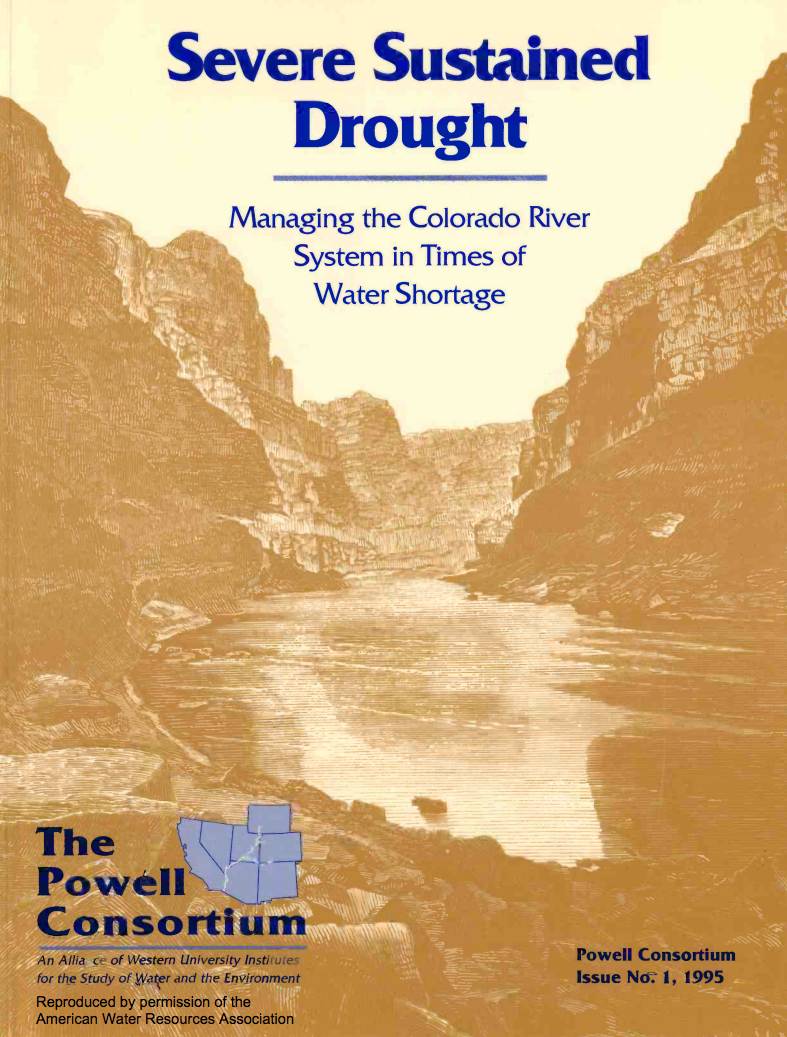
Severe Sustained Drought

Severe Sustained Drought

I recently (happily) stumbled across a web version of the full  1995 publication of the Colorado River “Severe Sustained Drought” study, a comprehensive “what if” exercise done in the 1980s and early 1990s. From the forward::

The Severe Sustained Drought Study contemplates a much more dire water supply scenario than that which has occurred in the past century. Reconstruction of river flow records, based upon several centuries of data, suggests that periods of much reduced flow in the river have periodically occurred. These data are derived from analysis of growth rings in trees from around the Colorado River Basin states. Combining this information, the SSD researchers have created a highly plausible scenario of severe and sustained drought and used that as a means of assessing what the hydrologic, social, and economic impacts of such a drought would be under the current law of the river. As you will see, the impacts are substantial.

Full (big) pdf here, courtesy the University of Arizona.

the ag conservation conundrum

Hannah Holm of the Water Center at Colorado Mesa University argues that agricultural water conservation doesn’t really save water:

When water is diverted from a stream and put onto the land, part of that water is taken up by plants, part of it evaporates, and part of it makes its way back to the stream. With flood irrigation, a lot of the water diverted from a stream is simply used to push water to the end of the ditch, after which it makes its way back to the stream. Seepage will also eventually return to a stream, in some cases sustaining late season flows. Increasing efficiency through a sprinkler or drip system may require less diversion of water out of the stream to transport water to the plants, but the plants will consume just as much as before.

To actually “save water” that can then be available to other uses, you have to reduce the amount of water that’s actually consumed, either by plants or through evaporation. That means changing to a less thirsty crop, reducing your acreage, or giving your plants less water than they really want — which is likely to lead to lower crop yields. Apart from measures to reduce evaporation and weed growth, there’s not really any way to reduce actual water use and keep getting the same production as before.

Macarena Dagnino and Frank Ward down at New Mexico State University made a technical version of this argument last year (pdf) in the context of subsidies for drip irrigation:

[A]n unexpected result is that water conservation subsidies that promote conversion to drip irrigation can increase the demand for water depleted by crops. Our findings show that where water rights exist, water rights administrators will need to guard against increased depletion of the water source in the face of growing subsidies for drip irrigation.


California’s resilience to drought

Given my profession, I’m incentivized to freak out about drought. If I thought it wasn’t a big deal, I’d have to find something else to write about. But in darker moments, I wonder if I’m overdoing the freakout.

Chris Austin’s writeup of Ellen Hanak’s comments at this week’s California water bond hearing raise the question anew:

Ellen Hanak, senior fellow at the Public Policy Institute of California, gave a retrospective of how the state managed during the recent drought. “California has lived through droughts before,” she began, noting that when they looked at the impact of drought on the state’s economy, “the conclusion was that because of our variable climate, we are set up as an economy to manage droughts pretty well.”

“One key reason why the economy is fairly resilient to drought is because a lot of the economic activity is in the urban sector, which is not that reliant on large quantities of water as a production input,” she said. Urban utilities manage droughts by compressing at the residential level first, and not shorting the industries, commerce or key public health and safety sectors like hospitals, so the job losses in the urban sector aren’t many.

“Agriculture tends to suffer more during a drought because water is such a key production input and agriculture is a big user of water, but from the standpoint of the statewide economy, that’s not such an issue as it is such a small share of the economy. It’s about 1 or 2% depending on how you count it,” she said.

I like Hanak’s phrase: “demand compression”.