River beat: the emptying of Lake Powell

Colorado River Storage

Colorado River Storage

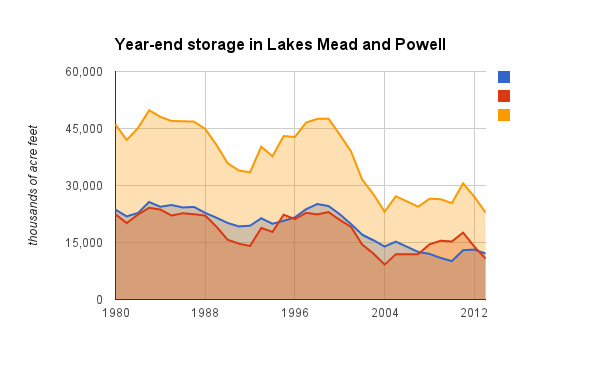
In late 2010 and early 2011, when I was plotting out the narrative arc for my Colorado River book, I began collecting what I imagined was the detailed storytelling material to describe the decline of the river’s great reservoirs. I’d been out to Lake Mead to document the day it dropped to record level. And then it got wet. Total storage jumped 5 million acre feet in 2011. Great for the river’s water managers. Totally screwed up my story line.

Looking at the latest numbers in the Bureau of Reclamation’s monthly river operations plan (pdf) I’m wondering whether it’s time to pick up the story line again.

Based on the latest forecast, the year-end storage level in Lake Powell will be the second lowest in history, only behind 2004. After the brief bump from the very wet 2011, Lake Mead is dropping again too. And with Powell low, the “bonus water” the Lower Colorado River Basin’s water users have come to depend on as a result of the complex “equalization” rules aimed at balancing supplies in the two big reservoirs, can no longer be counted on.

Mead’s projected to drop 11 feet this year (end of September compared to same date in 2012). Powell will be down an estimated 32 feet.

Maybe this story arc is going to work out after all.

Stuff I wrote elsewhere: water problems are hard

From Tuesday’s newspaper, State water bills down to trickle:

New Mexico’s water problem is simple. We’re using more than we’ve got.

When it’s framed this way, the solutions are simple. Get more. Use less. Or, at the very least, stop using more every year.

But watching the 2013 New Mexico Legislature wrestle with these questions suggests that, while the concept might be simple, this is hard stuff.


A new framing of the Sacramento Delta problem

From the California state water contractors, a new framing. It’s not that stupid little fish, or those pesky environmentalists:

Limits on pumping operations are an ongoing issue due to the Delta’s outdated water delivery system.

“Earlier this year, storms came through that could have provided a substantial boost to our water reservoirs, but we simply could not capture enoughwater due to restrictions facing the existing projects in the southern Delta,” said Terry Erlewine, general manager of the State Water Contractors. “If we had intakes in the northern Delta and a way to convey those supplies to the existing aqueducts, as proposed by the Bay Delta Conservation Plan, we could have diverted more supplies without impacting fish species such as Delta smelt.”

It’s all about outdated infrastructure.

A New York story: not all the tree rings’ tales are about drought

Andrew Freedman had an interesting piece last month about tree ring research that’s different than the stuff I usually write about:

The past several decades have been the wettest in nearly five centuries for the watershed serving the nation’s largest city, New York, according to a new study. But that wet period is deceiving because it is masking the city’s real drought history and may be lulling water managers into a sense of complacency, which could hurt the city when the next severe drought strikes.

OK, not that different. Because the basic message from the tree rings – see my book for a ton of examples – is that the range of variability in past climate is greater than the instrumental record, and our post-Industrial Revolution society, has seen.
 

Benson on the Drought Relief Act

Reed Benson, water law professor at the University of New Mexico, has an op-ed in this morning’s Albuquerque Journal arguing for the re-authorization of the US Bureau of Reclamation’s Drought Relief Act powers, which expired last year (adwalled):

Major droughts, including more intense ones than this, have always been a fact of life in the West. We can’t expect government to stop drought, but we do expect it to assist in planning for it and to provide a measure of relief when it strikes.

The last Congress, however, actually made the current drought a little worse for the West: It failed to reauthorize the Drought Relief Act, allowing key parts of the law to expire in 2012.

This is one of those fascinating but obscure cubbyholes of federal water law that’s worth more attention than it gets.

The question is what authority the federal water agencies have, and what purposes they’re legally authorized to pursue, in managing water. (For example, the Army Corps of Engineers regularly argues that it’s only got the statutory authority to protect against flooding. That’s the job Congress gave it. This played a role in debates this year over barge traffic on the Mississippi, and is an argument that’s currently in play in debates over who has what responsibility in managing the Rio Grande for protection of endangered species.)

The Drought Relief Act provided the US Bureau of Reclamation the authority to expand its scope of action during drought. Here’s Benson writing in the Ecology Law  Quarterly:

Title I of the Drought Relief Act, however, authorizes the Secretary to take a variety of actions including drilling wells, constructing temporary facilities, acquiring water from willing sellers, making loans for various purposes, and providing temporary water supplies for a range of uses…. Thus, Title I can provide a measure of authority to act, which should allow USBR to be more effective in reducing the impacts of water shortages … including those related to climate change.

In particular, Benson argues that the Drought Relief Act might provide the Bureau with some flexibility in providing environmental flows during drought times (like now, for example). More generally, he argues the legislation might offer more general operational authority to the Bureau to help manage for what he calls the “double whammy” of climate change and drought.

my new rain gauge

rain gauge

rain gauge

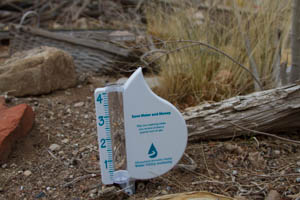
At the xeriscape show last  week, I picked up a nifty new rain gauge, courtesy of the Albuquerque Bernalillo County Water Utility Authority, with this helpful advice:

Skip one watering when you receive at least a quarter of an inch of rain.

The last time that happened at my house? September.

my education in economics: an anti-Jevons anecdote

power curves

power curves

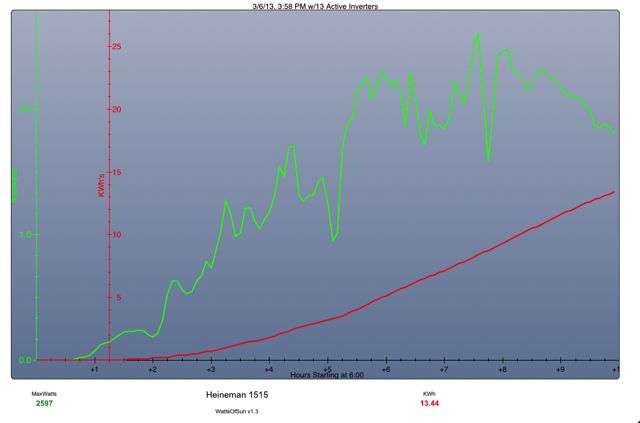
The Jevons Paradox would suggest that our new solar panels would give me an easy comfort about using more electricity.

And yet, ever since we gathered two weeks ago with the installers and the electric company guy in the ritual of turning them on and watching the meter run backward, I have been obsessed with turning off lights, rather than willing to leave them on.

I am a living anti-Jevons anecdote.