“The environment has always gotten the short end of the stick.”

The interplay between human water use and natural systems has always been a ratchet, and when the environmental conversation began in earnest in this country, the ratchet was already cranked down tight.

By the time, for example, that we began having a conversation about preservation of environmental values on the Lower Colorado River, Hoover Dam was already in place and the Colorado River Delta was already getting very little of the water it once had.

Or take the Sacramento-San Joaquin Delta. California state law codifies the importance of “co-equal goals“: “providing a more reliable water supply for California and protecting, restoring, and enhancing the Delta ecosystem.”

I can’t imagine UC Davis fish biologist Peter Moyle being terribly popular among water managers for pointing out this:

The reality is that the water priorities for people and fish and have never been anything approaching equal. The environment has always gotten the short end of the stick.

So achieving coequal goals should mean greatly improving conditions for fish, first, and then figuring out how to share the water better. It means we should give far greater consideration to native and other desirable species in the way we release water from dams and move it through the Delta.

Moyle’s got a lot to say about life in the anthropocene and thinking about “nature” and California’s great delta. Highly recommended click.

More on where the Bellagio fountain gets its water

The Dunes

The Dunes

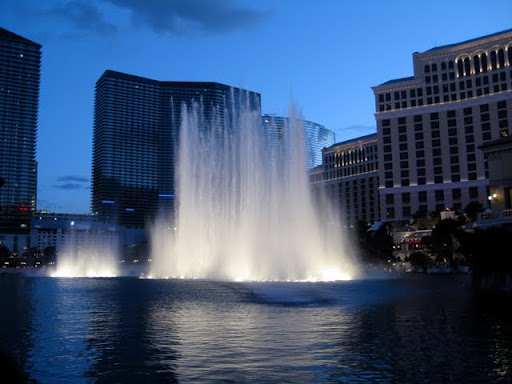
My post last week on the Bellagio fountain and the fact that it got its water from wells originally drilled to water an old golf course drew questions. Today, we have answers.

Jeffrey Prest asks: “What was the name of the old golf course?”

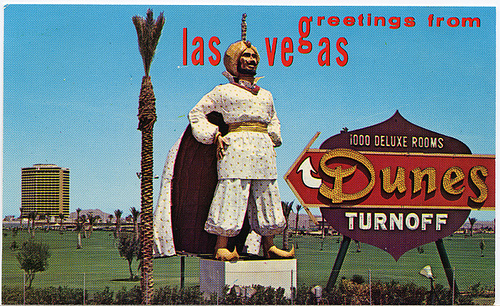
Doug Bennett at the Southern Nevada Water Authority shared this old postcard of the Dunes Hotel and the golf course behind it, which Doug says stretched from Tropicana Ave. to Flamingo Rd.

David Zetland observed: “I thought it was saline g/w, i.e., ‘useless’ for drinking but not for display…”

Doug explains:

The fountains at Bellagio are fed using well water for which the Dunes already had a long-standing permit from the State of Nevada. The fountains do not use municipal water. It is my understanding that the water is not of suitable quality to go straight to the fountain and that Bellagio treats it first. The Bellagio Hotel and fountain uses much less water than the golf course did and produces substantially more economic return, as you pointed out in your presentation. Similarly, the Wynn Hotel, built on the site of the old Desert Inn, also used well water conserved by a redesign of the old golf course to meet the needs of their landscape and water feature.

And now, my full confession, which may require me to turn in my Western Water Wonks membership card: I love the Bellagio fountain.


A half-hearted defense of the New York Times decision to kill the green blog

I’ve been a member of the Society of Environmental Journalists for a number of years, but every year when my renewal notice comes up I wrestle anew with the membership and the label it entails.*

I’m a journalist who covers topics that are sometimes labeled “environmental”, but I’m not sure how to define the subject area other than by listing the things that fit within it. With some notable exceptions, I don’t really care much about water pollution or air pollution, for example. I write a lot about climate change because water. I write some about forests because fires, towers of smoke billowing over my community, jarred me. I’m pretty diligent about covering one endangered species, but ignore most others. I know I’m supposed to care about this Keystone pipeline because people who care a lot about the “environment” have placed it on the agenda, but it’s not on mine. Roadless rules and wilderness just don’t interest me journalistically. I pretty much bought the Nordhuas and Shellenberger argument (pdf) because the category they were killing off wasn’t working for me.

So I’m sympathetic here to Dean Baquet at the New York Times as he explains the reasons for killing off the newspaper’s Green blog:

“I think our environmental coverage has suffered from the segregation — it needs to be more integrated into all of the different areas,” like science, politics and foreign news, he said.

He agreed that environmental coverage is of great importance, and said that having The Times’s environmental reporters working on other desks is the best way to “drive more of these important stories onto the home page and the front page.”

A Green blog is a place where environmenty people go to look for environmenty news. If we’re doing it right, that sort of news is embedded in all sorts of stories rather than a category of its own. So I agree with the rationale – both for killing the Green blog and for dismantling the Times’ green pod. I think coverage of the family of issues sometimes called the “environment beat” is best done integrated into a bunch of different beats, not off on its own.

But I called this a “half-hearted defense” because it only works if Baquet and company aren’t bullshitting us here, if they’re really planning to drive the topic(s) out into the newsroom as a whole.

* Every year I re-up because, as Lissa reminded me this morning, it’s a great organization, and I have a lot in common with the other members.
Stuff I wrote elsewhere – Anthropocene diaries: how much water for the minnow?

From the morning paper, the latest in the struggle to figure out how much water the endangered Rio Grande silvery minnow needs:

According to an analysis by the New Mexico Interstate Stream Commission, the river has only once since the 1990s, in 2005, had enough water to meet the Fish and Wildlife Service’s “conservation objective” for spring runoff high enough to help the endangered minnow’s population recover.

The gap between flow goals and the reality of dry-year flows on the river has led to high-level negotiations among the federal agencies trying to manage the Rio Grande, including the Fish and Wildlife Service, the Bureau of Reclamation and the Army Corps of Engineers.


landmark Arizona-Nevada water deal coming to an end

The agreement between the Southern Nevada Water Authority (Las Vegas)  and the Arizona Water Banking Authority, under which Arizona banked water for Nevada, has always seemed to me like a harbinger of the future in the Colorado River Basin – mutually beneficial sharing across state borders. Via Juliet McKenna and Michele Robertson, it now appears that it’s more a thing of the past. But with some lessons learned:

[T]he parties are now looking to terminate future water banking obligations. Lessons from the past are not forgotten, however; the new draft agreement provides the flexibility to adapt to changing conditions. In fact, the parties can agree to resume storage at any point in the future. This adaptive approach will be important to managing the Colorado River as both states grapple with the potential impacts of climate change and future population growth.

Stuff I wrote elsewhere: Real water, real people, Maxwell NM edition

oops, update, forgot link

Journal photographer Robert Rosales and I recently visited Maxwell, NM, which I describe (I think safely, though how does one know for sure?) as having “arguably the most serious drought-driven municipal water supply problem in the state of New Mexico.”

From the story:

Asked about the burden she bears in trying to find the water to keep her village alive, Pinkston chafed at the word “burden.” What would she call it? “A responsibility,” she said.

Whatever the word, Pinkston is clear about what is at stake.

“People would just have to move if there’s no water,” she said. “We’d be a ghost town.”

Where the Bellagio Fountain’s water comes from

Bellagio Fountain

I’ve been getting this wrong.

The water in the Bellagio Fountain in Las Vegas does not come from recycled sewage:

The Bellagio fountains are mostly using well water that exists beneath the Bellagio landscape. That well water was used previously to maintain a golf course that previously existed there. The beauty of that is the current water use, because of the lake, represents only two-thirds of the water that was used before when the golf course existed, so in reality, the Bellagio uses less water than the golf course that use to be there before.

(I got it wrong in a talk I gave this morning, and a gentleman who knows Vegas water kindly corrected me in the hall after.)