The risks of risk communication

[A]n informed and properly motivated risk communicator would proceed deliberately and cautiously. In particular, because efforts to quiet public fears about vaccines will predictably create some level of exactly that fear, such a communicator will not engage in a high-profile, sustained campaign to “reassure” the general public that vaccines are safe without reason to believe that there is a meaningful level of concern about vaccine risks in the public generally.

That’s Dan Kahan, pointing out the need to tread carefully in risk communication because of the danger of reinforcing that which you’re trying to debunk.

In the eastern Mediterranean, tree rings tell of a shift toward stand-replacing fire?

In a Greek forest, tree rings telling a familiar story – a history of surface fire, but a trend toward much more destructive blazes:

the size of the area burned as well as the type of fire seem to have changed, with the 2007 event being the most extended crown fire encountered so far. Our study has provided additional evidence that P.nigra is indeed a fire-resistant tree species provided that it is exposed to surface fires, even if they are recurrently occurring. Shifts from this pattern may lead to local extirpation of the species, as in the case of severe and extended crown fires.

Interested in learning more on the use of tree rings in science? I’ve got a book for you.


Anthropocene diaries: a fish story I wrote elsewhere

A forest burns down. Humans rescue fish, keep ’em alive in an Albuquerque warehouse. Maybe 80 years before the drainage that feeds their forest creek recovers. Maybe 200. This is life in the anthropocene:

Angela James’ fish tanks don’t look much like Whiskey Creek.

But for 68 imperiled Gila trout, the tanks in a northeast Albuquerque warehouse will have to do for now. After last year’s Whitewater-Baldy Complex Fire in the mountains of southwestern New Mexico, Whiskey Creek itself doesn’t look much like Whiskey Creek anymore.

“I refer to it as a halfway house,” said James, a fish biologist with the U.S. Fish and Wildlife Service, as she prepared a breakfast of frozen bloodworms for her guests.

Insanely cool new evapotranspiration maps from USGS team

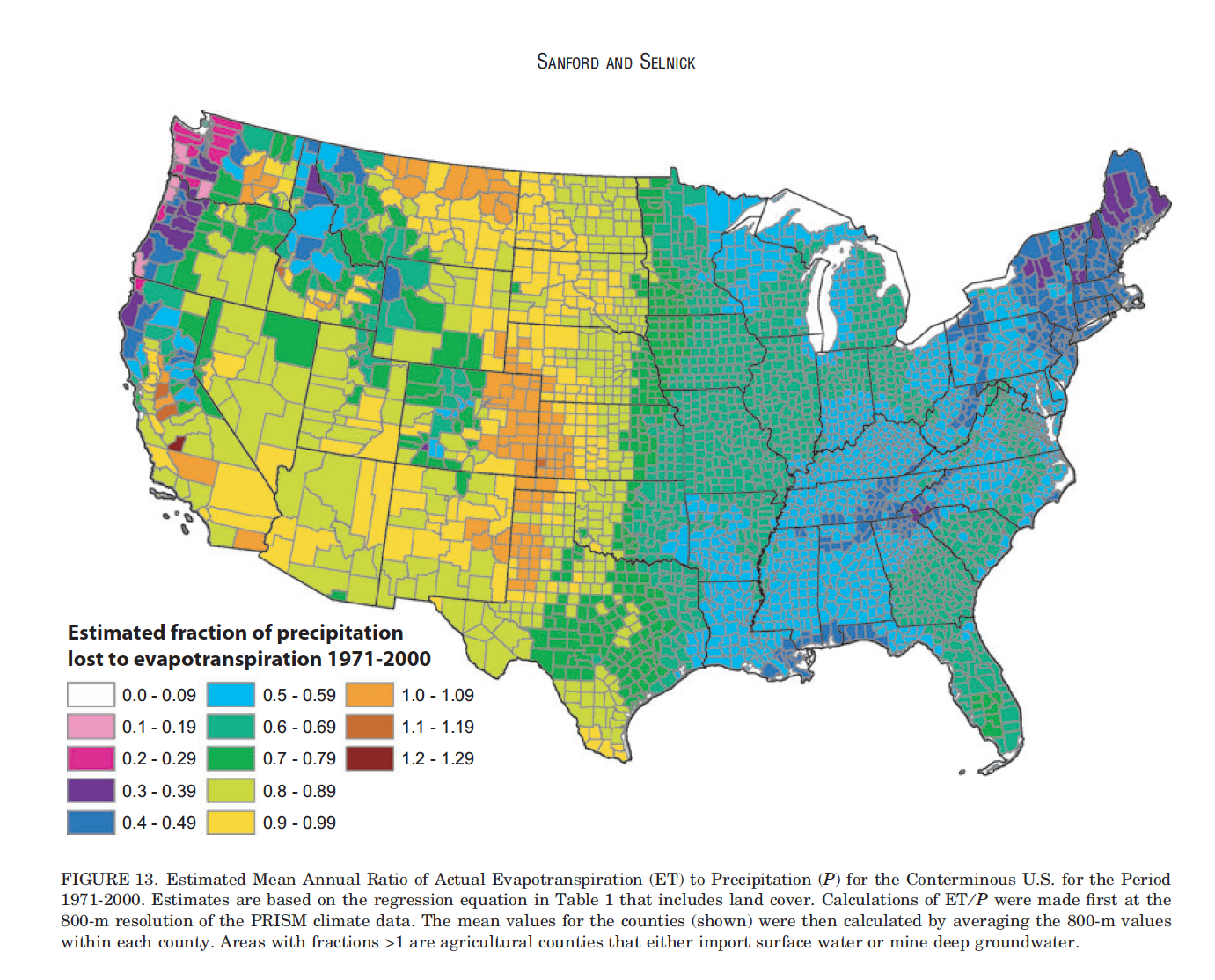
Evapotranspiration is the combination of water evaporated from soil, surface water, etc., and water transpired from the leaves of plants. It’s an incredibly important measure of what’s going on in the hydrologic system. Which is why I love this new map:

US Evapotranspiration, from Sanford and Selnick

US Evapotranspiration, from Sanford and Selnick

From Estimation of Evapotranspiration Across the Conterminous United States Using a Regression With Climate and Land-Cover Data, Sanford and Selnick, Journal of the American Water Resources Association, Volume 49, Issue 1

Ed Ruscha is from Oklahoma

Via the economist Tyler Cowen, I learned today that the artist Ed Ruscha is from Oklahoma.

When I mentioned this to Lissa, she wisely observed that many of the people we think are from California are not. That’s one of the central points of Carey McWilliams’ classic “California: The Great Exception”, which I am rereading. McWilliams’ snapshot in time is California’s enormous explosion in human energy and population in the decade of the 1940s. (The book was published in 1949.) The book is about California’s marvelous and chaotic talent for self-invention as one wave after another of population pours in and does new things.
My Mom is from California. My Dad was part of the same post-McWilliams wave as Ruscha. I’m not sure if I think of Dad as quintessentially Californian, whatever that means, except that he obviously was, one of those immigrants who made the place.

Watershed stuff

My friends at Carpe Diem West, who’ve been doing some interesting work on the science/politics/policy interface of watershed restoration, are holding one of those ghastly named but increasingly useful “webinar” things next week:

Join the Academy’s first extended webinar taking a closer look at how to value watersheds and the services they provide to downstream users.

Investment in watersheds expands the portfolio of risk management options available to water utilities as they plan for the effects of climate change on their water systems. Implementing a watershed valuation study informs the structure of, and determine possible sources of funding for, ongoing watershed investment programs. Watershed valuation helps answer some of the questions of what services watersheds provide, and how to account for them – for example, what are the costs of providing those services through some other mechanism or what costs can be avoided by investing in watersheds?


Desalination and engineering optimism

Nearly every time I give a talk on water (which seems to happen frequently lately – wonder if I’ll be less popular as a speaker once the drought ends) I get asked about desalination. It is, as Bettina Boxall noted in a recent LA Times story, the stuff of dreamers: “an inexhaustible, drought-proof reservoir in the state’s backyard”.

Or not. Using the Poseidon project in Southern California, Boxall does a nice job of demonstrating why, despite many proposals and much engineering enthusiasm, we’re not seeing much desal in practice:

The reasons boil down to money and energy. It takes a lot of both to turn ocean water into drinking water, driving the average price of desalinated supplies well above most other sources.

Desal, it seems, is one of those ten-dollar bills on the sidewalk that economists like to joke about.

On the unpopularity of peripheral thingies in northern California

To say that it is unpopular in northern California when the state ships water from north south is to understate things. So here’s a fun little bit of history on the willingness of the Record Searchlight, in Redding, to buck the will of its readers. From Bruce Ross, the paper’s current editorial page editor, great moments in editorial persuasion:

Northern California fiercely opposed the Peripheral Canal, and our area was no exception. The referendum on the issue, Proposition 9, was as one-sided as I’ve ever seen. The vote was 94.5 percent against in Trinity and Siskiyou counties, 89.5 percent against in Shasta County. November’s vote to lock up sex offenders for longer wasn’t that lopsided.

Anyway, I also found our editorial on the subject. Bucking 90 percent of readers, we endorsed Prop. 9, for a rather subtle set of reasons involving protection of North Coast rivers. Well, maybe our endorsement explains the 5 percent larger vote in favor in Shasta County. Hey, we get results.