Apologies to regular readers, these are some links for UNM Daily Lobo crew, with whom I’ll be chatting this afternoon:
Desal and the broken windows fallacy
The “broken windows fallacy” is the economic argument that spending money on X is of intrinsic value because of the jobs created, regardless of the value of the thing being done. The reference to broken windows is the argument’s reductio ad absurdum – hire one person to break a bunch of windows, and a second person to fix them. Certainly the people hired to break and fix windows make out OK under the arrangement, but does society benefit?
Supporters of the Carlsbad Desalination Project in California have been making the jobs argument of late:
Like so many San Diegans, David Shin was laid off in 2009.
“I know what it’s about to not be in a job for awhile,” said Shin. “It’s an eye-opener.”
But now, with his gloves on, walking alongside the site for the Carlsbad Desalination Plant, Shin said things are looking up.
“It’s great to know there is work out there,” said Shin. “It not only provides jobs for the local people, but it has the added benefit of clean water for everyone.”
Shin is an engineer who works on the filters that turn ocean water purer than bottled water through reverse osmosis. He’s one of 2,500 San Diegans brought on to work on the controversial plant.
To be clear, I’m not mocking the 10News story I’m quoting there. It at least hints at the flip side of the argument:
Most San Diegans will see a $5 to $7 increase in their residential bill every month.
And of course, the core of the broken windows fallacy is that the money spent building desal plants could have instead been used in some other way. What’s the benefit, and what’s the opportunity cost?
So my question: is coastal desal a broken windows thing?
Stuff I wrote elsewhere: Navajo water rights
From this morning’s newspaper, a deep dive into the issues surrounding the Navajo Nation’s struggle to secure water rights in northwestern New Mexico:
It was 1948.
Fred Wilson, New Mexico’s representative to the interstate group working to divide up the waters of the Upper Colorado River Basin, was pleading.
“The state of New Mexico wants the Indians to be protected,” Wilson told the other commissioners at the gathering in Vernal, Utah. The federal government’s Office of Indian Affairs had estimated that future water needs for Navajo Nation lands within the state of New Mexico would be substantial. But no deal that did not set aside enough water for both Indian and non-Indian water users could win political approval in New Mexico, Wilson told the other negotiators.
Water for the possible completion of the Navajo Indian Irrigation Project, first promised by Congress in 1962, but never finished by the federal government, is at the heart of a battle playing out in San Juan County court. (Journal file)
Wilson got his way. The final Upper Colorado River Basin Compact gave New Mexico a large share of water compared with the state’s contributions to the big river’s flow.
“New Mexico was allotted a share of water sufficiently large to take care of every water use currently planned for the Indians by the Office of Indian Affairs,” wrote Clifford Stone, the state of Colorado’s representative to the commission.
But while the 1948 compact gave New Mexico a big lump sum of water, it was left to the state and Navajo Nation to work out the details.
Sixty-five years later, the Navajo Nation is back in court, defending its claim to the water with the backing of the state of New Mexico and the federal government.
Technology is not just the gizmo
Here’s a great reminder that technology properly understood is not just the gizmo, it’s the human-gizmo interaction.
The old people apartments where Mom lives some time ago added big-screen TV’s on the wall between the elevators on every floor. The idea was to use them as a messaging system, giving residents up-to-date information on stuff. Some improvisation has been required:

creative use of technology
This is just a funeral notice correction. My favorite bit was the creative way the residents used it to circumvent HIPAA federal medical privacy rules when one of them ended up in the hospital. The institution is not allowed to release health care information on a resident, but the residents scrounged it up among themselves and posted notes on the TV by the elevator – updates on how she was doing, which hospital room, visiting hours, etc.
“we use imported water…”
Via Nora Reed, via Sociological Images, a particularly odd way of viewing water sustainability in Las Vegas, Nev.:
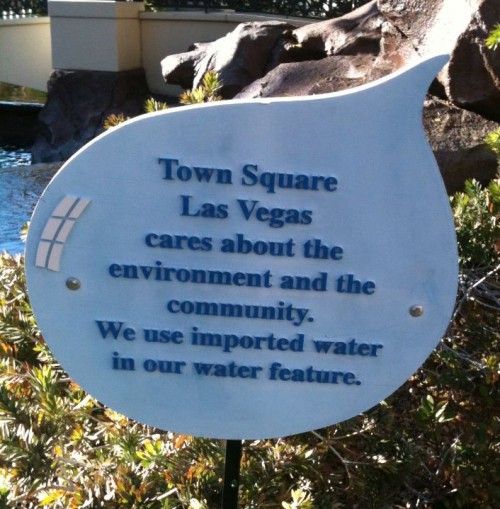
Courtesy Sociological Images
As commenter Rishi noted, “Pretty much all of the water in Las Vegas is imported.” And Vegas is in the midst of an effort to import a whole lot more.
Image courtesy Sociological Images, cc, some rights reserved
River beat: 54 percent of average runoff into Lake Powell
The February forecast is for not very much water to flow down the Colorado River and its tributaries into Lake Powell:
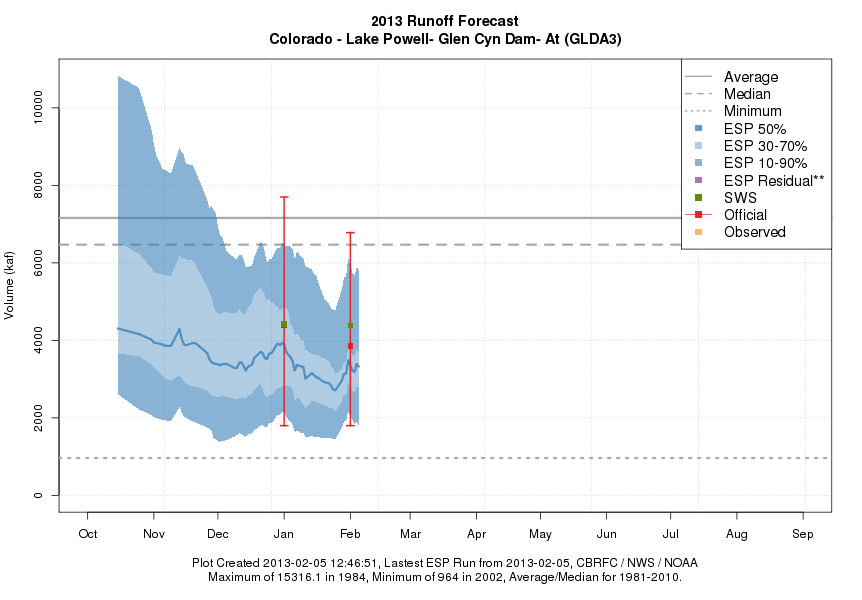
Lake Powell inflow forecast, courtesy CBRFC
The dotted line is the median forecast. The solid line above it is the mean. The median forecast is for 54 percent of normal into Lake Powell. The dark blue bands mean that, even if it’s wet as hell from here on out (don’t count on that) we’ll have a below-average year on the Colorado River. Most probably, a lot below average.
What exactly does the Basin Study mean we need to do?
Juliet McKenna is on a roll. You should really just skip me and add her to your RSS feed.
Her latest entry is a look at the various ways of completing the sentence, “The Colorado River Basin Study is a call to action to….”?
Check out her great list. Here’s the reason the diversity of entires matters:
The diversity of the group starts to emerge when looking at tremendous range of options presented to address the projected supply deficit. And for this reason, the next step – deciding what action to take – may not be as harmonious as the first step.
And having seen some of the sausage-making, it’s pretty clear that even that harmonious first step wasn’t as puppydogs and flowers as it might seem.
Dust, runoff and the Vegas pipeline
Juliet McKenna has done a fantastic back-of-the-envelope calculation about potential effect of dust created by Las Vegas, Nevada’s proposed groundwater pumping system.
Vegas, you’ll recall, wants to build a pipeline across the state, using groundwater from distant rural areas to fuel growth in that state’s largest metropolis.
McKenna notes that various analyses of the project have projected increasing dust as the groundwater pumping dries out the source region. Then she tries to connect the dots with recent studies of the impacts of dust-on-snow:
It has been estimated that dust events in the Rocky Mountains of the Upper Colorado River Basin could cause up to a 5 percent reduction in annual runoff to the Colorado River. More information from the National Academy of Sciences is here, and here. As an example, 5 percent reduction in runoff amounts to 700,000 AF of 14 MAF Colorado River of annual runoff. While this may be an overestimate both of the Colorado River’s annual flow and the reduction caused by dust, even a 1 percent reduction in a record low flow would still amount to more than 100,000 AF/year – more than the amount of groundwater pumping approved for Nevada. As a comparison, Nevada has an annual allocation of 300,000 AF of Colorado River water.
The cost of Arizona water
An interesting note from the Montgomery and Associates water blog on the financial problems facing the Central Arizona Project, which delivers Colorado River water to Phoenix and Tucson.
If the Board leaves rates alone this year, some customers may be temporarily satisfied. However, financial problems will persist and grow, adding to uncertainty for the future. The next few months will reveal whether the Board plans to endorse a wait-and-see approach or pursue a more aggressive course to address its long-term structural revenue deficit.
So this happened
2013 Earth Science Achievement Awards
The 2013 New Mexico Earth Science Achievement Awards will be presented on February 4 to John Fleck, for outstanding contributions advancing the role of earth science in areas of public service and public policy in New Mexico, and to Tien Grauch, for outstanding contributions advancing the role of earth science in areas of applied science and education in New Mexico. These awards, co-sponsored by the New Mexico Bureau of Geology and Mineral Resources, a division of New Mexico Tech in Socorro, and the Energy, Minerals and Natural Resources Department (EMNRD) in Santa Fe, were initiated in 2003 to honor those often unrecognized champions of earth science issues vital to the future of New Mexico. Selections were made following a statewide nomination process.