Anthropocene diaries: fight the man

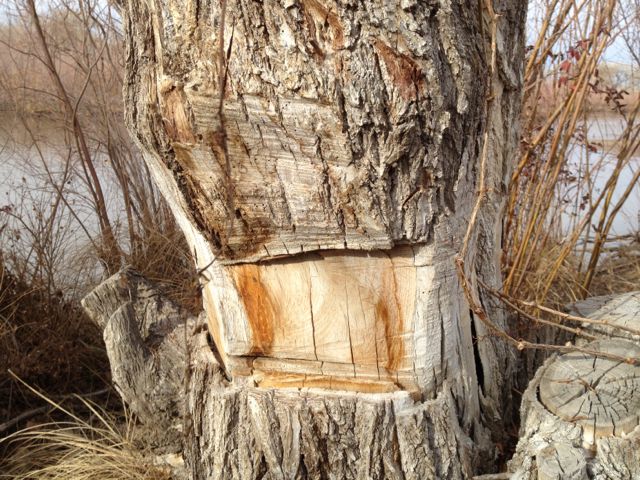
girdled tree, Albuquerque bosque, February 2013

girdled tree, Albuquerque bosque, February 2013

I’m going to make up a story. I’d like to think it might be true.

There’s an impromptu path I like to walk along the Rio Grande in Albuquerque that follows a narrow high spot of riverbank for something between a quarter and a half a mile. As you head north, the river’s on your left and to your right is a created marshland, part of an artificial cattail marsh (an ecologist I know who works on the project calls it a “wet meadow”) created as part of a local-state-federal habitat restoration project. It’s great for birding – a golden eagle to my left this morning, serene in a cottonwood across the river, and a riot of birds in the wet meadow to my right – downy woodpeckers, hermit thrush, flickers. In summer it’s a red-winged blackbird metropolis.

All along the path are old dead trees like this one, city garden invaders squeezing out the native cottonwoods, stealing their water (I think this is an elm?) killed by girdling them near their base. Some have been cut down outright, the logs left behind. But many have simply been killed and left standing.

I’ve no idea who did it. It doesn’t bear the hallmarks of the government-funded habitat restoration work that has been done throughout this reach of the river. The restoration crews chip the wood and spread the chips out across the bosque floor. It’s also obviously not the beavers (though there are a lot of small stumps left by beavers, and clear signs that the beavers had been moving back and forth between the river and the wet meadow within hours of my arrival this morning). There are clear saw marks.

I like to think it’s vigilantes, desperately trying to push back against the Anthropocene.

Anthropocene Diaries: Searsville Dam

Keith Kloor had a nice riff the other day on the question of how we should decide what “nature” is supposed to look like, now that we’re kinda in charge:

It’s not my job to say what nature should mean in a world shaped primarily by humans–I’m still working it out, myself–but I know others feel this is a discussion we should be having.

Yup. Clumsily, it’s a discussion we’re having now, piecemeal, one prairie and watershed and treeline and backyard at a time. As, for example, the discourse underway today on the vastly altered peninsula south of San Francisco where Stanford University’s eucalyptus-decked campus (an Australian import) is so physically and culturally dominant.

Stanford, it seems, has a dam, which some folks thing ought to be removed:

Two environmental organizations filed a lawsuit Tuesday against Stanford University, claiming the school’s management of Searsville Dam and Reservoir harms steelhead trout and violates the Endangered Species Act.

So we’ve got our normal toolkit in place for these sorts of societal discussions – the Endangered Species Act, its blade dulled by the years but no one can remember where Richard put the sharpener before he left. Crap, but this kind of a job is a hassle with such a lousy tool.

And we’ve got the canonical argument:

There many issues to consider besides the steelhead, Lapin noted. Since the dam was built in 1892, the reservoir has created wetland habitat that would disappear if the dam is removed. And the land beneath the dam has been developed, leading to concerns about flooding.

Charging into the Anthropocene, which anthros get to decide?

drought at my house

I get it. Albuquerque is not a wet place. With an average of 9.71 inches (24.7 cm) per year of precipitation at the PRISM pixel for my house, I live in a desert, a hair beneath the arbitrary 10 inch (25 cm) definitional cutoff. But this is f’ing ridiculous.

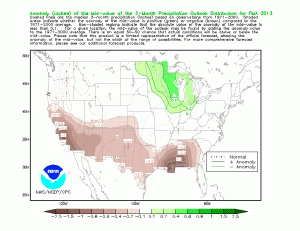
With January done, I’ve received 0.44 inches (1.12 cm) of precipitation since Oct. 1, the first four months of the “water year”. Driest start since I started keeping records in 1999. Here’s the Feb-Mar forecast map:

Feb-Mar forecast

Feb-Mar forecast

Turtles. All the way down.

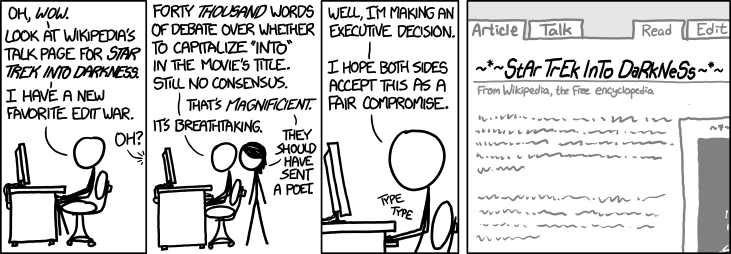
In today’s XKCD, Randall Munroe makes fun of the Wikipedia talk page for the new Star Trek into the Darkness movie:

Star Trek into the Darkness

Star Trek into the Darkness

And then the Star Trek into the Darkness talk page people discuss whether to include a mention of the XKCD comic on the Star Trek into the Darkness page:

I think this talk page needs a wikipedia article about this talk page. With an “in popular culture” section 99.226.191.43 (talk) 15:45, 30 January 2013 (UTC)

Turtles. All the way down.


advice for climate communicators

from Dan Kahan:

[W]hen positions on a fact that admits of scientific investigation (“is the earth heating up?”; “does the HPV vaccine promote unsafe sex among teenage girls?”) becomes entangled with the values and outlooks of diverse communities—and becomes, in effect, a symbol of one’s membership and loyalty in one or another group—then people in those groups will end up in states of persistent disagreement and confusion. These sorts of entanglements (and the influences that cause them) are in effect a form of pollution in the science communication environment, one that disables people from reliably discerning what is known to science.

The science communication environment is filled with these sorts of toxins on climate change. We need to use our intelligence to figure out how to clean our science communication environment up.

An example or two may help:

How readily and open-mindedly people will engage scientific information depends very decisively on context. A person who hears about the HPV vaccine when she sees Michelle Bachman or Ellen Goodman screaming about it on Fox or MSNBC will engage it as someone who has a political identity and is trying to figure out which position “matches” it; that same person, when she gets the information from her daughter’s pediatrician, will engage it as a parent, whose child’s welfare is the most important thing in the world to her, and who will earnestly try to figure out what those who are experts on health have to say. Most of the contexts in which people are thinking about climate change today are like the first of these two. Find ones that are more like the second. They exist!

Dan’s sciency take on this subject provides a sort of post hoc explanation for why I abandoned the climate wars.

Stuff I wrote elsewhere: where the water will run out

2013 has the potential here in New Mexico to be a great laboratory for exploring the question of specifically where and when water supply shortages actually play out during a drought year. I took a crack in this morning’s paper at setting up the problem, highlighting what I see as the four key New Meixco drought trouble spots:

“The potential exists out there for a zero-release year.”

That’s Phil King, a water resources professor at New Mexico State University and adviser to the Elephant Butte Irrigation District. The district provides water released from Elephant Butte Reservoir to farmers in Doña Ana County. Dollar for dollar, Doña Ana is the state’s most agriculturally productive county. But in the past couple of years, there hasn’t been much water to provide.


The Tree Rings’ Tale, as told by olives

As Kevin Anchukaitis put it, the Tree Rings’ Tale told by the olive tree is “Really really really really really really hard” to read. From Cherubini et al:

Dendrochronological analyses of olive trees growing on the Aegean island Santorini (Greece) show that the determination of the number of tree-rings is impossible because of intra-annual wood density fluctuations, variability in tree-ring boundary structure, and restriction of its cambial activity to shifting sectors of the circumference, causing the tree-ring sequences along radii of the same cross section to differ.

We will have to leave the olive tree to literary dating:

Good morrow, fair ones: pray you, if you know,

Where in the purlieus of this forest stands

A sheep-cote fenced about with olive trees?

it’s gotta carry the coffee

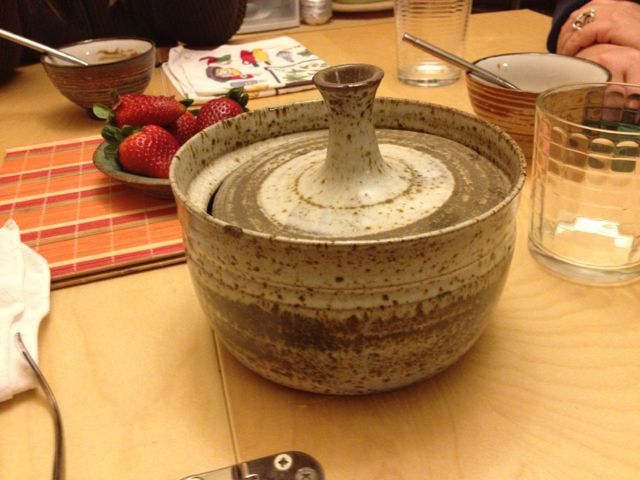
Whitey Watson casserole

Whitey Watson casserole

Lingering at my sister Lisa’s dining room table this evening after dinner, my eye drifted to this casserole on a shelf opposite. My memories of childhood are vague, and I often depend on Lisa for the sort of specifics I can’t quite grab hold of. But neither of us could remember the casserole’s story, other than it had been in our family since forever, an object of extraordinary familiarity. Lisa reminded me that it traditionally held the Thanksgiving stuffing.

Given the world in which we grew up, chances were good that an object of this sort was made by someone we knew.

I flipped it over. Scratched on the bottom was the name “Whitey”.

The problem of hindsight in constructing the arc of one’s life story suggests that autobiography is as much fiction as fact. So bear in mind that much of this is likely bullshit, but indulge a middle-aged man trying to figure out how this all happened?

Whitey Watson (Lisa and I had to struggle to reclaim the last name, and I confess to breaking my personal rule against mobile phone googling at the dinner table) was a friend of my dad’s, part of a circle of artists in and around Claremont, California, in the 1950s and ’60s. Some of them had names big enough to end up in Wikipedia (Karl Benjamin, Sam Maloof, the local boy made good Millard Sheets). Mostly not. They pretty much all taught, at the Claremont Colleges or, like my dad, at one of the local community colleges. And they made stuff.

We were little kids, so among this group Whitey was the biggest star because she had this big ceramic mosaic mural at Disneyland’s Tomorrowland. Lisa reminded me this evening that you could see it really well from the PeopleMover. This was a big deal. I remember visiting Whitey’s studio as a very young boy and, at her encouragement, touching wet gray clay. I remember the round muddy grace of her wheel. I remember finding her signature at the bottom right corner of the Disneyland mural and touching that, too.

Recall that I’m making things up here, but I think I’m roughly on the right track when I place Whitey – Helen Richter Watson – somewhere along an important arc in ceramic arts, as this California crowd pushed against the functional craft tradition of plates and coffee mugs and the like and made art. Look at the magnificent gleaming ceramic pear forms – a still life in ceramics –  featured in the permanent collection at Texas A&M’s Helen Richter Watson Gallery. No one’s going to be putting turkey stuffing in those.

And yet here we’ve got this magnificent little Whitey Watson casserole that has held the Fleck family’s food for half a century. It’s got a couple of chips because Whitey made it for us and we have used it.

When I was an intellectually ambitious young philosophy student, I tried to engage my father in a discussion about what art is. It was a disappointment, because he was profoundly inarticulate about the core issues. In later years, I made peace with my disappointment. He was a painter, not a word guy. He just did it, full of unarticulated assumptions, one piece at a time. (Mostly, that’s what we all do, myself included, word guy or not.) And learning what art was by watching him do it really was the thing, anyway. It took a while, but I think I’ve finally got a handle on it.

After college, I moved back to Claremont, fell in love with an artist (she’d made ceramics, no less!) and the romantic notion that I was going to be an artist too (whatever that meant), but with words. I worked at a small newspaper, to hone my craft, and bought myself a fine typewriter to write in the evenings. On our first date, I joined Lissa at an artist friend’s house in Padua Hills (Padua Hills!). Lissa had promised to cook her specialty, gyoza, in exchange for an old flat file the Padua Hills artist was getting rid of.

But my ambitions to art stumbled into the ceramicist’s dilemma. If you’re making a coffee mug, it can be magnificently beautiful, but it’s also gotta carry the coffee without leaking, and you’ve gotta be able to drink out of it. Whitey’s casserole is still in the family, and chipped, not only because of its great beauty, but because it works really well for turkey stuffing. I was writing newspaper stories, and they were most surely not art, but I was finding it enormously satisfying to sit at a typewriter and imagine what sort of coffee I wanted readers to get out of this mug I was making.

So that’s become my functional definition of what distinguishes craft from art – it’s gotta carry the coffee.