Jerry Brown: all in on #cawater

I often don’t know what to make of California, despite it being the state of my birth and a source of endless study and fascination.

Jerry Brown was the governor when I was a teenager, and I respect him as one of the nation’s great politicians. I mean something specific and respectful by the term – not “politician” in the pejorative sense of the word so often used today, but “politician” in the sense of someone skilled in working within the inherent messiness and limitations of political processes to try to actually solve problems. His current term as governor, now that we are both much older men, is a reflection of that.

So what to make of his use of the precious resource of his political capital push for the Peripheral Tunnel as a way of untangling California’s seemingly untangleable Bay-Delta water mess? And specifically, his signaling by use of the precious time in his State of the State address Thursday to lay down a marker? What does that say about where the solution space for this problem lies?

And then, what to make of this (possibly?) telling detail from Julie Small’s account of Brown’s Thursday address:

In his State of the State address Thursday, Gov. Jerry Brown reiterated his pitch to protect California’s water supply. But in a speech lawmakers repeatedly interrupted with applause, Brown’s plea to spend billions on water elicited silence.

#lobocamp

With apologies to the regular audience, I’m talking to students tomorrow morning at Lobocamp, using this post to share some links with the students:

Old trees and the curse of Prometheus

There’s a romance about the tree ring lab, and the culture flowing therefrom, that seems to draw writers like me. It’s probably the same reason the sliced and polished slab of a tree’s trunk, marked with little flag markers pointing to moments in history (“Columbus lands”, “Declaration of Independence”) is such a museum of natural history staple. Tangible chronology. Built for us by nature. That one can do important science, too, seems sometimes like icing.

It’s why I chose tree rings when I wanted to write a book for kids about climate.

Shelley Littin, writing for the University of Arizona, delightfully captures that romance in a piece about the oldest tree:

Past the door you will find the cause of the fire marshall’s concern: Boxes full of wood, circular cross sections of tree trunks, whole logs and branches, boards and remnants of dead wood fill up rows of shelves – and oftentimes the aisles – from the sawdust-strewn floor to the dusty ceiling.

On one wall, a 7-foot slab of wood is mounted with care: A cross section of the radius of the tree known as Prometheus.

Supporting non-profit journalism

I consider the business model that supports my journalism a great privilege. But I understand that a big part of the benefit offered by news production is a classic case of what economists call a “public good“. That is to say, civil society as a whole benefits, even if you don’t have the time to read the newspaper or the money to pay for the newspaper. The fact that a subset reads news and engages in the civic discourse that flows from that has the potential to benefit all. It’s easy to be a free-rider on those benefits, even without reading the paper or paying for it. You didn’t have to read the Washington Post’s coverage of Watergate, or buy the newspaper, to benefit from the civic results. That’s one of the key elements of news’s “public goodness”.

One of the corollaries of the theory underpinning the idea is that public goods in a society will tend to be underprovided.

That’s a long-winded explanation for why I grabbed my credit card out of my wallet today and made a donation to New Mexico In Depth. It’s a state-based non-profit news organization that, in collaboration with newspapers around the state, attempting to take up some of the slack for the provision of this public good as the commercial news business declines.

A Popperian approach to journalism

I happened to be in the midst of reading Kuhn vs. Popper when I ran across this, by Nicholas Lemann, on the sometimes clumsy dance between narrative and analysis in journalism:

Forming a hypothesis. It’s healthier to admit to yourself that you have one than to go into a story with the idea that you have no presuppositions at all – that would be impossible. You should state a working hypothesis (to yourself, anyway), and then ask yourself what would prove the hypothesis false and what would be an alternate hypothesis to explain whatever it is you are investigating. As you report, you should try not just to prove but also to disprove your working hypothesis, and you should engage in a continuing process of revision of the hypothesis, if necessary. If you don’t design your reporting in such a way that if your hypothesis is flawed, you will find that out before you finish the story, then you are leaving yourself open to getting the story seriously wrong.


Cool jewelry

We’ve got some cool jewelry in the household thanks to Nora Reed’s work. You might like some too:

swirling mother of pearl jewelry

swirling black and white

I’ve always had a thing for swirls and black and white patterns. This high-contrast piece combines soft mother-of-pearl white with a few kinds of black and white beads; the colors echo themselves throughout it to create a cohesive necklace that is versatile enough to match to many outfits.

OMG, we’re running out of water!

My current water policy obsession is the question of what actually happens – agency by agency, water user by user – when the water starts to run out.

Much of the “OMG, we’re running out of water!” discussion plays out in the form of graphs of the future that extend projected supply and demand curves, pointing to the gap, and running around with our hair on fire. But to the extent that the gap between supply and demand equals negative water, we can’t do that, and individuals and institutions will change their behavior in some way, and the question is how. Who will use less and how, or who will run out?

As one watches the Midwest discussion right now, perhaps the “how” involves reframing our basic approach to water:

“Water has been viewed as a basic commodity, a basic right,” said Les Lampe, a water expert with consultancy Black & Veatch. “You turn on the tap and water comes out and you don’t pay very much for it. That has to change.”


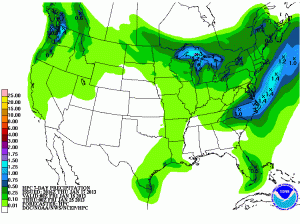
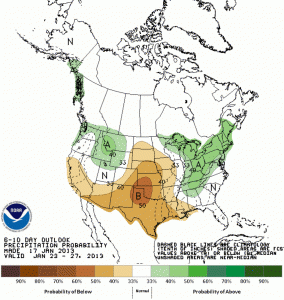
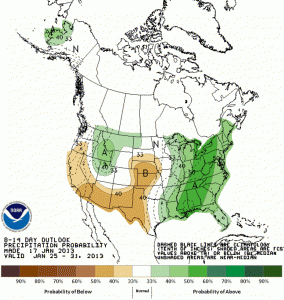
Running the table: dry at all relevant time scales

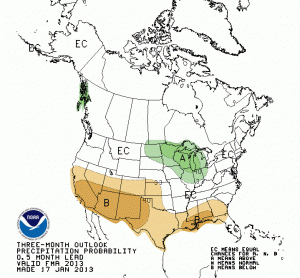
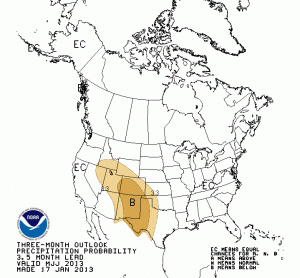
I confronted a litany of drought when I was making the rounds on my newspaper beat this morning. No doubt this has happened before and I’ve just not noticed it, but the current forecasts are dry at all the basic time scales I watch closely. I lined ’em all up so you could share New Mexico’s pain:

Next seven days:

Five to seven days

Next seven days

Six to ten days:

Six to ten days

Six to ten days

Eight to fourteen days:

Eight to fourteen days

Eight to fourteen days

February-March-April:

February-March-April

February-March-April

May-June-July:

May-June-July

May-June-July

New West: the economics of immigration

At the peak of the housing bubble in January 2006, when the annual pace of new home construction hit a blistering 2.29 million units, an estimated 14 percent of laborers in the construction sector were undocumented immigrants, including 20 percent of carpet, floor and tile installers, 28 percent of drywallers, and 36 percent of insulation workers. In September 2007, housing starts were down almost 50 percent, prices tumbled, and tens of thousands of migrants had lost their jobs.

Rubén Martínez, Desert America: Boom and Bust in the New Old West