“Climate change is water change”

One of the points Steven Solomon’s book Water: The Epic Struggle for Wealth, Power, and Civilization hammered home for me is water’s importance in providing transportation routes. Here in the western United States, it’s not something I’ve had to think of too much (see rivers without water to understand the cognitive dissonance).

So I’ve been watching and trying to learn from the drought in the upper midwest, with its implications for shipping on the Missouri and Mississippi rivers. I get water for farms cities and the rivers themselves for environmental purposes. Adding transportation adds an additional layer of complexity that’s fascinating. Here’s Alan Bjerga at Bloomberg:

Shippers and carriers still want Missouri River water. “There is the real chance that navigation could at best be severely impaired, and at worst effectively shut down, for an extended period of time if necessary actions are not taken immediately,” American Waterways Operators President Tom Allegretti said in a statement on Dec. 7. A closing would imperil farm exports and fertilizer shipments needed by February for U.S. spring planting, he said.

The setback for shipping interests is a shift from river- management priorities that dominated the 20th century, said Robert Kelley Schneiders, an environmental consultant at EcoInTheKnow in Boulder, Colorado, who has written books about the Missouri.

As far back as the 1800s, the barge industry has always held powerful sway over river use, he said. The current dam system itself was created to promote shipping along the lower Missouri, which has never been realized, Schneiders said.

The full article is worth reading.
With the Basin Study done, we can get back to draining Lake Mead

Last week’s release of the Colorado River Basin Water Supply and Demand Study was a headline-grabbing event – “Colorado River water supply to fall short of demand, study says“, to cite but one of a zillion examples of the core message getting big play. Barry Nelson argued the study “has the potential to mark a new era in the management of the West’s largest river basin.”

Lee's Ferry

Lee’s Ferry

We will see. As with most massive undertakings of this nature, the angels and devils are in the Basin Study’s details. And a separate, routine little US Bureau of Reclamation report that came out last week helps illustrate the point.

There were two big talking points. The first, the supply-demand gap, comes as no surprise to anyone involved in Colorado River management. To the extent this a big deal, its importance is the way the Basin Study loudly points out something that’s been painfully obvious for some time.

The second point, a bit more surprising to some (and also worth loudly pointing out), is that plain old water conservation is far more cost-effective, and quicker to implement, than big engineering solutions like building a pipeline to the Missouri. I chose to highlight these two points with the precious few words available for my newspaper story about the study.

But there’s something deeper in the Basin Study that’s worth exploring. (click through for wonky details) Continue reading ‘With the Basin Study done, we can get back to draining Lake Mead’ »

Augmentation – the central question

As I’ve written previously, the Colorado Basin Study suggests that augmenting water supply in the region is the most expensive and least quick approach to closing the supply-demand gap. But if folks do want to pursue augmentation, Juliet McKenna is asking the right questions:

The consequences of implementing any water supply augmentation plan need to be considered in terms of not only economics, but also in terms of where and how the water would be used. For example:

1. An additional 600,000 AF/year of water in the basin could support 1 million people. Will this supply be used to plug a supply gap or will it double the population living in eastern Colorado? Which outcome is desirable?

2. Would the cost (billions of dollars) be shared by all uses – people, industry, and agriculture? Or would only a subset of users, or new users have to pay?

So, as I think the authors of the Colorado River Basin Water Supply and Demand Study would agree, its time to start talking.

If you’re not already following Juliet, a water professional down in Tucson, I recommend bookmarking/RSSing.


Stuff I wrote elsewhere: Basin Study – it’s conservation for now

From this morning’s Albuquerque Journal, my distillation of the Colorado River Basin Study’s key message:

Towing icebergs from Alaska or building a giant pipeline from the Missouri River won’t bail out the western United States from its growing water supply crisis, federal officials said Wednesday.

Instead, conservation by the region’s farms and cities offers the quickest and most cost-effective way for New Mexico and the other states of the Colorado River Basin to close the growing gap between water demand and supply, according to a new study done jointly by the U.S. Bureau of Reclamation and the seven Colorado River Basin states.


Why the Basin Study is not about a pipeline to the Missouri

The Bureau of Reclamation’s study of supply and demand in the Colorado River Basin is due out tomorrow, and already it’s been getting a lot of attention. Bruce Finley at the Denver Post and Felicity Barringer at the New York Times have both highlighted the study’s consideration of the “pipeline to the Missouri” option, one of a host of water augmentation possibilities submitted by stakeholders and the public which has gotten some analysis over the course of the two year study.

The PTM option has some legs, because people in the non-water world can grasp it. But it’s an unfortunate framing for the release of this very important study, a piece of the puzzle that rightly ought to be confined to fine print along with towing icebergs down from the north (another idea that gets its due).

Most of the study’s findings are already public – the Bureau’s been releasing them steadily in a series of data dumps over the last year. What they show is a growing gap between supply and demand in the basin (with some legitimate argument over whether the Bureau let the states use pre-housing crash trajectories to high-ball their growth projections, making the gap look larger than it should). At whatever size it is, though, the study also shows that various types of “magic water” (icebergs! PTM!) can’t fix this problem. If you read carefully, it’s there in Barringer’s story:

It is unclear how much such a pipeline project would cost, though estimates run into the billions of dollars. That does not include the cost of the new electric power that would be needed (along with the construction of new generating capacity) to pump the water uphill from Leavenworth, Kan., to the front range reservoirs serving Denver, about a mile above sea level, according to Sharlene Leurig, an expert on water-project financing at Ceres, a nonprofit group based in Boston that works with investors to promote sustainability….

Ms. Leurig noted that local taxpayers and utility customers would be shouldering most of the expense of such a venture through their tax and water bills, which would make conservation a more palatable alternative.

What it shows, if I may be so humble as to generalize, is that the basin’s water users need to learn to live within their means. I’m confident they can, even if they’d rather just have the feds build them another pipe.

Dry November

New Mexico’s 2012 weather feels increasingly like a teachable moment, though the lessons must be handled with care. As the folks in the local media-weather complex went into stormpocalypse mode over the possibility that it might actually snow this weekend, I took pause in Saturday’s paper to look back:

The storm comes as New Mexico withers through the second year of drought, with fears of a third. Federal water managers warned major irrigation and municipal water agencies this week to be prepared for shortfalls in 2013. After two dry years, water storage in most of the state’s reservoirs has been drained and current snowpack in the state’s northern mountains is less than a quarter of normal for this time of year.

The first 11 months of 2012 have been more than 2.5 degrees warmer than the long-term average, according to the National Climatic Data Center — the warmest in records going back to 1895. It is the latest warm year in a long-term trend that scientists attribute to increasing greenhouse gases. The 24 months ending Nov. 30 are also the driest such period on record, Polasko noted, with less precipitation than the worst two-year stretch during the drought of the 1950s.

See also here for more of my journalistic whining about how warm and dry it’s been.

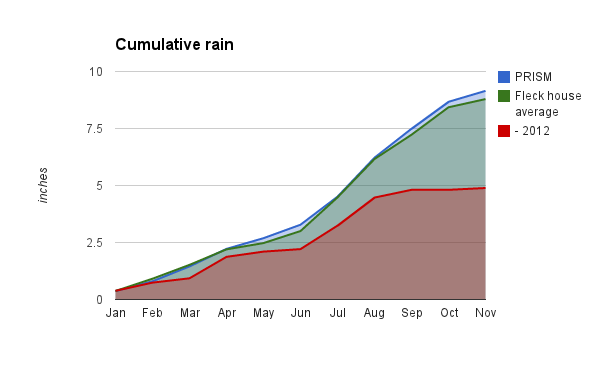
So as I sit here on an early Sunday evening watching it not snow at our house, I’ve been finishing up my November WS Form B-91 to send in to the Albuquerque Weather Service office’s Citynet program. Final tally: 0.08 inch (0.2 cm) precip in November, 22 percent of my long term average. For the first 11 months of 2012, I’ve had 4.89 inches (12.4 cm) of precipitation, 55 percent of my mean (data back to 2000). Nine of the 11 months so far this year have been below average:

2012 precip, Heineman-Fleck house

2012 precip, Heineman-Fleck house


How to measure snow (and buy my book!)

measuring snow

measuring snow

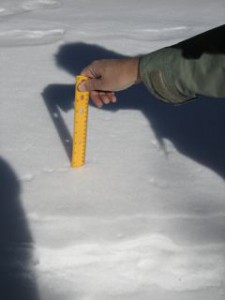
We’ve not had much opportunity of late to measure snow here in Albuquerque, so I had to snag this picture from some time ago.

But it’s that time of year when thoughts of weather nerds turn to the snow in their backyards, which offers me another chance to flog my book, which would be a delightful gift if you’re trying to think of what to buy for that precocious child in your world who wants to learn how to think about weather, climate and science for herself.

One of the things we tried to do with the book was not only explain who paleoclimate, modern climate science and meteorology are done by the grownups, but to show how easy it is to do a lot of this sort of science for yourself, one backyard rain or snow measurement at a time.

Here are the basics for snow: Take a ruler outside. Look for places where the snow has fallen on a flat surface, like a picnic table or the top of your car. Stick the ruler down through the snow, and note the height of the top of the snow on the ruler. Take three measurements and average them.

I have learned in doing this myself over the years that I’m not very good at “eyeballing” it and guessing the depth, a reminder of the usefulness of measuring.

The book is The Tree Rings’ Tale: Understanding Our Changing Climate (Worlds of Wonder), published by the University of New Mexico press.


Nationalism on the Lower Colorado

The All-American Canal, which grabs water from Imperial Dam and runs it along the north side of the California-Baja border before delivering it to Imperial Valley farmers, was built at some great expense to replace the original wandering route that took the water south into Mexico before curving back north to US farms. The folks behind the project pushed it because they tired of letting Mexican farmers have a cut of the water before it got to US lettuce crops.

But maybe it’s about more than an unwillingness to share? Maybe it’s who the sharing was with? From the LA Times last month, a fun piece by Tony Perry at the reaction to the fact that the new US-Mexico Colorado River water deal calls for some of Mexico’s share of the river’s water to be delivered by the canal with that very specific name:

The idea does not sit well with farmers and officials in the Imperial Valley who believe that powerful outsiders are again ignoring the valley’s hard-fought water rights, this time in an effort to improve relations with the Mexican government.

“There’s a reason it’s called the All-American Canal,” said Kevin Kelley, general manager of the Imperial Irrigation District, raising his voice for emphasis.


In Texas, water policy is a front burner political issue

Texas Agriculture Commissioner Todd Staples is setting up a run for lieutenant governor. Making the rounds, he ended up this week in the dry parts of the state, where folks naturally asked him about water:

“When I talk to companies about them expanding in Texas or moving to Texas,” he said, “inevitably two questions come about: What’s Texas going to do about its water needs and what is Texas going to do to have a skilled and available work force?”

Pointing to area’s struggles with the Texas drought, Staples said the solution can’t just be to restrict usage.

“Last decade, we had 1,200 people a day move to Texas,” Staples said. “This decade, we’re going to have 1,500 people a day moving to Texas. Having an available water supply is critical to the future of our state’s economic growth. Having an available water supply means jobs.”

He cited a number of routes for improving water resources, including improved irrigation techniques, developing plants that are drought resistant as well as pest resistant and using low-cost natural gas or excess wind energy to fuel desalination plants to treat brackish water to make it usable.

My point in bringing this up is not to argue that there’s anything particularly special about Staples’ policy prescriptions. Rather, it’s the fact that a statewide Texas candidate making the rounds has a water schtick at all, that it’s on the agenda.

Possible San Juan-Chama water shortages

Regular readers will know of my obsession with pushing beyond the “OMG we’re running out of water!” story line to look in detail at who, specifically, gets shorted when supplies run low and what adaptive responses they have available.

In New Mexico, water managers are using the occasion of our current drought to helpfully prepare a test case for me!

From this morning’s Albuquerque Journal:

The federal government has begun notifying Rio Grande water users that they may not get a full allotment of water from the San Juan-Chama project in 2013 after two years of deep drought sapped reserves.

San Juan-Chama water, imported through a tunnel beneath the Continental Divide, has been a lifeline for Rio Grande water users in recent drought years, especially Middle Rio Grande Conservancy District farmers and the Albuquerque metro area’s government water utility.

But two years of drought have drained the project’s water reserves, and U.S. Bureau of Reclamation managers have been informing water agencies that they could see a 20 percent curtailment in water deliveries next year.