Coyotes and geese – the trajectories of our newly forming urban ecosystems

Canada geese seems especially fond of Albuquerque’s country club and the neighborhood around it. So it also seems likely, according to research into urban coyotes, that the skinny little dog-wolves are in this urban ecosystem mix:

Though urban coyotes do occasionally attack cats and dogs, far more often they avoid them. (Coyote attacks on people are even less common.) They also don’t rely on garbage, as urban scavengers like raccoons do. Instead, their diet seems heavy on rabbits, rats, mice, fruit, and goose eggs (geese being a surprisingly common pest in many big cities).

From a delightful little bit of business by Kim Tingley on the urban coyote.

Russian thistle and the American heartland

I’ve always known, in very general terms, that the tumbleweed is an interloper. But the story is better than I could possibly have hoped. From Tim Egan’s The Worst Hard Time (a book I’m just catching up with and wondering what took me so long):

[W]hen they boarded ships for America, the Germans from Russia carried with them seeds of turkey red – a hard winter wheat – and incidental thistle sewn into the pockets of their vests. It mean survival, an heorloom packet worth more than currency. The turkey red, short-stemmed and resistant to cold an drought, took so well to the land beyond the ninety-eighth meridian that agronomists were forced to rethink the predominant view that the Great American Desert was unsuited for agriculture. In Russia, it was the crop that allow the Germans to move out of the valleys and onto the hihher, drier farming ground of the steppe. The thistle came by accident, but it grew so fast it soon owned the West. In the Old World, thistle was called perekati-pole, which meant “roll-across-the-field.” In America, it was knonw as tumbleweed.

Tim Egan is a very good storyteller

On water and storytelling

Hoover Dam and the bathtub ring

Hoover Dam and the bathtub ring

Water is at the core of a compelling human drama. Or perhaps dramas (plural). Yet the core issues, where the drama lies, are maddeningly difficult to, if I may share a personal journalist neologism, “storyize”. Cynthia Barnett, my favorite water writer, explains in the Los Angeles Times:

But we can’t see dried-out aquifers the way we could see black Dust Bowl storms in the 1930s or water pollution in the early 1970s. So we still pump with abandon to do things like soak the turf grass that covers 63,240 square miles of the nation. We flush toilets with this same fresh, potable water, after treating it at great expense to meet government standards for drinking.

We fill the fridge with beef, the shopping bags with cotton T’s, the gas tank with corn-made ethanol — all with little inkling of how we’re draining to extinction the Ogallala aquifer that irrigates a quarter of the nation’s agricultural harvest.

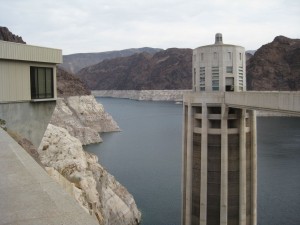
So Cynthia, as we all inevitably do, makes the pilgrimage to Lake Mead, and points out the “bathtub ring”:

Lake Mead is different. It’s one of the few places in the United States where the illusion of water abundance is being exposed for what it is: a beautiful bubble doomed to pop, just like other great national illusions — the unending bull market, say, or upward-only housing prices.

For 12 years, the nation’s largest reservoir has dropped steadily to reveal a calcium-carbonate bathtub ring, evidence of human folly and nature’s frailty — the over-allocation of the Colorado River and the drought still battering so much of the United States.

The problem, she found on her visit to Hoover Dam, is the tales we tell ourselves. I struggled with this a couple of years ago on my own similar pilgrimage:

We are sufficiently buffered by affluence that almost no one I talked to today had any inkling of what was going on. Just another tourist Sunday on Hoover Dam. The best I got was from one the folks in this picture, who were on a Sunday drive at one of the Lake Mead overlooks. One of them, a Las Vegas resident, knew the lake was way low, and said the solution was simple – somebody needs to have the political courage to make them release more water from Lake Powell, upstream.

I decided against explaining the Colorado River Compact, and the complex reservoir equalization rules in the 2007 shortage sharing agreement, that upper basin states are using less than their share of the river anyway, that Powell is low too, that it’s not that easy. But ultimately, I guess that’s what I have to figure out how to explain.

Consider this a call for better storytelling. Cynthia’s LA Times piece is a good place to start.

US-Mexico Colorado River Deal

Kudos to Chris Austin, who was out ahead of everyone else earlier this week in laying out the details of the pending US-Mexico Colorado River water deal. I encourage you to head over to Chris’s blog for more on the deal, which was first presented last Monday to the board of the Metropolitan Water District of Southern California, the first step in a rollout that’s now happening all across the seven US states that share the Colorado. Since Chris’s piece, some of the news types have jumped in, though Chris’s piece is the best explanation of what’s going on.

I’ll know a lot more next week, when New Mexico gets its briefing at a meeting of the state’s Interstate Stream Commission. But in brief, this has the potential to be an extremely important deal because of the way it extends the Colorado River’s complex accounting system across the US-Mexico border, in the process addressing one of the major unsettled package of questions regarding Colorado River management.

The underlying problem the negotiators have been trying to address is how to equitably share shortages between the United States and Mexico. The US-Mexico treaty of 1944 (pdf) calls for reduction of Mexico’s share of the river in the case of “extraordinary drought”:

In the event of extraordinary drought or serious accident to the irrigation system in the United States, thereby making it difficult for the United States to deliver the guaranteed quantity of 1,5000,000 acre-feet (1,850,234,000 cubic meters) a year, the water allotted to Mexico under subparagraph (a) of this Article will be reduced in the same proportion as consumptive uses in the United States are reduced.

But how “extraordinary drought” might be defined, and the details of how the shortage sharing contemplated in the treaty might be implemented, was left as an exercise for future generations. It’s taken a bit longer than I imagine anyone expected to get back to to it. Beyond the shortage/surplus management issue, the deal also appears to address a couple of major steps forward in trans-boundary river management, including the creation of a framework for Mexico’s storage of water in US reservoirs, and some management tweaks that seem aimed at providing environmental flows in the de-watered Colorado River delta.

For background on the outstanding issues, I recommend Jason Robinson’s “Respective Obligations of the Upper and Lower Basins Regarding the Delivery of Water to Mexico: A Review of Key Legal Issues” (pdf), a white paper produced with the University of Colorado School of Law Colorado River group.


Stuff I wrote elsewhere: Engineering nature at the Bosque del Apache

From the morning paper, a look at the wet bits and the dry bits at the Bosque del Apache National Wildlife Refuge during a drought, and the challenge of mimicking nature:

Some years, like this one, drought comes to the refuge in a way that matches what we would have seen in a drought year a century ago. The beloved “boardwalk pond” at the refuge’s south end, home to cormorants and pelicans, was nothing but cracked mud when Mize took Brose and I on a tour last week. There was so little water in the ditch feeding pond this year that it finally just dried up, Mize said.

To my look of concern, Mize responded with a wildlife manager’s calm equanimity: “Healthy wetlands are fluctuating wetlands,” he explained. “Drought is a natural occurrence. Our landscape evolved with drought.”

To the south, Mize showed us how refuge crews had cleared out unnatural thick stands of cattail that had choked one of the refuge’s ponds, taking advantage of drought to bring the system back to a more “natural” state. The pond is in an old river channel that in some years would have dried in drought, and in other years been ripped clear by spring floods. A consistent water supply has, in the past, given the pond a spectacular stand of cattails – lovely, but requiring human intervention to get “nature” back on an even keel.

Hence the dried-up pond and ripped-out cattails. “This is what Mother Nature would have done,” Mize said.


Transborder conflict on the Mekong

I’m generally sympathetic to the notion that transboundary water conflicts are overrated, and that they often provide a framework for cooperation. Except when they don’t (from this week’s Economist):

The decision by Laos to push ahead with the giant Xayaburi dam makes it the first of what could prove to be a cascade of 11 proposed dams on the lower Mekong. Because the decision fails to take account of the consequences for downstream countries, it has raised tensions with neighbours. Having long pretended otherwise, the Lao government recently asserted that construction was forging ahead, and indeed was on schedule. That prompted a warning from the president of Vietnam, Truong Tan Sang, that “tensions over water resources are not only threatening economic growth in many countries, but also presenting a source of conflict”.

The core of the conflict is the freshwater fishery, one of the world’s largest, on which the Economist reports 65 million poor folk depend for protein.

Beetle kill, watersheds and water quality

When beetles kill trees, it changes water chemistry for the folks downstream of the hammered watersheds. And not in a good way (DBP is “disinfection by-products”, study area is in Colorado):

Results demonstrate higher total organic carbon concentrations along with significantly more DBPs at water-treatment facilities using mountain-pine-beetle-infested source waters when contrasted with those using water from control watersheds. In addition to this differentiation between watersheds, DBP concentrations demonstrated an increase within mountain pine beetle watersheds related to the degree of infestation. Disproportionate DBP increases and seasonal decoupling of peak DBP and total organic carbon concentrations further suggest that the total organic carbon composition is being altered in these systems.

Mikkelson et al., Water-quality impacts from climate-induced forest die-off, Nature Climate Change (2012) doi:10.1038/nclimate1724

Denver water use dropping

Bruce Finley in the Denver Post tallies up another western city cutting municipal water use, demonstrating that, for city water users, this is a tractable problem:

Water-saving efforts already have dropped metro Denver residents’ overall average daily usage to 85 gallons, down from 104 gallons in 2001.

Only one city better than Denver in Finley’s review of residential water use:

Albuquerque at 70 gallons a day.

Note that Finley’s talking here about withdrawals, and doesn’t get into the extent to which a portion of cities’ indoor water is reused after treatment, with the exception of a nod toward the way Las Vegas handles its wastewater.

CSFC Index: an NM economic data puzzle

Cheap Shit From China

Cheap Shit From China

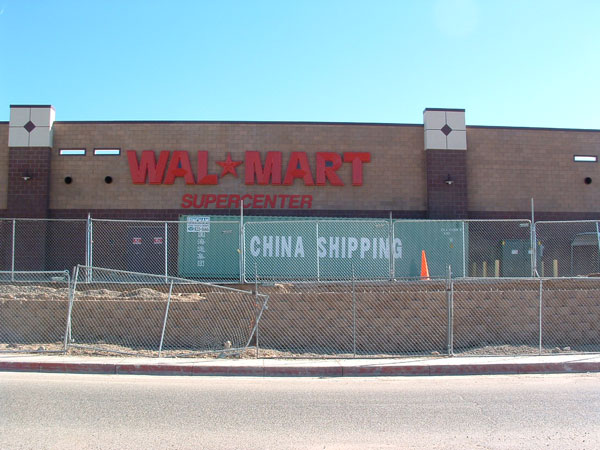
The folks on the Inkstain Economics Desk point to an intriguing puzzle, in the form of 22 shipping containers out behind the neighborhood MegaWalMart this morning.

We’ve long used the Cheap Shit From China index (CSFC) here at Inkstain as a crude but useful economic barometer. The premise is this: WalMart has better data than just about anyone else on aggregated consumer behavior. They also operate their entire system on incredibly tight margins. In the case of the neighborhood MegaWalMart, that includes minimal back end storage space. A number of years ago, I the Inkstain Economics Desk noticed while out on a bike ride while doing their routine data collection that during the holiday shopping season, inventory was spilling out the back of the MegaWalMart, stored temporarily in big shipping containers. So in a sort of random, half-assed fashion, I the rigorous fashion they’re known for, our analysts began counting shipping containers, using it as a visible index of the things WalMart is forecasting about our aggregated economic behavior.

Here’s the problem.

We know New Mexico’s economy is sucking wind, its economic recovery, by one measure, lagging behind every other state in the nation. Yet the CFSC Index stands at 22, an unusually high number for this time of year.

I can see two possibilities. One is that WalMart knows something the Philadelphia Fed doesn’t, and that the CSFC Index could be viewed as a promising leading indicator. The second, which seems more likely, is that the CSFC Index has broken down, perhaps because WalMart is simply leaving empty containers sitting out there because there’s no real demand for them anywhere else. Maybe they’re just sitting there empty. Evidence in support of this is the fact that the containers this morning looked kinda rusty and unused.

I’ve directed the Inkstain economic analysts to go on more bike rides begin updating the data more frequently.

Clarity on withdrawal versus consumption, San Diego style

Regarding my discussion yesterday of the fact that not all water conservation measures are created equal, here’s a nice treatment of the subject by Deborah Brennan at U-T San Diego:

“It’s one of the simplest, most common sense things you can do to save money and restore the ecosystem, especially in San Diego where we have chronic drought,” said Candace Vanderhoff, chief executive of RainThanks & Greywater, and the installer of Murphree’s system. “By retaining the water on the site instead of sending it out to the ocean, we’re able to create more green spaces.”

The key bit here is that “sending it out to the ocean” line. Makes clear where the effluent goes – that San Diego’s clothes washer drain water is being discharged to the ocean, rather than being returned to the system for reuse somewhere else downstream. San Diego’s at the end of the downstream. Kudos.