
I would like to personally thank the taxpayers of Albuquerque for saving my life.
Delta hostages
One of the smartest comments on last week’s Cal-Fed announcement about the California Bay-Delta system came in a blog comment from UC Davis’s Jay Lund:
The Delta has always been about hostage taking – traditionally with local interests using Delta salinity as a hostage on the big water export projects, and water export users using Delta salinity as a hostage to gain the support of local Delta landowners – who depend on Sacramento River flows to dilute salts in the lower San Joaquin River/south Delta. This situation has trashed native species habitat. Unfortunately, the hostages are dying (native species, subsided island levees, and drinking water quality). So new infrastructure and hostage arrangements will be needed.
Lund and Kaveh Madani wrote an insightful paper last year on the political/game theory problem:
Today’s Delta problem has characteristics of a Chicken game, where cooperation is in everyone’s interest, but is unlikely because parties deviating from the status quo are likely to bear more of the costs of a long-term solution. The state of California may become the victim (or chicken) of the Delta game, bearing the greatest costs, if it continues to rely on a policy of leaving parties to develop voluntary cooperative resolution without a sufficient mechanism for enforcing cooperation.
Phil Isenberg made a related point in his piece responding to the Bay Delta Conservation Plan Announcement (he’s actually quoting here from a talk he’s given to several California audiences):
In public, most of the speakers say pretty much the same thing. The most common refrain is “me, and my interest first.” However, when I talk to these people in private, they say things differently. In private, people are more candid, flexible and pragmatic. This difference between public posturing and reasonable private conversation irritates me. I occasionally demand they say in public what they tell me in private. Some smile, but mostly they glower or stare back without responding. This is the American way to negotiate: demand more than you want or need, in the hope of getting something better than you expect. Ask tough questions of your opponents, but duck the ones that come your way. Offer to compromise 30 minutes before a final decision. This pattern is not a great way to make public policy.
Fire and water
One of the hidden constituencies for forest health is downstream water users. Western wildfires can really muck up a watershed, creating problems when bad fire happens and therefore significant incentives to try to keep it from happening.
Today’s case in point, from my colleague Rene Romo, is the Little Bear fire in southern New Mexico:
When more than five inches of rain fell in the area of Bonito Lake, a man-made reservoir located in the White Mountain Wilderness, between July 5 and 9, the lake was inundated with silt, ash and burn debris, rendering the reservoir useless as a source of water to Alamogordo and Holloman Air Force Base. Bonito Lake represents about 15 percent of Alamogordo’s water supply, and the city is relying on other sources to fill the gap while hiring a contractor to determine what is needed to unclog an intake line and dredge the lake, said Alamogordo city manager Matt McNeile.
In the meantime, the city has five pumps sucking water out of the reservoir to free up capacity for the next time rainfall sends large amounts of silt and black ash down the watershed, McNeile said.
At another Lincoln County reservoir, Alto Lake, crews are working to remove 70,000 cubic yards of debris to increase the lake’s ability to absorb run-off.
Lots of helpful background on this issue from the folks at Carpe Diem West’s Healthy Headwaters Program.
California water’s “grumpy old guy” on BDCP
Phil Isenberg, California water’s self-described “grumpy old guy”, put down a marker today with a particularly useful, nuanced take (pdf) take on this week’s Bay-Delta Conservation Plan announcement, arguing that it is a bigger deal than some of us have been willing to acknowledge.

Phil Isenberg
“Serious public policy people should pay attention,” Isenberg wrote.
As I’ve written before, the Delta is a hairball of a wicked problem. Isenberg sketches what seems to be a solution space he sees taking shape in the proposal announced Wednesday for a tunnel beneath the Delta to carry water from north to south.
Isenberg is one of the most savvy politicians I’ve ever had the pleasure to meet. I mean “politician” here in the best sense of the word, with politics being the noble means by which we settle conflicts among competing societal values. Isenberg’s job as head of the Delta Stewardship Council is to do just that. Given that political skill, however, what I don’t know is whether Phil is describing here what he actually thinks is happening in the BDCP, or whether he is trying to frame things in a way he hopes they will happen. Probably a bit of both.
In particular, Isenberg finds it significant that the scheme laid out yesterday includes no guarantees for how much water the exporters (San Joaquin Valley farmers and water-using cities in the Bay Area and Southern California) will be able to extract from the system in the long run:
Absolute guarantees of endless amount of ‘new water’ are slipping from the discussion. This may be the most interesting part of the BDCP announcement. For the entire history of California, people have demanded legal guarantees of water supplies (we also call them “assurances,” or “entitlements”). But if you read all the documents presented this week, it clear that water contractors are not asking BDCP to guarantee a set amount water will be provided – not even a “minimum amount” to be exported (see the Questions and Answers on page 3). Rumbles have circulated through the water world for many weeks that “guarantees are no longer a pre-condition for BDCP approval.” That was so peculiar that many of us thought it could not be true.
I don’t read the “Questions and Answers on page 3” (pdf) as being quite as firm as Phil would suggest:
Our package of recommendations does not currently address any specific guarantees of minimum water exports. Whether and how to shape these “assurances” must await further environmental and cost analyses which will be forthcoming in the reviews currently underway.
That seems to me to leave an opening for guarantees down the road. But maybe this is an example of Phil, the savvy politician, trying to frame the discussion in a useful way?
The related point is that “Science will now guide how to best restore the ecosystem and how much water can be exported.”
This declaration breaks new ground. Not by saying that science should be involved, but by saying that science will guide water operations as well.
Isenberg argues that “this may well qualify as a major change in how California deals with water supply and demand”:
Historically, we have overpromised the total amount of water to be delivered. That was not a big problem when California’s population and economy were small and the supply of water ample. Today, our population and economy is very large and the supply of water has remained static. The tension is also greater because of strong public supports for reversing the environmental damage from previous water development.
Is dropping the demand for guaranteed levels of water a way to talk honestly about supply and demand? I sure hope so. The Delta Stewardship Council has wrestled with this problem, and ultimately decided that the best way to say it “matches the demands for water to the available supply – not the other way around.” The announcement this week sounds very much like this approach.
If you’re interested in sussing out what is happening with BDCP, I recommend reading the whole thing.
Stuff I Wrote Elsewhere: the Colorado River’s supply-demand problem
While it’s easy to get caught up in the climate wars rhetoric about the Colorado River, and the effect of anthropogenic warming on the river’s flows, it’s important to remember that’s only one of the variables changing in my region’s water future:
With population growth pushing up Colorado River Basin water demand as climate change pushes down supply, New Mexico and the other states that depend on the river face a growing gap between how much water nature provides and how much humans want to use.
New Mexico’s population that uses the river’s water, currently nearly 1.5 million people, is expected to grow to between 2 million and 3 million by 2060, according to the latest data from a U.S. Bureau of Reclamation study.
The Delta as wicked problem
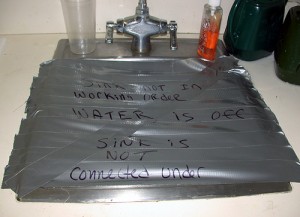
duct tape and water, courtesy Metropolitan Library System, used with permission, some rights reserved
It’s just geographical coincidence that Horst Rittel and Melvin Webber were at Berkeley in 1973 when they published their Dilemmas in a General Theory of Planning (pdf), less than 30 miles as the American white pelican flies from Sherman Island at the downstream mouth of the Sacramento-San Joaquin Delta. But as we await tomorrow’s unveiling of the latest effort to fix the Delta, it’s worth revisiting Rittel and Webber, because I’ve seen few better case studies of “wicked problems” than this:
Policy problems cannot be definitively described. Moreover, in a pluralistic society there is nothing like the undisputable public good; there is no objective definition of equity; policies that respond to social problems cannot be meaningfully correct or false; and it makes no sense to talk about “optimal solutions” to social problems unless severe qualifications are imposed first. Even worse, there are no “solutions” in the sense of definitive and objective answers.
The most useful formulation of the “wicked problem” thesis, for me, involves two elements. The first is that one’s definition of the problem suggests the solution path. The second is that there is no unique problem definition, but rather multiple possible definitions, suggesting multiple different solution paths, based on the values and the interests of the person doing the defining.
Watching the Bay Delta Conservation Plan pre-show, as all the players stake out their ground prior to tomorrow’s announcement by the state of California and the Feds, has been to see Rittel and Webber reified. Consider a few of their criteria for what counts as a “wicked problem”, and how these criteria might apply here:
- There is no definitive formulation of a wicked problem
- Wicked problems have no stopping rule
- There is no immediate and no ultimate test of a solution to a wicked problem
- Every wicked problem can be considered a symptom of another problem
Nowhere is this more obvious than the valiant attempt by Californians to constrain the definition of the problem the BDCP is attempting to solve (quoted from the recent state-federal joint recommendations – pdf):
the two coequal goals of providing a more reliable water supply for California and protecting, restoring, and enhancing the Delta ecosystem
The explicit mantra – “coequal goals” – was an attempt to sidestep the core of the wicked problem – the lack of a definition. Was the ecological collapse of the Delta the problem? Or was it the lack of water supply reliability? Each problem definition, separately, suggested a different set of solutions. So the state’s political leadership tried to duct tape them together, really tightly.
In fact, the Sacramento-San Joaquin Delta Reform Act of 2009 has a lot more duct-taped in. The protection and enhancement of the Delta itself (carefully defined in cultural, recreational and agricultural terms as “an evolving place”, for example), and some particularly critical language about state government’s policy to “improve the water conveyance system” and “to reduce reliance on the Delta in meeting California’s future water supply needs”.
“There is no problem,” one of the state’s smart senior water politics-policy people told me when I was out in California last year. “There are multiple problems.”
deBuys on the climatology of the New West
I don’t think we’ll recognize this:
One upshot will be the emergence of whole new ecologies. The landscape changes brought on by climate change are affecting areas so vast that many previous tenants of the land—ponderosa pines, for instance—cannot be expected to recolonize their former territory. Their seeds don’t normally spread far from the parent tree, and their seedlings require conditions that big, hot, open spaces don’t provide.
What will develop in their absence? What will the mountains and mesa tops of the New West look like? Already it is plain to see that scrub oak, locust, and other plants that reproduce by root suckers are prospering in places where the big pines used to stand. These plants can be burned to the ground and yet resprout vigorously a season later. One ecologist friend offers this advice, “If you have to be reincarnated as a plant in the West, try not to come back as a tree. Choose a clonal shrub, instead. The future looks good for them.”
The Colorado River. And tubeworms.
Is this Michelle Nijhuis piece on the Colorado River terrific because she’s willing to go against the grain and argue for an optimistic future?
[D]eputy secretary of the U.S. Department of the Interior David Hayes, ecologist Osvel Hinojosa Huerta of the Mexican conservation group Pronatura Noroeste and University of Arizona paleoclimatologist Jonathan Overpeck all described something that sounded suspiciously close to adult behavior. The outlook for climate and water supplies on the Colorado is grim and getting grimmer, they agreed, but the basin states have reached a few important cooperative agreements in recent years, and are even involved in promising discussions with Mexico about getting more water across the border and to the river’s dried-out delta.
I was skeptical. (That’s my job.) But Hayes, Hinojosa, and Overpeck each insisted, in public and in private, that the progress was real. Part of the reason, Hayes said, is that the veteran adversaries along the river have developed a grudging trust: “These people have worked together for so long,” he said, laughing and shaking his head. “They know each others’ tics, they know each others’ food preferences. They’re like a family.”
Or is it terrific because of tubeworms?
Cooperative relationships, he says, are especially important in harsh conditions: Deep-sea tubeworms, for example, lack mouths and guts, so they depend on colonies of obligate symbiotic bacteria to fix hydrogen sulfide into food for them. (See? I promised tubeworms.)
+1
We were reporters once, and young
A treasure found in an old file drawer – a 1995 congressional press pass:

note the lack of necktie
pigeons redux
John Upton asked for suggestions about “your favorite plant, animal, pathogen or natural phenomenon” as blog topics. I suggested pigeons, and John did not disappoint:
[N]ew research suggests that pigeon racers could be constantly fueling the wild populations with physical prowess-imbuing genes, helping to spawn today’s urban super-pigeons.
University of Utah researchers studied the genes of hundreds of domestic and free-living pigeons in the United States in an effort to map their family tree. What they discovered, and reported in February in the journal Current Biology, was a free flow of genes from specially bred racing pigeons into the wild.
Anywhere from five to 20 percent of racing pigeons fail to complete any given race. Some fall prey to predators. But others may simply get lost, or choose to not return home, and then blend into wild populations, where they coo and carry on and breed with feral lovers.