Stuff I wrote elsewhere: ABQ water infrastructure

On Albuquerque’s appearance in the “our pipes are getting old!” discussion:

Albuquerque’s water and sewer utility, facing hundreds of millions of dollars in costs over the next decade to replace aging pipes and treatment plants, is considering a series of rate increases in the next five years.

When the last of the proposed rate hikes takes effect, the average residential customer’s bill would rise to $54 per month, up from $45 today, according to Mark Sanchez, executive director of the Albuquerque Bernalillo County Water Utility Authority – an additional $108 per year for the average customer by 2017.

More than 400 miles of metro area water and sewer pipe are at high risk of failure, according to a study done for the water utility and the backlog of aging pipes that need replacement is growing because of inadequate funding.

On the relative change between the level of ocean and land in the Sacramento Delta

When I posted a couple of weeks back on the fact that land in the Sacramento-San Joaquin Delta is subsiding faster than sea level is rising, a smart reader asked privately, “Yeah, so what’s the point?”

My reader’s observation was, in essence, that it doesn’t really matter much in terms of policy response whether the ocean is rising or the land is sinking. And that was precisely the obscure point about which I was thinking, but about which I wrote poorly.

Consider what happened in North Carolina when a panel of scientists prepared a report for the state looking at the best available science on sea level rise:

The final recommendation was for the state to plan for 39 inches of sea level rise. This number corresponds well with expert reports produced in other states.

And the response?

NC-20, a group purporting to represent North Carolina’s coastal counties, attacked both the integrity of the science panel members and the body of sea level rise literature that was reviewed. The rebuttal consisted largely of oft-repeated arguments pulled from the climate skeptic blogosphere, along with an adamant assertion that predicting the future is impossible. To the great surprise of those of us on the state’s science panel, these tactics have worked.

To the extent that a change in the relative elevation of sea and land in California’s Delta poses a threat that requires a policy response (more robust levees, perhaps?), it doesn’t really matter whether the sea is rising or the land is falling. But to the extent that rising sea level is a driver, California runs the risk of a North Carolina problem, in which the policy discussion becomes mired in the identity politics of climate change.

Thank heavens we now know the land is sinking and we don’t have to fight that fight!

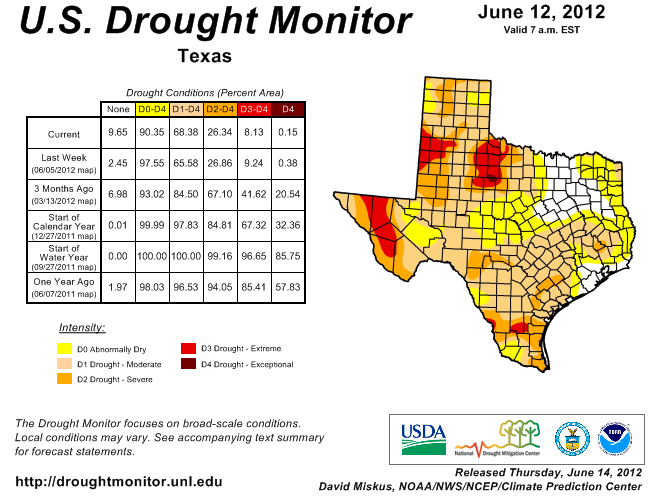
Sizing up Texas drought response

With Texas emerging from its record drought, it’s a good time to size up how the state’s water systems have responded.

The Texas Commission on Environmental Quality reports that just two small community water systems, Spicewood Beach and Florence – a total population of less than 3,000 people – are in danger of running out of water now. This supports the argument I’ve been making – that Texas communities have made the necessary adjustments during the drought of record.

Kate Galbraith at the Texas Tribune has taken a much more detailed look at the issue, and her excellent stories provide substantial support for my argument. In case after case, Texas communities have shown the ability to manage their water supplies far better: Consider:

The final story in Galbraith’s series – On Water Conservation, Texas Has Room to Improve – suggests a bit of  a mixed bag, showing the resistance some conservation efforts have met. But given the rest of her findings, I think I’d argue the Texas experience shows that, when communities are really up against it, they’ve demonstrated the ability to do a far better job at managing scarce water. As I’ve said before, it would be nice if we had the foresight to manage our water well before the shit hits the fan. But maybe that’s unrealistic. Maybe the best we can hope for is effective water management once the crisis is upon us.

“sewage epidemiology”

The residents of Lubbock use more cocaine on the weekend. How do we know this? Science!

Influent to the Lubbock (Texas) Water Reclamation Plant was sampled twice a week to assess weekly variations in estimates of cocaine consumption over a 5-month period. BE was extracted from influent wastewater samples using solid phase extraction and analyzed using gas chromatography/mass spectrometry. Measured concentrations of BE were converted to cocaine equivalents; the estimated average daily consumption of cocaine during the study period was 1152 ± 147 g. Based on BE concentrations and sewage epidemiology, higher cocaine consumption was observed on weekends compared to weekdays (p < 0.0003). This method was effective in monitoring BE in wastewater and could be used to complement survey data in estimating cocaine use at a local level.


The Sacramento Delta and the Colorado River – a comparison

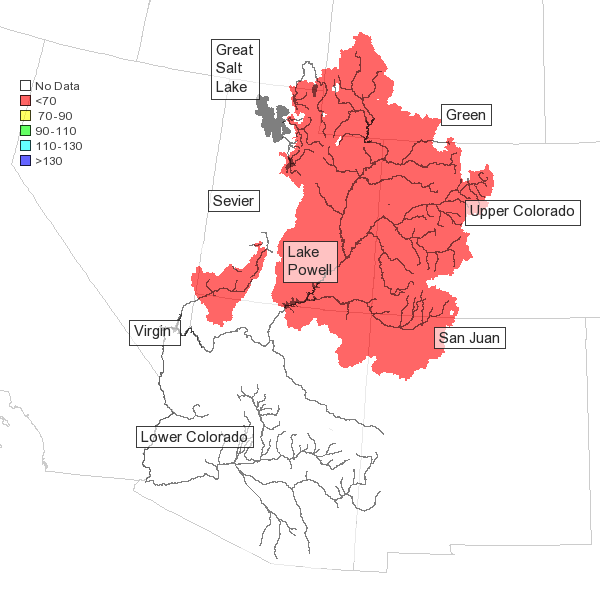
Barry Nelson had an insightful post today comparing and contrasting the Colorado River and the Sacramento-San Joaquin Bay Delta systems. There are important similarities – crashing (or crashed) ecosystems and water supplies for human systems that are stretched beyond the point of sustainability. But the institutional frameworks for addressing those problems and the prospect of solutions arising from those frameworks are very different.
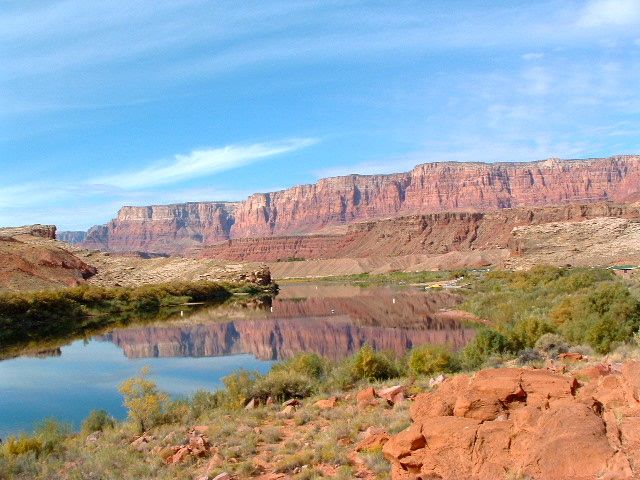
Lee's Ferry, 2005

Lee's Ferry, 2005

Oddly, as Nelson lays this out (and I agree), California in some sense has more institutional momentum behind grappling with core questions in the delta than one sees on the Colorado River. Yet I would argue (and this is me, not Nelson) that the chances of solving the Colorado River’s problems are much more realistic than the Delta.

On the Delta, Nelson points out via the recent Delta Vision report card that near term actions, things like levee upgrades, are stalling:

The Foundation also concluded that “the level of effort is impressive” on Bay-Delta issues. Why the apparent conflict between these two conclusions? In short, the Foundation concluded that there is a tremendous current investment in efforts to develop long-term solutions through the BDCP and Delta Plan programs, but that short-term actions like improving Delta levees and beginning ecosystem restoration are proceeding far more slowly than is needed.

I’d argue that the level of accomplishment is not commensurate with the level of effort on the long term Delta solutions either.

Compare this now with the short term and long term situations on the Colorado. As Nelson points out, short term successes on the Colorado are substantial:

In recent years, a great deal of effort has gone into developing near-term water management solutions, in light of the decade-long drought on the Colorado. Among these near-term solutions are water banking agreements between Nevada and Arizona and the Bureau of Reclamation’s interim guidelines regarding the allocation of shortages in the Lower Basin.

But what about the long term on the Colorado? Nelson:

The Bureau of Reclamation’s Colorado River Basin Supply and Demand Study is putting the long-term challenges in sharp focus. The Bureau’s conservative interim conclusions paint a stark picture of the challenges that would result from a status quo approach in light of the likely impacts of climate change on the available water supply in the basin.

The problem, as Nelson notes, is the lack of a framework for dealing with the grim numbers coming out of the Basin Study:

What I find interesting is that there is no well-established forum to address the Bureau’s findings that includes federal agencies, as well as all of the Basin states, water agencies and stakeholders. In short, there isn’t a well-established and comprehensive Basin-wide forum to pick up the ball from the Bureau’s Basin Study. Given the size of the basin, the diversity of the players and the scale of the challenge, such a forum is likely to be critical to developing and implementing a sufficiently ambitious long-term plan.

Shorter Nelson: Delta – big institutional framework, lack of progress. Colorado River – progress, but not much framework.

This is the same issue lingering behind Carpe Diem West’s Governing Like a River Basin report. As I wrote then, there are a variety of possible governance frameworks that might be used to begin tackling the big picture Colorado River problems…

But what remains … is the meta-process question. By what process involving the existing institutions we’ve got will some sort of solutions-oriented new process arise?

I actually am more optimistic about such a meta-process arising organically than I was when I wrote the above sentences back in December. I’m sure that some sort of uber-process-framework creation, along the lines of BDCP in California, won’t work. But Nelson noted something important regarding Colorado River processes:

I was … struck at a recent Colorado River conference by the commitment among agencies and stakeholders to develop workable interim solutions and to develop relationships that set the stage for more far-reaching long-term efforts.

I see that too on the Colorado. On the Delta, not so much. That’s the key difference.


Stuff I wrote elsewhere: climate change and megafires

With the Whitewater-Baldy fire pushing 260,000 acres (New Mexico’s largest by a wide margin), I spent some time talking with the forest-climate community about climate change, forest health and the role of natural variability in creating the conditions for the southwest’s recent megafires:

Global warming is playing a role in the conditions in the Gila — “50-50 wouldn’t be a bad guess,” Betancourt told me last week — but the problem defies simplistic explanations. A big part of the warming is likely natural variability, driven by long-term natural ocean temperature patterns that influence continental weather, Betancourt said.

In addition to uncertainties in the climate attribution problem, Westerling pointed out that a century of human forest management has played a role in the recent fires, with grazing and fire suppression leading to woods choked with increasingly vulnerable fuel.

Sacramento Delta sinking faster than sea level is rising

The risk from sea level rise to California’s Sacramento-San Joaquin Delta system is frequently discussed. As sea level rises, the argument goes, the risk of failing levees increases. With a substantial share of California’s farmland and population depending on water supplies that flow through the delta, failed levees is an enormous risk. Levee failures, as the delta’s low-lying islands fill with water, would draw in sea water, saltying up the farm and municipal water systems that draw from the delta.

But a new paper from Benjamin Brooks of the University of Hawaii and colleagues adds a wrinkle. The land is sinking, Brooks argues, faster than sea level is rising. The team used space-based synthetic aperture radar (which goes by the name “InSAR”). This is not the well-known phenomenon of delta islands sinking as their peat soils is exposed to air and oxidizes:

Because the measurements are insensitive to subsidence associated with peat thickness variations over Delta-island length scales, it is most likely that InSAR rates reflect underlying Quaternary sedimentary column compaction.

This is the vast deposits of sediment below the peat layer, which built up since the end of the last ice age. Brooks et al. put the subsidence rate at 3 to 20 mm per year. The latest satellite estimates put global sea level rise at around 3 mm per year.

Inkstain Weather Central: a dry May

Let us stipulate that my home weather records are subject to what Tversky and Kahneman would likely call “the law of small numbers“. Which is to say that, when I tell you May is the driest month of the year around here, you should suspect my statistical reasoning. That said, it is factually correct to say that, in my backyard, over the 12 years I’ve been keeping data, May has been the driest month.

  • May – 0.22 inch (average 0.28)
  • water year to date (since Oct. 1) – 5.07 (average 4.58)