The Peripheral Canal vote, 30 years on

Here’s a cool map for folks thinking about California’s current discussions about building some sort of Peripheral Thingie to carry water around (through? beneath?) the Sacramento-San Joaquin Delta:

1982 Peripheral Canal vote

1982 Peripheral Canal vote, courtesy PPIC

That’s the vote thirty years ago on a ballot initiative asking voters whether the state might build a Peripheral Canal to do the same thing. The red bits show level of pissed-off-ness about the idea. The green bits show where people liked it.

In  governance terms, California’s always been an unwieldy beast – divided north-south, divided urban-rural, divided in some sense east-west (coastal-inland?).

Map courtesy PPIC. (pdf) Nice interactive web version of the map here.


On dams, pipes, and western water

When I interviewed Mike Connor, the Bureau of Reclamation’s then-newly minted commissioner, back in 2009, one of his central points was that the era of American dam building was behind us:

Michael Connor, the New Mexican who took over as head of the U.S. Bureau of Reclamation three months ago, inherited an empire.

It is an empire built by predecessors like the famed dam builder Floyd Dominy, the man who built Glen Canyon Dam.

But when Connor went back to reread Dominy’s story recently in preparation for a talk, he realized how different things are today.

More than perhaps any other government agency, Reclamation shaped the West. The great dam builder of the 20th century, it is the agency behind Hoover and Glen Canyon dams.

Those days are gone, Connor said in a recent interview. “There was a lot of good,” he said, “and there was a lot of bad.”

This has become a truism, but Barry Nelson (NRDC) and Denise Fort (University of New Mexico), have a new report pondering a followup question that had me smacking my forward because it, in retrospect, seems so obvious. But I’d never quite framed it this way. Are we entering the era of pipe-building instead? Because while there are no more major dam-building projects on the drawing boards, there are a tremendous number of projects in the west aimed at piping large quantities of water hither and yon. From Barry’s blog post on the report:

Today, increasingly, water engineers are proposing to build new pipelines crisscrossing the West, mostly without the storage projects associated with past water projects. (Only three of the projects we examined propose new reservoirs.) This raises a simple question: where will the water come from to fill these new pipelines? In many cases, the answer is far from clear.

From a journalistic perspective, this report highlights a problem with the fact that, while we’ve got reporters at regional papers covering all of this on a project-by-project basis for their local communities, no one’s really looking at the whole thing. That makes this report a useful contribution.

The fascinating full report is here.

 

Clickwhoring the monsoon

Over at the work blog, I’ve been having fun with the onset of the North American Monsoon (or lack thereof).

My smartypants idea Tuesday, to crowdsource the problem of predicting the onset of our summer rains, turned out in retrospect to be lousy. I made a spreadsheet and everything. So far just four entires, what the crowdsourcing community would call “a thin market”. But I did find that, while few people wanted to play my silly game, the newspaper’s drought-obsessed readers seem willing to click on anything with the word “monsoon” in the title. Given that a) I’m always obsessing about the monsoon this time of year anyway, and b) there is some sort of corporate monetary incentive for clicks, I’ve instituted a daily monsoon watch feature.

You get the idea. I can keep this up through September. My fascination with the monsoon is indefatigable.

Edwards Aquifer and the hole in my argument

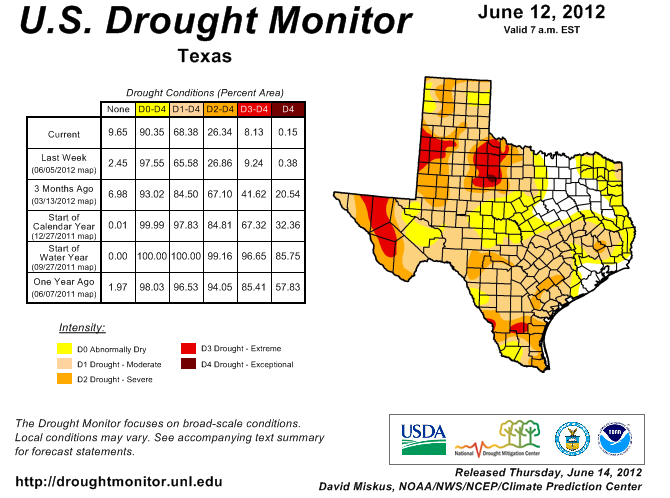
I’ve been using Texas and the drought of 2011 as an argument for optimism about US water management:

I’d argue the Texas experience shows that, when communities are really up against it, they’ve demonstrated the ability to do a far better job at managing scarce water.

But there’s a huge hole in my argument. What if communities that are “really up against it” simply delay the inevitability of their water problems by overpumping aquifers?

Water levels are falling rapidly in the Edwards Aquifer in San Antonio, the primary source of water for municipal users in the region. In just two weeks, the levels have dropped 5 feet, and are projected to drop further. Victor Murphy, the Climate Program Manager for the National Weather Service Southern Region, says there’s even more cause for concern than last year.


Stuff I wrote elsewhere: forecasting is hard, especially about the monsoon

In the morning paper, I pine over our elusive monsoon forecast:

I know this is the time you would really like a forecast. You would really like to know when New Mexico’s summer rains will finally get here, and whether we will have a wet monsoon season.

Sorry. Can’t help. Believe me, I’d like to. We are so far into drought debt that it will take an extra-wet monsoon to get us out, but the forecasters just don’t have much to say about what we can expect.

update: I realized after seeing the tweetage that my blog excerpt here left out the best bit:

What scientists are finding as they study the monsoon, Gutzler said, is that the forecast problem is tough to crack. “More understanding,” he said, “leads to a deeper appreciation of uncertainty.”

Stuff I wrote elsewhere: ABQ water infrastructure

On Albuquerque’s appearance in the “our pipes are getting old!” discussion:

Albuquerque’s water and sewer utility, facing hundreds of millions of dollars in costs over the next decade to replace aging pipes and treatment plants, is considering a series of rate increases in the next five years.

When the last of the proposed rate hikes takes effect, the average residential customer’s bill would rise to $54 per month, up from $45 today, according to Mark Sanchez, executive director of the Albuquerque Bernalillo County Water Utility Authority – an additional $108 per year for the average customer by 2017.

More than 400 miles of metro area water and sewer pipe are at high risk of failure, according to a study done for the water utility and the backlog of aging pipes that need replacement is growing because of inadequate funding.

On the relative change between the level of ocean and land in the Sacramento Delta

When I posted a couple of weeks back on the fact that land in the Sacramento-San Joaquin Delta is subsiding faster than sea level is rising, a smart reader asked privately, “Yeah, so what’s the point?”

My reader’s observation was, in essence, that it doesn’t really matter much in terms of policy response whether the ocean is rising or the land is sinking. And that was precisely the obscure point about which I was thinking, but about which I wrote poorly.

Consider what happened in North Carolina when a panel of scientists prepared a report for the state looking at the best available science on sea level rise:

The final recommendation was for the state to plan for 39 inches of sea level rise. This number corresponds well with expert reports produced in other states.

And the response?

NC-20, a group purporting to represent North Carolina’s coastal counties, attacked both the integrity of the science panel members and the body of sea level rise literature that was reviewed. The rebuttal consisted largely of oft-repeated arguments pulled from the climate skeptic blogosphere, along with an adamant assertion that predicting the future is impossible. To the great surprise of those of us on the state’s science panel, these tactics have worked.

To the extent that a change in the relative elevation of sea and land in California’s Delta poses a threat that requires a policy response (more robust levees, perhaps?), it doesn’t really matter whether the sea is rising or the land is falling. But to the extent that rising sea level is a driver, California runs the risk of a North Carolina problem, in which the policy discussion becomes mired in the identity politics of climate change.

Thank heavens we now know the land is sinking and we don’t have to fight that fight!

Sizing up Texas drought response

With Texas emerging from its record drought, it’s a good time to size up how the state’s water systems have responded.

The Texas Commission on Environmental Quality reports that just two small community water systems, Spicewood Beach and Florence – a total population of less than 3,000 people – are in danger of running out of water now. This supports the argument I’ve been making – that Texas communities have made the necessary adjustments during the drought of record.

Kate Galbraith at the Texas Tribune has taken a much more detailed look at the issue, and her excellent stories provide substantial support for my argument. In case after case, Texas communities have shown the ability to manage their water supplies far better: Consider:

The final story in Galbraith’s series – On Water Conservation, Texas Has Room to Improve – suggests a bit of  a mixed bag, showing the resistance some conservation efforts have met. But given the rest of her findings, I think I’d argue the Texas experience shows that, when communities are really up against it, they’ve demonstrated the ability to do a far better job at managing scarce water. As I’ve said before, it would be nice if we had the foresight to manage our water well before the shit hits the fan. But maybe that’s unrealistic. Maybe the best we can hope for is effective water management once the crisis is upon us.

“sewage epidemiology”

The residents of Lubbock use more cocaine on the weekend. How do we know this? Science!

Influent to the Lubbock (Texas) Water Reclamation Plant was sampled twice a week to assess weekly variations in estimates of cocaine consumption over a 5-month period. BE was extracted from influent wastewater samples using solid phase extraction and analyzed using gas chromatography/mass spectrometry. Measured concentrations of BE were converted to cocaine equivalents; the estimated average daily consumption of cocaine during the study period was 1152 ± 147 g. Based on BE concentrations and sewage epidemiology, higher cocaine consumption was observed on weekends compared to weekdays (p < 0.0003). This method was effective in monitoring BE in wastewater and could be used to complement survey data in estimating cocaine use at a local level.