More reason to hate the Canadians

Canada’s always, frankly, seemed to have a sort of politely understated superiority to the United States. Consider their health care system, for example, and sweaters.

Now comes news that they’re also measurably better than us when it comes to managing their water:

“One-half of Canadians (51%) limit their shower time to eight minutes or less, while fewer than one-in-three Americans (32%) do so.”

They’re more likely to fix leaks and water in the evening rather than during the day, when evaporation is higher.

Also, hockey.

The importance of Albuquerque’s water conservation efforts

I had a story in the morning paper on Albuquerque’s success in reducing per capita water consumption below 150 gallons per person per day, a 40 percent drop from 1994, when our odyssey from water profligacy began. Here’s the bit I slipped in that shows the regional importance:

Albuquerque’s reduced usage is a demonstration that, despite the dry climate and dwindling water supplies, it is possible for cities in the western United States to learn to live within their means, said Michael Cohen, a water policy analyst with the Pacific Institute, a California-based think tank.

“Continued reductions are still possible and achievable,” said Cohen. “At some point there’s a wall, but I think we’re a long way from that.”

By comparison, Santa Fe has reduced its usage to 106 gallons per person per day, according to water conservation officer Dan Ransom.

Stuff I wrote elsewhere: “Lake” Arthur

From the morning paper, the story of Lake Arthur, the pond in the middle of Estancia, a rural New Mexico town that won’t give up on its public water:

The natural flow in the spring feeding Lake Arthur stopped long ago, said 51-year-old Daniel Chavez, Estancia public works director and proud native son.

By the fire station, up a low hill from Lake Arthur, Chavez pointed to the big metal lid over the first well, drilled 170 feet down to pump water up to the spring once it stopped flowing on its own.

When that well failed, they drilled another back in 2004. Just to be safe, they ran it down 400 feet into the groundwater that is the lifeblood of the Estancia Basin. And where the spring once flowed on its own, they now pump 50 gallons a minute, up to a fountain, then down through a little artificial stream to lovely Lake Arthur.

Where the stream enters the lake, Chavez and his colleagues built a lovely little bridge, already a popular spot for weddings.

The tale of Lake Arthur is a story you hear a lot out in the Estancia Basin — where springs once flowed, now we pump. And in most places, the water table keeps dropping.

How Django Reinhardt survived the Nazis – the most interesting thing I read today

From Sociological Images, how Django Reinhardt survived the Nazi effort to exterminate the Roma by playing jazz:

Reinhardt, then, survived because the Nazis loved jazz music, even as Hitler censored the music and, on his orders, people who dared to listen to, dance to, or play it were encamped and members of the groups who invented it were murdered. Irony indeed.

Moorten’s

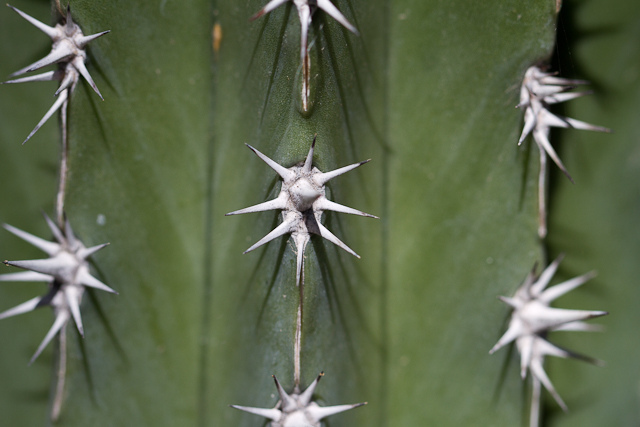
Thorns, Moorten's, March 2012

Thorns, Moorten's, March 2012, by Lissa Heineman

My favorite stop on our California desert vacation was the strange and wonderful little Moorten Botanical Garden “in the heart of Palm Springs”. Between the golf courses and the ill-advised decision to try to coax palm trees out of their desert oasis canyons (they take a lot of water – per capita use here is 540 gallons per person per day), Palm Springs has some problems. But Moorten’s left me willing to forgive a great deal.

It’s probably less than an acre spread out around the old Moorten family house, and since the 1930s Chester “Cactus Slim” Moorten, his wife, Patricia Moorten, and their heirs have offered up a delightful three quarters of an acre of cactus and desert plants, for a small fee that is very much worth it.

Lissa’s late sister Ginnie, who lived up the road in Morongo Valley, first took L to Moorten’s some years ago, but I’d never been. We love cactus, so when we were plotting out our journey around the Salton Sea and nearby points, Lissa added Moorten’s to the itinerary.

A maze-like path winds through the tiny property, hand-lettered signs tell you what you’re looking at, and if you’re there at the right time of year, a Costa’s hummingbird sits on the postcard rack, right above a postcard of a hummingbird. Really.

Full slide show of L’s Moorten’s pictures is here.

Living without water

One of the reasons I’m more optimistic than many about our ability in the western United States to cope with our looming water shortages is the evidence of our ability, when we’re really faced with shortage, to adapt to using far less. (That was the core argument behind my piece last year for Stanford’s Lane Center.) There was a nice piece by Michelle Barker in the Globe and Mail last week that illustrates what I’m talking about. Faced with a broken water system in her home, Barker quickly learned to do with a lot less:

People in Canada do not sing the praises of indoor plumbing anywhere near as loudly and fervently as they should. Living without it all of a sudden is a little like breaking your collarbone – you know in theory that the bone is important, but you don’t understand how much you rely on it for almost every physical movement until you can’t use it any more.

Try living without running water, even for just one day. Forget your morning shower. Forget flushing your toilet, brushing your teeth, making coffee, cleaning clothes or dishes. Washing your hands. Watering your plants. Rinsing your vegetables. To say nothing of drinking a glass of the stuff. You don’t realize how often you reach for that tap until it stops working.

Barker’s piece is a plea to think about such issues before the shortage hits:

We waste water. We pollute it. Climate change is already having an effect on how much water we will have access to in the future. And Canada is a water-rich country. Many other places in the world are already suffering what we cannot yet envision.

Everyone knows this. We’ve all heard it a thousand times. Yet still we water our lawns and wash our cars obsessively. You cannot appreciate the gift of running water until you experience what your life is like without it.

It would be nice if we gave up on our lawns and car washing before the balloon goes up. But I’m confident that when we’re faced with the alternatives, we’ll be willing to give them up when we have to.

The last concrete?

Is the age of big concrete – the dams to store western water and the canals and pipes to move it – really over? Are the projects now underway – perhaps the Southern Nevada Water Authority’s “third straw” into Lake Mead – the last we’ll ever see built?  (I’m working on a piece that in part will explore this issue. See my questions at the bottom.)
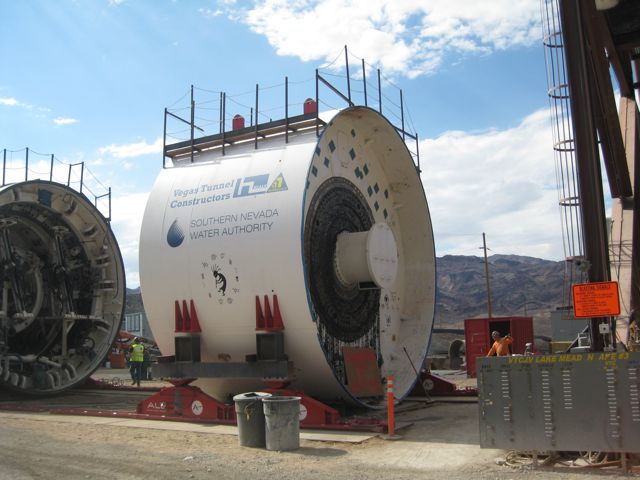
tunnel boring machine, Southern Nevada Water Authority third intake

tunnel boring machine, Southern Nevada Water Authority, photo by John Fleck

Three things I’ve read recently have me thinking about this, and I’m looking for some feedback from the smart water wonks in the audience.

The first is a most intriguing essay by Patrick Wilson (pdf here) about the way the existence of big concrete has shaped our western water institutions.

The second is Jay Lund’s analysis of the Bureau of Reclamation’s study of the economics of the $1.1 billion raising of Shasta Dam in California:

This expansion produces an additional 76,000 acre-ft of firm yield (dry year deliveries). This is less than 0.2% of agricultural and urban water use in California. (Modern water engineers will wonder why the antiquated firm yield is still the main water supply indicator.) Average annual deliveries increase by only 63,000 acre-ft. Other traditional benefits (hydropower, recreation, flood reduction) were small.

That’s some mighty expensive water.

The third is Jeffrey Michael’s observations on the latest round of Bay-Delta Conservation Plan analyses:

Given that the incremental water supply being discussed by the conveyance is 0.3 maf to 1.5 maf requested by the water contractors. That comes out to between $3600 and $730 per acre foot of new supply – not counting operations costs – just to get the new water to the Tracy pumps. Add a few hundred dollars more for operating costs and pumping to Los Angeles.

That’s some mighty expensive water.

Big concrete has always meant expensive water, most often subsidized by general taxpayers (mostly federal, but sometimes state as well), but it’s increasingly looking to me like the next marginal increments of water are getting so expensive that these things are going to collapse under the weight of their astronomical costs. I’d be a sucker to bet that the Peripheral Thingie will never be built (I made a bet like that once – never’s tough to collect on), but that’s what I think.

Here’s my quick list of other suggested/proposed/contemplated projects in the western United States subject to this argument:

Question 1 is what else should be on this list? And am I right that these projects are just too expensive to build? Which of the current round of big concrete proposals has the best chance of really being built?

Question 2: If we really are at the end of concrete, what should I call the last project? My vote goes for Vegas’ third straw. But Animas-La Plata has some standing here too. What else is underway now that should be on a list of the West’s last big water projects?
 

That lone Republican vote against HR1837

While I was away last week, the House passed HR1837, the California Water’s Fer Fightin’ Over Act of 2012 (pdf).

The vote was largely along party lines, with only one Republican voting against the bill. Who was that lone R dissenter? Justin Amash, a 31-year-old Michigan legislator ranked by the Club for Growth as the most conservative member of the US House. Why did he oppose HR1837? From his Facebook page (where this guy seems to explain every one of his votes):

The bill accomplishes many policy goals I support: It reduces the impact of a federal regulation that requires the diversion of California’s water to wildlife protection; it requires a federal fund to be more transparent in the way it spends water users’ money; and it allows water users to purchase longer-term contracts, which could enable California farmland to be more productive.

Unfortunately, the bill preempts (overturns) state water laws. Those laws were enacted by Californians to govern water that originates in California, that is for the use of Californians, and most of which flows through a water system California built and operates. The Constitution does not give the federal government the power to overturn those laws, regardless of whether I as a federal Representative think those laws have or don’t have merit. I voted “no.”


Snowbirds

snowbirds

snowbirds, photo by L. Heineman

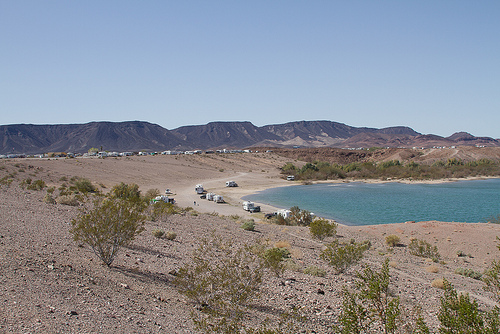
During our just-completed trip across the deserts of southern Arizona and southeastern California, the persistence of the snowbirds was one of the most striking features. I’d noticed them when I was down in Yuma in April 2010, but that was late in the season. Late February-early March is earlier, and they were everywhere. Canadian license plates were the most common, but they were from the full range of northern cold places, south for warmer climates just like the migrating birds after which they’re named.

Lissa took this picture at one of the BLM “camping” areas along the Colorado River just upstream from Imperial Dam. It’s just a tiny snapshot, but it gives you a flavor of the way they spread out into the desert. This is an example of the formal government-sanctioned campground version, which seems to really just create large parking areas with vague scenic value. There were also huge commercial ventures, especially among the tribes on the lower river. And then there were the squatters, people who just seem to pull their big expensive RVs off into the desert wherever they want.

I found a reference to a study that put the number in Arizona a decade ago at 300,000.

Moon cake

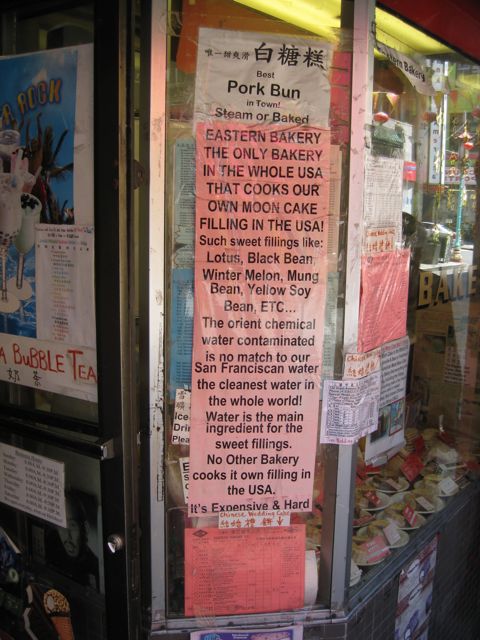
Two of Inkstain’s bedrock principles involve 1) correcting errors of fact quickly, and 2) re-running, as often as possible, the “best pork buns in town Hetch Hetchy” picture I took in San Francisco’s Chinatown last year.

This one’s a twofer.

In the aforementioned “Hetch Hetchy – Best Pork Bun in Town” post, I incorrectly argued that Eastern Bakery’s pork buns depended, per the store’s advertisement, on that sweet, sweet Hetch Hetchy water. As Matt correctly pointed out today in the comments on that post, it is in fact the bakery’s moon cake fillings that would be ever so inferior were it not for Hetch Hetchy’s bounty.

best pork buns, also moon cake filling

"Water is the main ingredient for the sweet fillings. No Other Bakery cooks it own filling in the USA. It’s Expensive & Hard"

I stand corrected.