You mean we have to pay for our own water?

It’s easy to blame climate change when you’re in DC begging for money to subsidize your water problems. OK, maybe not easy, on account of DC not believing in climate change and stuff. Also not having any money even if it did.

But the dynamic in this Steve Tetreault story as Pat Mulroy visits our nation’s capital hat in hand is fascinating.

I’m not sure if the LVRJ has called off their copyright attack dogs yet, so I won’t blockquote the key passages. Go read it and come back. (Can I link without getting sued? Hope so.)

Basically, Mulroy, head of the Southern Nevada Water Authority, was in DC arguing that a changing climate has hammered Las Vegas’s water supply such that the rapidly growing southwestern city (at least it was rapidly growing until recently) needs the feds to chip in to somehow help fund the “third straw” intake to ensure continued supplies to Vegas even as Lake Mead drops.

Here’s the problem, which I’ve argued until I’m blue in the face. During the great drought of the ’00s, as Lake Mead dropped and Vegas stared a catastrophe in the face, the great reservoir continued to get its entire legally mandated allotment. The drought cut into surpluses that Vegas and other Lower Basin water uses have come to depend on. But over the decade of drought, the river never missed a payment to Lake Mead. It did this in two ways – because upper basin states aren’t using their full allotments, and because Lake Powell, upstream, was relatively full when the whole mess started. Vegas and the other downstream users survived on bonus water that they can’t count on in the long run.

So sure, blame climate change on the supply side if you want. But there’s a demand side issue here too.
Prediction: Science won’t settle Cadiz

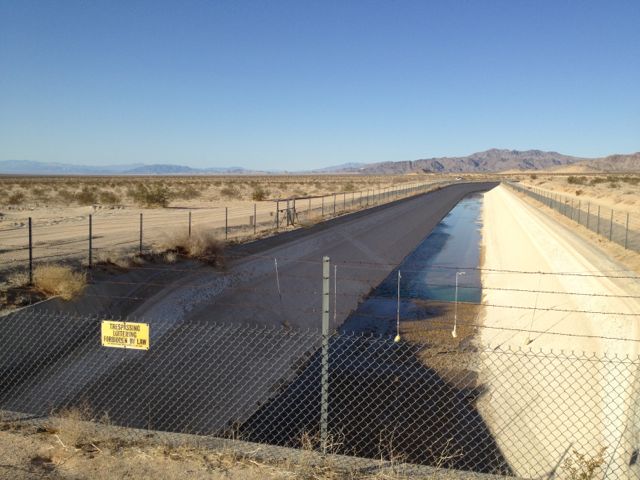
Colorado River Aqueduct, looking north into the Cadiz Valley in the Mojave Desert of southeastern California, March 2012

Colorado River Aqueduct, looking north into the Cadiz Valley in the Mojave Desert of southeastern California, March 2012 photo by John Fleck

I have a prediction: clarifying the science will not settle the political argument over the proposed Cadiz water project in the deserts of California.

Chris Clarke wrote this today about Cadiz, a proposal to pump water from beneath the Mojave Desert and pipe it to coastal Southern California cities:

According to an independent hydrologists’ evaluation of the proposed Cadiz Valley water project, project backers used flawed models and incomplete data to forecast the amount of water they could pump out of a desiccated valley in the Mojave Desert.

To which public relations consultant Laer Pearce, who has been flacking for the project, had this to say (scroll down to the comments on Chris’s post):

It is incorrect and misleading to your readers to refer to this new study’s authors as “independent.” They were hired and paid by the National Parks Conservation Association, a longtime opponent of the Cadiz water project and an advocacy group dedicated to resisting commercial enterprises in and around national parks. It is based in Washington, D.C. and has annual revenues of $61 million.

In contrast to the modeling done by the Association’s hydrologists, the studies undertaken by Cadiz are more comprehensive and, most importantly, have been peer reviewed by some of the nation’s leading hydrology experts who serve on the Groundwater Stewardship Committee. This committee will continue to monitor the aquifer as the project progresses to ensure that there are no impacts to the environment.

Which is richly ironic – to accuse project opponents’ scientists of having a lack of independence while citing the work of scientists hired by the project’s supporters. No doubt Pearce is paid to say things like that with a straight face.

Full disclosure: I’ve avoided writing about Cadiz because I haven’t had the time to do the necessary journalistic due diligence on the technical questions involved. If I had time, I would, but I’m not sure it matters, because it’s clear that this is shaping up as a case study in what John Bass recently called “design and the problem of ‘contradictory uncertainties’“. John invokes the work of political scientist Dan Sarewitz (which in meta fashion I pushed on him) regarding the way science does not settle political controversies. John here is writing about the Sacramento-San Joaquin Delta, but his argument applies, I think, with a few tweaks, to Cadiz:

My money is on a stalemated, status quo Groundhog Day future, until there is a shift in consciousness and consensus (either rightward or leftward) similar to the one that led to the great environmental movement of the late 1960’s. If that consciousness shifts right, then property rights and Randian selfishness ideology will have won out. If the shift is to the left, toward environmental justice and a willing footing of the bill for remediative machines and regimens, then our evolution will have continued.

The “stalemate” part may apply more effectively to the Delta than Cadiz. But it’s clear that, like in the Delta, science won’t settle this. Values will.


Stuff I wrote elsewhere: on our ability to cope with reduced water supply

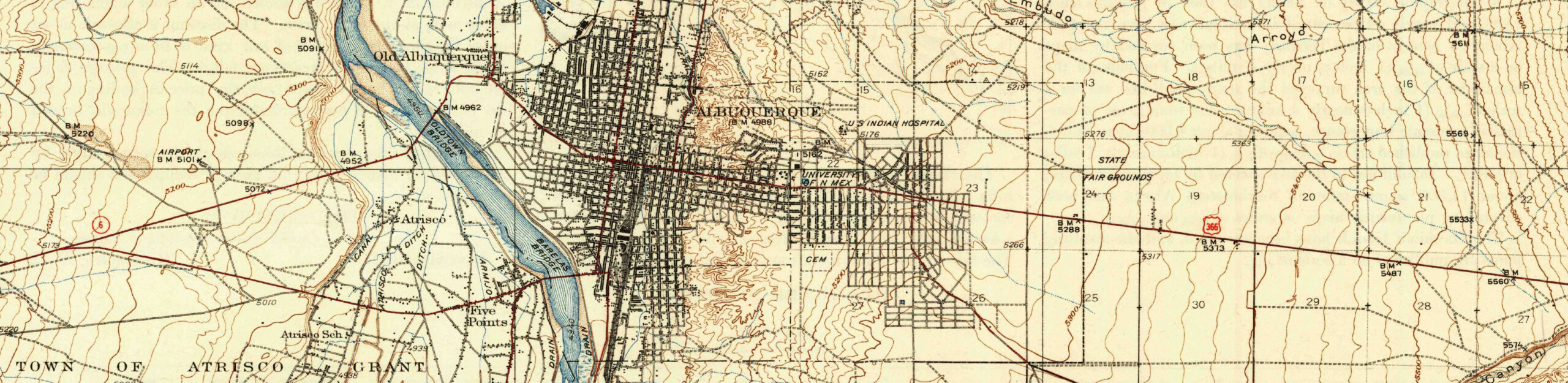
My whole “what’s all the fuss? we can cope with far less water than we’re now using” agenda is on display in this screed in the morning newspaper about the implications of Albuquerque’s drop from 252 gallons per person per day a decade-and-a-half ago to 150 today:

There are, I think, two key messages to take from the remarkable Albuquerque numbers.

The first is how much water conservation is possible in modern America. We’re not all as bad as Palm Springs. But when Albuquerque in the 1990s came to grips with the fact that our groundwater use was unsustainable, we found that with relatively little community pain, we were able to reduce our water usage. Even as the population has grown in the nearly two decades since, our total usage has dropped.

This has been repeated across the western United States….

There is a common theme in discussions of water and cities in the arid West – the analogy to past cultures that have abandoned the place, done in by drought and a lack of awareness of the realities of living in an arid land. The story of Albuquerque and other places like it is that when modern cities are faced with water problems, we are capable of using a lot less. Given the alternative of abandoning the place, I’m confident the folks in Palm Springs will quite easily figure out how to get their numbers down from 540 gallons per person per day. I confess to loving those palm trees too, but I’m guessing they could adjust to having a lot fewer of them.

The second message in Albuquerque’s numbers is that we’re nowhere near the bottom.


Last concrete diaries: someone has to pay for it

The water model in the western United States has generally involved Party A getting a bunch of water via a dam, canal, pipe, etc., while Party B (usually some broad group of taxpayers, either state or federal) pays for it. Economists will tell you that this tends to lead for building more giant concrete thingies than would otherwise be found to be economically optimal. But whatever, I like living here.

The current discussions over California’s Bay Delta Conservation Plan have a new sort of earnestness of late, as a realization among water users sinks in – OMG, we’re going to have to pay for our water ourselves? Wyatt Buchanan did a great job with this theme yesterday in the San Francisco Chronicle:

[W]hile urban users may be able to afford the yet to be determined price increases, agricultural water users may not. The price of water could more than double for farmers, though it is too soon to know how high the increase would go, said Tom Birmingham, general manager of the Westlands Water District, which covers 600,000 acres serving about 600 farms.

“There is a breaking point at which the project is no longer feasible,” Birmingham said. “It’s a significant concern,” though he said officials can’t evaluate the cost effectiveness until the outstanding questions are resolved.

MWD decides to sit out HR1837

In a puzzling decision, the board of the Metropolitan Water District of Southern California seems to have overridden a board committee and the board’s staff and decided to sit out the argument over HR1837, Rep. Devin Nunes’ legislation to revamp California water distribution. If you’re not into the arcana of California water wars policy discussions, you can skip this post.

Continue reading ‘MWD decides to sit out HR1837’ »

The power of Snopes. Or not.

I’ve always thought Snopes, the debunking site run by Barbara and David Mikkelson, is a treasure. Fighting the good fight and all.

Kinda sad, then, but not surprising, to read this:

When reporters interview us about our work, they often ask us to comment on the notion that we’re engaged in a great public service, making the world a better place by “striking a blow for the truth” and stamping out rumor and misinformation by replacing them with facts. Those reporters usually seem to be taken aback or disappointed when I tell them that I don’t really believe our site makes much of a difference in the greater scheme of things; that the responses we get tend to indicate a good many people are determined to believe whatever they want to believe, and no collection of contradictory factual information, no matter how large or authoritative or impressive it might be, is ever going to dissuade them from their beliefs.

Tree rings tale of Atlanta’s mistake

Neal Neil Pederson and colleagues have a new paper (pdf) using tree rings to reconstruct flows in the Apalachicola–Chattahoochee–Flint that offer another stark reminder of a classic water management dilemma: make water management decisions during a wet time and you’ll be screwed by the regression to the mean.

We’ve seen this story before, with the Colorado River’s allocation, made during the unusually wet 1920s. The new tree ring work on the ACF basin shows a remarkably similar story, according to Pederson et al:

Our results indicate that the era in which local and state water supply decisions were developed and the period of instrumental data upon which it is based are amongst the wettest since at least 1665. Given continued growth and subsequent industrial, agricultural and metropolitan demand throughout the southeast, insights from paleohydroclimate records suggest that the threat of water-related con?ict in the region has potential to grow more intense in the decades to come.

As always, my book has lots more on tree rings.

(updated to correct spelling of Pederson’s name)

Another New West real estate metric: dog pee

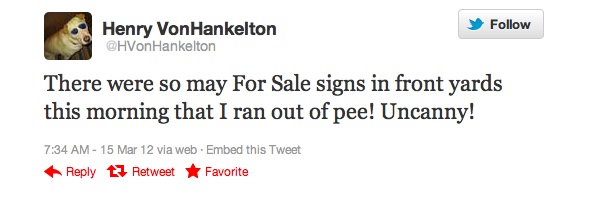
My interest in water lured me into an interest in real estate, because of the way the West’s housing boom ramped up the demand for water, and the way the bust has scrambled the equation. So I’m looking for new ways of measuring the housing market’s recovery. I’m still scratching my head about this one, from Henry VonHankelton, a dog I follow on twitter*:

can dog pee help us measure the housing recovery?

can dog pee help us measure the housing recovery?

Yes, on the Internet we now know you’re a dog.

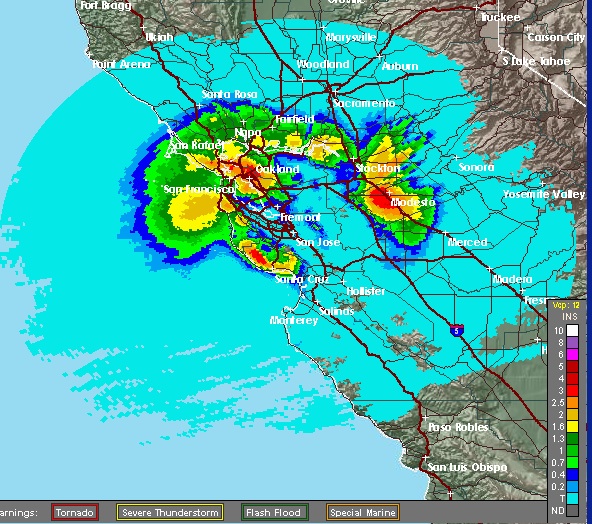
Atmospheric rivers, in real time

California radar storm estimate, evening 3/14/2012

California radar storm estimate, evening 3/14/2012

As I write this, California’s being pounded by a particularly impressive storm.

According to Mike Dettinger, it’s an “atmospheric river” storm, one of the type he and other climate/water researchers have been studying increasingly closely because of their importance to California’s water supply. As I wrote last year, California has the most highly variable precipitation in the country (as measured with the standard deviation divided by the mean), with annual water supply strongly influence by the presence or absence of a handful of these AR storms. From a paper last year by Dettinger et al:

If just a couple of storms do not arrive in California, or yield significantly less precipitation than needed, in a given year, that year’s precipitation total and water resources suffer disproportionately, compared to other regions. Alternatively a relatively few large or “extra” storms may result in a particularly wet year.

This year, we seem to be having a year that was extremely dry getting a last-minute reprieve by an AR blast.