On borrowing and the richness of language

One of the things I love about language is its staggering combinatorial possibilities. I revel in a Google game – picking a seemingly ordinary phrase and doing a search to see how many times it has appeared in the vast body of language indexed by the search engine. It is amazing how relatively few times even the most compact phrases have appeared.

It was with that in mind that I read Emily Green’s piece today in the Los Angeles Review of Books about the similarities between her epic Las Vegas Sun series Quenching Las Vegas’ Thirst and the discussion of Vegas water in Alex Prud’homme’s The Ripple Effect. Emily quotes two passages, first hers and then Prud’homme’s.

Green:

Las Vegas lies at the intersection of three deserts. To the west is the Mojave, to the south the Sonoran, and to the north the Great Basin.

Prud’homme:

Las Vegas sits at the intersection of three deserts. To the south is the Sonoran, to the west is the Mojave, and to the north lies the Great Basin.

Savor that simple four-word phrase: “intersection of three deserts”. In the entire corpus indexed by Google, that phrase appears to have been written only three times – once by the Australian Wildlife Conservancy to describe three Australian deserts, once in 2008 by Emily Green to describe Las Vegas, and once by Alex Prud’homme in his new book – also to describe Las Vegas.

Sadly for Emily, Prud’homme’s book is the first Google hit.
Stuff I wrote elsewhere: water policy and the endangered species act

New Mexico’s in the midst of a tense and interesting discussion about the Rio Grande silvery minnow, the Endangered Species Act and managing the Rio Grande. I’ve got a post up over at the work blog going meta on the underlying issues – why I think ESA discussions have become our proxy discussions for big water policy issues (sub/ad req):

Why is this such a big deal? Hint: It’s not really about a fish. Or, more precisely, it’s about much more than a fish. If you believe those who argue that we’re overusing water in the Middle Rio Grande Valley and headed for a crash, it’s likely that the problem will first show up in the river itself, as we take out too much surface and groundwater and leave the Rio Grande dry. The first specific legal/regulatory manifestation of that problem will be a lack of water to meet Endangered Species Act requirements for the Rio Grande silver minnow. The minnow has been described as a “canary in a coal mine” for a crashing ecosystem. But it’s also a canary for our water supply problems. So we see here a jockeying over the question of who’s responsible for the problems of the fish that mirrors broader jockeying over who’s responsible for the region’s water problems.

I’ve thought this for a while, but the work I’ve been doing on Sacramento-San Joaquin Delta issues has really helped clarify my thinking by giving me a second case study where the issues are playing out in much the same way.

But are there other case studies of water policy/ESA management on western rivers where it’s not playing out this way? What are the counter examples?

The case for calling it a “Peripheral Thingie”

John Bass today argues for clarity in our use of language when talking about a water conveyance around the Sacramento-San Joaquin Delta:

Could I ask that Dan Bacher and those he quotes use the term “canal” when referring to a canal to take water around the Delta, the term “tunnel” for the other option under discussion, and canal/tunnel when referring to both?

I ask because there are important differences in the potential effects of a canal or a tunnel on the Delta’s environmental and social health (to keep it tight), and elisions that blur these distinctions make everyone that much less informed.

Might I humbly suggest that “canal/tunnel” is clumsy, and that a “peripheral thingie” might be just the linguistic solution needed?

Stuff I Wrote Elsewhere: Bonus Water on the Colorado

Over at the Lane Center, a look at what the extra water on the Colorado River means:

While Colorado Basin water users had survived 11 years of drought without suffering shortages, simply by draining their two big reservoirs, US Bureau of Reclamation calculations raised the clear possibility that by next year, the first ever shortage declaration on the river would be needed, forcing Nevada and Arizona to cut back.

This year’s bounty has pushed that possibility off another three years at least.

Drought, outdoor landscaping, and the benefit of being a bit wasteful

Water conservation poses a dilemma.

Let’s say you’re an American city that’s running into a serious drought problem. I don’t know, say for example you’re Galveston, Texas:

Authorities have banned outdoor watering in most Galveston County municipalities as Texas continues to grapple with its record drought.

In a letter this week, the Texas Commission on Environmental Quality instructed municipalities that draw water from the Brazos River Basin to enforce stricter limits on outdoor water use. The Brazos River Basin supplies water to the Gulf Coast Water Authority, which serves the cities of Galveston, Texas City, League City, La Marque and Hitchcock.

This is good, right? Serious problem, tough response.

Now let’s suppose that our hypothetical Galveston had been really effective over the years in conserving water, switching to outdoor landscaping that only needs the rain that falls from the sky. Suddenly, when drought hits, the community no longer has the wiggle room left by profligate outdoor landscaping. They’ve got nothing left to cut.

So good for you, Galveston, for being so wasteful. That left you with an “out” this year!

Water in the desert, urban agriculture edition

Headed out on my bike ride this morning, I spotted our neighbor, Farmer John, in the front yard working on his food patch, and rolled up on the sidewalk to chat. It’s a lovely little garden – big robust tomatoes, some melons and a couple of rows of big, healthy-looking corn. Lissa and I have been enjoying watching it rise all spring and summer, watching John lovingly tending it. But when I stopped to talk this morning, John was perplexed.

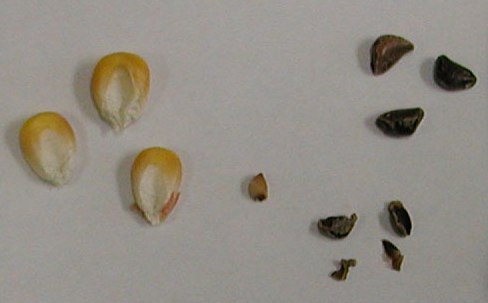
corn and teosinte

Corn and teosinte, its wild ancestor. Courtesy USDA

The corn stalks look great, with big tassels and leaves a sheen of green, but the ears just weren’t coming on very well. He pulled one off to show me, peeling back the husk to reveal a pretty anemic-looking ear of corn.

It’s a modern breed, sweet (he gave me a bite), but the kernels just weren’t developing the way he hoped. He thought maybe it wasn’t getting enough water, or maybe something wrong with the seeds he used. Hard to know.

We humans have been doing maize here for a long time. Old spindly dried remnants thousands of years old have been found in Tularosa Cave, for example. It’s interesting to think about what Farmer John’s frustration at a bad corn crop might have felt like back in the day, when it would have been his family’s primary source of food for the coming winter.