
Thinking about the big dry

It rained this afternoon at my house.
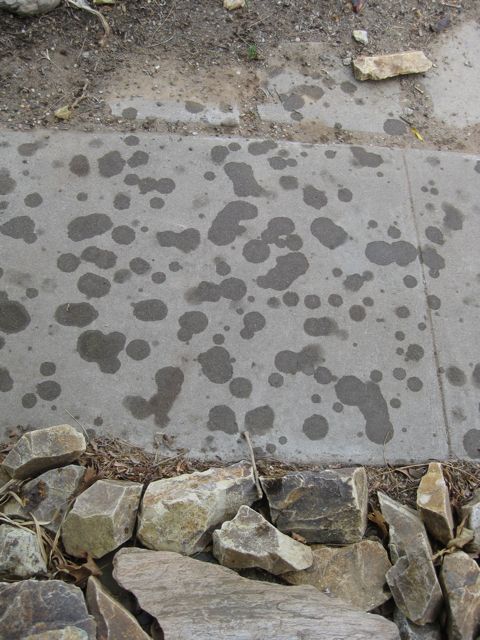
raindrops on my front walk, July 2, 2011

raindrops on my front walk, July 2, 2011

The physics of raindrops, I once learned, means that the largest raindrops falling out the bottom of a thunderhead hit first, and I was sitting in my office at the back of the house writing when I heard them banging onto the metal roof. I went out to the living room to make sure Lissa heard it, then walked out shirtless and barefoot and stood beneath it, flashing fingers to her in the front window as I counted off the raindrops hitting me. One. Two. ThreeFour. FiveSixSeven (two hands now).

I sat for a long time on the front porch watching and smelling – not enough for the cars going by to turn on their windshield wipers, but enough to wet the street so their tires sizzled.

I’ve been zigging and zagging this week, trying to get my head around things without precedent, either in personal experience or in the data we substitute when personal experience misleads, or is not enough.

To say it has been dry this year in New Mexico falls so short of the mark that I don’t know where to turn next. As a journalist I’m a bit of a technocrat, a collector of numbers and measurements. It’s usually a strength, but feels right now like a weakness. A week ago, I’d been planning a newspaper piece that tried to capture the Big Dry in numbers, using the completion of 2011’s first half-year as one of those calendrical milestones that give us an opportunity to take stock.

Then shit started burning, and the numbers used to measure this sort of thing veered off in weird directions – acres burned instead of acre feet of water, percentage forest fuel moisture instead of percentage precipitation. And lingering beneath it was this uncomfortable sense that, as a writer, I’ve got nuthin’ in the face of this truly remarkable phenomenon laid out before me.

precip at my house so far in 2011

precip at my house so far in 2011

I’ve got a shit ton of numbers, everywhere I turn. For grins, for example, the daily precip at my house since Jan. 1: Six days total, just two of them above 0.04 inches (0.1 cm), today the first measurable since May 20. Click to biggen it, look at the y axis. A measure of our pain.

Working the fire story, I heard some remarkable stories from folks I’ve known for years, forest ecosystem types who work in the Jemez, who measure it but also live in it. And it’s the living in it, in this big dry, that’s so remarkable, and for which words so completely fail me.

I can imagine someone has done science about this, made up one of those “just so stories” that evolutionary types so love about how humans evolved with an exquisite sensitivity to rain because our lives so depend on it. I can understand how we’d be wired by our ancestry to get tense at times like this.

It is frankly one of those “It is impossible to say just what I mean” moments. Suffice to say it’s been really, really dry here, and the joy I felt at the 0.01 inch of rain I measured in the backyard gauge is both genuine but also sadly telling.

“Dams move water in time”

Hey smart water tweeps, here’s a lazyweb question the Google has been unable to assist me with.

Somewhere, sometime, I heart a great truism from some smart water person whose name is lost to the mists:

Ditches (canals, etc.) move water in space. Dams move water in time.

Have you heard this before? Source?

Stuff I Wrote Elsewhere: Weather, Climate, Forest Management, Fire, Drought

Been a busy week (what with New Mexico burning down) with little to show for it other than an overactive Twitter feed, but I caught my breath this morning and threw together some thoughts on weather, climate, forest management, drought, and the unnerving fact that I had to cut my morning bike ride short because of the smoke. The state I live in and love is on fire:

As Los Alamos National Laboratory forest ecologist Nate McDowell told me yesterday with some understatement (from his evacuated safe haven of Santa Fe): “It’s a warm drought.”


Stuff I Wrote Elsewhere: the California-NM connection

From the morning paper, some thoughts (sub/ad req) from my recent trip on the west-wide linkages, and the institutional problems those linkages have created:

“We’ve got a system that is not sustainable,” said Curt Schmutte, Met’s top official working on the Delta problem.

Given the political rancor that surrounds California’s Delta discussions, it is unclear what a solution might look like. Can Californians engineer a solution that could allow high rates of pumping to continue while at the same time moving water less destructively through the Delta ecosystem? Will California farmers and Southern California cities simply have to learn to live with less? Will the system crash completely, leaving Southern California dry?

And, if the answer is the latter, will that increase pressure on the Colorado River, which has its own overuse problems, and on which Albuquerque now depends for its drinking water supply?


Stuff I Wrote Elsewhere: Bending the Law of the River

I’m excited to join an “I’m not worthy” sort of group at Stanford’s Lane Center who share a common interest in our changing West. My piece of the problem is water management. My initial contribution touches on my cautious optimism about long term institutional management issues on the Colorado River – some success in recent decades, questions about whether that success can be a model for future progress on harder problems:

The hard negotiations among the federal government and the seven basin states that led to agreements rather than litigation means the Colorado no longer deserves the title Marc Reisner bestowed on it a quarter century ago of the “most litigated river in the entire world”, said Mike Connor, who worked on river issues as counsel to the Senate Energy and Natural Resources Committee and now heads the U.S. Bureau of Reclamation.

But the problems ahead clearly could dwarf those that triggered the deals Mulroy and Connor are so fond of. Jeff Lucas of the University of Colorado’s Western Water Assessment, in a pre-conference presentation to the Upper Colorado River Compact Commission, laid out the problem – climate change, driven by rising greenhouse gases, is likely to sap the river’s flow, he said. Terry Fulp of the Bureau of Reclamation put numbers to the problem with a newly released Bureau climate change scenario suggesting 9 percent less water in the river, on average, by 2050.

If there’s less water in the river, who will come up short?

Scientization in the Delta

How vulnerable is the Sacramento-San Joaquin Delta to earthquakes? Apparently the answer to that sciency-sounding question depends on your interests in various Delta solution paths.

The Delta is a giant, richly entangled example of what Dan Sarewitz talks about:

The necessity of looking at nature through a variety of disciplinary lenses brings with it a variety of normative lenses…. [S]cientific uncertainty, which so often occupies a central place in environmental controversies, can be understood not as a lack of scientific understanding but as the lack of coherence among competing scientific understandings, amplified by the various political, cultural, and institutional contexts within which science is carried out.

The Delta

The Delta

I invoke the dumb journalists’ prerogative here: I’ve not yet taken anything close to the deep dive necessary to understand the technical issues behind the debate over the Delta’s seismic vulnerability, and the risk that might pose for both Delta communities and California’s water supply. So I will simply note here that it was obvious during my recent visit to California that people’s beliefs about this apparently technical question seem to map quite nicely onto their interests and values in California’s Great Water Drama.

For water management types concerned about supply and worried about reliability, seismic vulnerability of the Delta is a key driver behind the argument for a Peripheral Thingie to carry water around the vulnerable Delta. This would, in their view, have other benefits as well, but reducing seismic risk to major water supplies is a key driver behind the argument.

Folks in the Delta? Not so much:

Nomellini cited studies about the Delta sustaining heavy damage in an earthquake. The research suggests that earthquakes on active faults, like the San Andreas, could also occur on inactive ones that run under the Delta, he said. The research is aimed at undermining the value and sustainability of the Delta so it can simply be mined for water.

“It’s a blatant water grab,” he said.

It’s not just seismic issues. As I’ve noted before, scientization is writ large in Delta discussions.

No Water Wasted

Water’s never really wasted. It always goes somewhere and does something.

See, for example, the lining of the Coachella Canal, on the northeast side of the Salton Sea:

[L]eakage from the unlined Coachella Canal recharged local aquifers. Wetlands have expanded due to spring discharge below the canal. Wetlands were natural features prior to canal construction, but their areal extent has increased substantially due to leakage from Coachella Canal. Lining of the entire canal was completed in early 2007.

The result?

A wetland mitigation project has been developed using artificial recharge to maintain adequate flow at the springs, but artificial recharge will amount to no more than 15 to 20% of the canal leakage that occurred before the canal was lined.

From Use of Environmental Isotopes to Determine Impacts on Wetlands Due to Lining of Irrigation Canals, Salton Sea Area, California, ASCE Conf. Proc. doi:10.1061/41173(414)109 B. J. Hibbs, M. Kelliher, and N. Erdelyi

Using Tree Rings to Track the Monsoon

A group at the University of Arizona is using new tree ring techniques to try to crack one of the interesting outstanding paleoclimate questions in the Southwest – the summer monsoon. Tree rings have long been used to reconstruct winter precipitation records (fat rings = wet years, thin rings = dry years), but the summer rains have been a harder nut to crack. Jessica Conroy had a nice writeup recently on the new work:

Some interesting results so far are that the 20th century has been somewhat unique compared to the last 350 years in that there weren’t any periods of persistently dry monsoons—meaning several years in a row of weak monsoons.

Before the 20th century, there were more periods of dry monsoon after dry monsoon, especially in the 1880s up until about 1905.

Dan Griffin, who’s doing the work, has some more on his page. And if you want to learn more about tree rings and tracking past climate, you should buy my book, The Tree Rings’ Tale: Understanding Our Changing Climate. (There’s a chapter on Connie Woodhouse, Dan’s thesis advisor.)