
Water wonks: I’m spending a few days in and around Phoenix later this month. Any suggestions for water infrastructure tourism?
Navajo-Gallup Water Project Moves Several Inches Forward
Back in the 1970s, Congress asked the Bureau of Reclamation to study the feasibility of extending a water line across western New Mexico to carry water from the San Juan River to Gallup, New Mexico. Gallup’s a desert city, dependent on a limited aquifer. Gallup sits on the edge of the Navajo Reservation. The Navajos also don’t have a whole lot of water either – less, in fact, than Gallup. So in 1975, the Navajo Nation essentially said, “Hey, what about us?”
Today, in a Washington, D.C. news conference, Interior Secretary Ken Salazar announced that the Navajos (and Gallup) will finally get their water. Maybe.*
The project Salazar announced is classic Western water in a couple of ways. First, it’s big, muscular, expensive engineering. The pipeline to carry the San Juan’s water to Gallup and the waterless Navajo communities will stretch more than 200 miles. But it’s also one more case where, despite being legally first in line for “paper water” under the doctrine of prior appropriation and its interpretation by the U.S. Supreme Court, the Native Americans are last in line for federally subsidized “wet water”.
Albuquerque, for example, is now drinking its share of Colorado River, via the San Juan-Chama interbasin project, “the bulk of which was subsidized by the federal government,” as Charles Wilkinson notes in Crossing the Next Meridian. Similarly, non-Indian farmers and cities all across the West have been the beneficiaries of federal largess in the development of the water systems that underpin our hydraulic society.
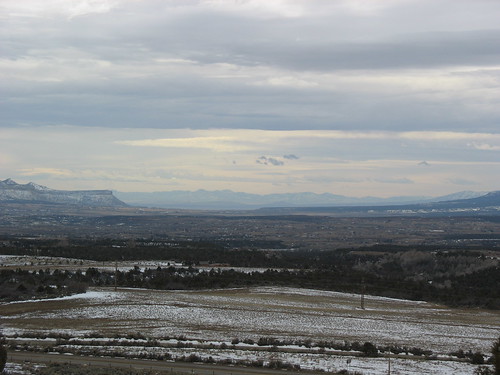
Chuska Mountains
It seems not unreasonable for the Navajos to get a piece of the action.
* The “maybe” is my way of characterizing the question of funding uncertainty. The Energy and Water Appropriations Bill that passed out of conference committee yesterday allocated $3 million for the first steps. The project has a complex funding mechanism to try to insulate it from the whims of Congress in the long term, but in the near term at least, it will need annual appropriations.
More:
Picture of the Chuska Mountains, licensed under Creative Commons, courtesy Teofilo
On the Risk of Overstating
Two of my favorite climate scientist-communicators recently posted on the risks of overstating.
First is Simon Donner on Ketsana, the tropical storm that devastated the Philippines:
The climate policy talks in “nearby” Thailand have led to a number of sloppy media reports and climate activist statements about the role of climate change in Ketsana. For once, I actually agree with Roger Pielke Jr, that people need to stop crying wolf about climate change and extreme events. Asking about climate change after a prolonged summer heat wave that could have come right out of a doubled CO2 regional climate model simulation is reasonable. The effort to draw a link between climate change and tropical storms during a rather middling storm year (in terms of power) is scientifically questionable. When the storm in question has had such a terrible human tool, it is also a bit tasteless.
And in short order, William Connolley makes a similar point in a critique of Paul Krugman’s most recent effort:
So K is puzzled: In a rational world, then, the looming climate disaster would be our dominant political and policy concern. It could be that we don’t live in a rational world (evidence: cars kill far more people than terrorists but we aren’t about to declare an undying war on cars). But another possibility is that the evidence for a looming disaster is weaker than K thinks.
Stuff I Wrote Elsewhere: ABQ Greenhouse Update
In early 2008, I did some inquiries on the data underlying Albuquerque’s “green” claims and we published what I found in the newspaper.
With a mayoral election underway and the city pushing forward on a “Climate Action Plan”, it seemed like a good time to revisit the issue. The results:
When Albuquerque Mayor Martin Chávez signed the U.S. Conference of Mayors Climate Protection Agreement in 2005, he pledged to reduce greenhouse gas emissions in Albuquerque.
By next year, according to a city estimate, emissions will have gone up 8 percent since Chávez made the pledge.
My previous story can be found here, but as part of my employer’s efforts to figure out how to compensate me for my efforts, you’ll have to subscribe to the paper or sit through an ad to read it.
Water and Renewable Energy in the Southwest
Where I’d be Oct. 22-23 if I had plane fare, registration fees and a few free days (none of which I have): Water and Land for Renewable Energy in the Southwest.
Inland Desalination
While much of the discussion of “new water” in the western United States involves desalination of seawater, there’s an experiment getting underway outside Albuquerque that is part of a new approach to the problem: desalination of brackish groundwater. My colleague Rosalie Rayburn has a story in the Albuquerque Journal on the latest testing going on here, out in Sandoval County on the northwest edge of the Albuquerque metro area:
The water is in a briny aquifer more than 3,500 feet below the Rio Puerco basin. A county drilling project discovered the aquifer in 2007. Testing last year indicated it is big enough to support a community of 300,000 people for 100 years. The water contains dissolved solids that must be removed before it is suitable for domestic use.
The technology is largely the same as used for seawater desal, generally reverse osmosis. But the difference in water sources raises a couple of problems that make inland desal quite different from ocean desal.
First, the ocean is, for all practical purposes, a sustainable water source. There are other sustainability issues, involving energy use, but you’re essentially never going to run out of ocean water. Inland desal depends on reservoirs of ancient water that will be mined if this process goes forward in a big way. So, like any groundwater mining, it’s not sustainable in the long term.
Second, you’ve got an enormous waste disposal problem. Roughly speaking, for every three gallons or so of clean water you get the residual brines concentrated in a fourth gallon. You’ve got to get rid of that somehow.
And of course the whole process – ocean or inland – is quite energy intensive.
For more, see what El Paso, Texas is doing.
Tower of Babel

I love the New Mexico State Fair. This is why: a giant Lego rendition of the Tower of Babel. Everyone’s strange and wonderful obsessions come together at the fair.
The Infamous Colorado River
A blog post showed up in my Colorado River news feed, about a winery on the west slope in Colorado, that is irrigated with water from “the infamous Colorado River” (emphasis added)
What an odd way of describing the Colorado. Is the great muddy lifeline of the West really “notoriously evil,” “having a reputation of the worst kind”?
A little googling showed me that it’s a common turn of phrase:
- “The guide on the boat spoke about the geology and plant life of this amazing canyon and the infamous Colorado River.”
- “We are proud to offer a relaxing trip down the infamous Colorado River!”
- “Mike gets his kicks from all kinds of recreation, traveling to Glamis, Dumont, and the infamous Colorado River.”
I was inclined to think it was just lazy writing, but in fact there were some gems that made sense:
- Buy the infamous Colorado River Toad!
- This was done in the infamous Colorado River Storage Project Act of 1956.
Sometimes it’s not the River itself that’s notoriously evil. Sometimes it’s laws. Or toads.
No Dogs, No Bikes
For my bike ride this morning, I headed north to check out the new bike path into Albuquerque’s Balloon Fiesta Park, which my colleague Rosalie Rayburn wrote about in this morning’s paper (sub/ad req). We’re a week away from Albuquerque’s famed balloon fiesta. I’ve always enjoyed riding bikes in the mornings and watching a zillion hot air balloons, but the auto traffic around the field itself is a nightmare, so I normally stick to the paved bike trails which go near the balloon field, but not too near.
This year, the newly completed trail goes right up to the balloon field itself – grade separated, zero auto, bikes only. This is great, a real positive step by the city to make one of Albuquerque’s most popular events more bike friendly. I’ve been watching the final construction for months, so I rode up this morning to see if the final bits were done.
When I got close, I found the final half mile still blocked off while workers put the finishing touches on whatever needs finishing. So I followed the old route into the balloon field, which I sadly had to share with large motorized vehicles. As, for example, the guy in the unnecessarily large pickup truck who yelled something to the effect that it would have been more convenient to him were I to have not used this particular road.
It also would have been more convenient to me if he weren’t on the road, but it’s all about sharing the space and trying to get along, right? It never occurred to me to yell at him for taking up so much space with his unnecessarily large pickup truck. But then, I don’t have a big metal cage to protect me from what might follow, so best to just smile and ride defensively.
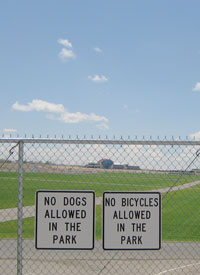
No dogs or bikes allowed.
When I got to the park’s entrance, where cars were heading in to do whatever it is they were heading in to do, I was stopped by a parking security person. She stepped out into the lane in front of me, waved me down assertively, and said, politely but firmly, “No bikes allowed.”
Sigh. We’re making progress, but we still have a ways to go. (Picture taken three years ago at the far end of the same park. I’m pretty sure the signs are still there.)
Stationarity Really, Most Sincerely Dead
Tom Beal has a story in the Arizona Daily Star that captures a couple of related realities one finds these days in the western water community.
One is that climate change is the real deal. It’s easy to go on quibbling about the attribution problem, but the Colorado River is mostly drier these days than it used to be. That’s the reality that water managers are grappling with, and it’s forcing them to confront the second reality: that stationarity – the idea that past is reasonable prologue – is fork-stuck-in-it-dead:
Stationarity, said U.S. Geological Survey senior scientist Julio Betancourt, allows you to predict future natural events “within a fluctuating but well-defined variability.”That notion died, he said, with the realization that climate change makes the future unpredictable.Sharon Megdal, who moderated the panel on the state’s water future, said she liked Yogi Berra’s definition: “The future ain’t what it used to be.”
Instead of variability around a stable mean, we have both a changing envelope of variability and an underlying trend in the mean.
Julio, who is both a terrific integrative scientist and an enormously articulate and effective advocate for his ideas (read my book to learn more about his work – it’s not too early to pre-order!) has been pushing this point recently, and the water community seems to increasingly get it.
The interesting thing here is that, at least in the Arizona water community, folks are getting serious about the conversation about what to do in the face of the loss of stationarity and the resulting likelihood that they’ve got less water to work with than they thought. I’m not so sure we’re there yet in the New Mexico conversation (thoughts, Inkstain readers?), but clearly the idea is now unambiguously on the table.
More on stationarity from Inkstain: