
Virtual Water Made Actual

Occasionally for lunch I slip away from the office, grab a sandwich from one of the places across the street, and head over to a little flood control pond about a mile from my office to check out the birds.

The sandwiches are messy, and inevitably little bits of lettuce spill out on the ground around me. Which, I’ve noticed, the local ants particularly love. I can only assume it’s the water content, since iceberg lettuce has very little nutritional value.
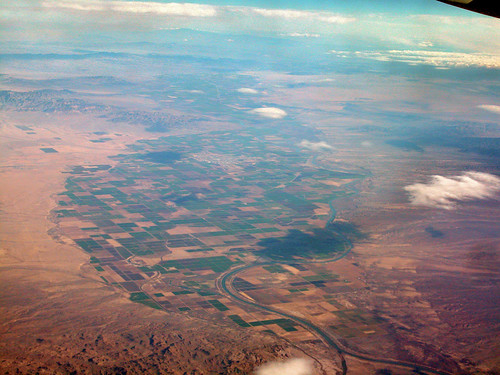
Imperial Valley farmland, courtesy Doc Searls

Imperial Valley farmland, courtesy Doc Searls

As I watched an ant struggle the other day with a piece of lettuce as large as itself, I was struck by the way this bit of virtual water had been made actual.

“Virtual water” is the term of art for importation of a water-intensive product. We don’t have enough water here in New Mexico to grow iceberg lettuce, so we import it from the Imperial Valley, along the Lower Colorado River. It’s a lot cheaper and less hassle to just import the lettuce, rather than schlepping the water all the way across the continental divide. It’s sunny in the Imperial Valley, and thanks to accidents of geography, law and history, the valley’s farmers have an awful lot of cheap water at their disposal for the growing of lettuce.

So here we have this vast apparatus of irrigation infrastructure in the Imperial Valley, refrigerated shipping to get the lettuce to Albuquerque, a sandwich shop, me – all to bring a bit of water to an ant. There are doubtless more efficient ways, but it has a sort of Rube Goldberg charm.

(photo courtesy Doc Searls, some rights reserved)

Our Southwestern Dystopian Future?

I confess that my literary life list does not include Dune, Frank Herbert’s sci-fi epic. But perhaps it should.

For a show at the University of Toronto, architect Andrew Kudless has drawn on Herbert to design a dystopian future urban world in which we southwesterners dig down, building underground to preserve our water:

Sietch Nevada is an urban prototype that makes the storage, use, and collection of water essential to the form and performance of urban life. Inverting the stereotypical Southwest urban patterns of dispersed programs open to the sky, the Sietch is a dense, underground community. A network of storage canals is covered with undulating residential and commercial structures. These canals connect the city with vast aquifers deep underground and provide transportation as well as agricultural irrigation.

Or perhaps a bunker to hunker down in when we finally have to fight the water wars? Can we grow lettuce on the roof? Long term, is this what Cadiz is really heading for?

(h/t io9)

Just Add Water II

When I started making noises about some sort of Colorado River project, one of the water wonks I know pointed me toward the delta, arguing it was a) central to understanding the Colorado, and b) widely ignored.

The problem, in short, is that essentially no fresh water flows there any more. An ecosystem once sustained by annual flows well in excess of 10 million acre feet per year now gets bubkes. Instead, I’m drinking it. I mean that quite literally. The glass of water to the right of my computer right now. Had my community not built a series of dams and a tunnel beneath the continental divide to convey this water to my drinking glass, said water would instead have dribbled into the delta. Think dead clams.

There’s some journalistic traction to the story right now, however. The water mavens of the Lower Colorado are not satisfied with taking almost all of the water. There’s one salty stream left, some frankly really crappy agricultural runoff from the farms around Yuma, too gross to put into the Colorado, so a drain was built to funnel them into what were barren salt flats. But, as an old Italian Catholic lady I knew in South Pasadena used to say, “The life force is strong.” At the end of the drain, a lovely wetland has grown up. But the mavens want that water, too.

Which is a long way of introducing Randal Archibold’s story in today’s New York Times about the struggle over the future of Cienega de Santa Clara:

But now the protracted drought in the Southwest has led water managers to rethink the possibilities for the wastewater, placing the preservation of the wetland, the Ciénega de Santa Clara, at the center of a delicate balancing act between the growing thirst of California, Nevada and Arizona and the delta’s ecology.

The biggest challenge involves a plan to take some of the wastewater, purify it at a desalination plant and direct it to other uses under a treaty that proportions the Colorado River among the Western states and Mexico.

Stuff I Wrote Elsewhere a While Ago: Rainwater Harvesting in NM

I forgot my usual Inkstain link last week to a piece I wrote for the newspaper about the strange world of rainwater harvesting law in New Mexico. David Zetland was on about this last September, asking about the legality of rainwater harvesting in various U.S. states. My short answer, in the comments, was, essentially “kinda sorta maybe” for New Mexico.

My longer answer, in last Tuesday’s Albuquerque Journal, was that it depends on what you’re using the water for (some sort of sub. or ad maybe req.):

This goes back to the first part of the state’s policy: the rule that when you’re capturing rainwater, you can’t reduce the runoff that would have come off your property “in its natural, pre-development state.”

In the strange world of water law, the portion of the rain and snow that falls on your property that would have run off before it was developed isn’t yours. It belongs in a legal sense to the myriad water rights holders downstream from you. It can be used by farmers and cities that have a pre-existing right to draw water from the state’s rivers and streams for their use. Or the water can be used to meet New Mexico’s legal obligations under the Rio Grande Compact to deliver water to Texas.

Water News

  • My head’s been spinning trying to follow discussions over California’s pending water legislation. Emily Green has helpfully rounded it all up in one spot: “Potential cost? $12bn. Who will it affect? Every Californian who needs water.”
  • George Johnson on Santa Fe’s water budget: “For all its aspirations to be different, Santa Fe is still guided by a rather ordinary assumption: that the primary use for water is to accommodate more development.”
  • Rosalie Rayburn on the next steps toward New Mexico’s first desal project. Note the echo of George’s theme here re the “d” word: “Desalination tests will begin next week on a Rio Puerco water source that Sandoval County officials believe will be critical to future development”

How Dry Southern California?

JPL climate scientist Bill Patzert wrote a nice op ed in the San Gabriel Valley Tribune about weather, climate and fire that got me thinking about my old home turf of Southern California yesterday:

What set us up for these fires? Rain has been scarce. A large-scale drought has strangled the American Southwest for almost a decade, four years of below-normal rainfall have parched the Southland, and six months with almost no rain at all have turned our foothills dangerously dry.

I’m more focused on my part of the southwest now, so I haven’t followed the numbers closely, but was amazed when I went back and looked at the data:

Annual Precipitation, California South Coast Climate Division, courtesy WRCC

Annual Precipitation, California South Coast Climate Division, courtesy WRCC

That’s the annual precipitation for 12-month periods ending in August (not a normal window of time, but it allowed me to capture the last 12 months). The green line is the long term average. In the last decade, there has been one unusually wet year, two that were sort of average, and the other seven have been extremely dry.

But here’s the kicker in terms of thinking about drought conditions. Remember my new meme – it’s not just precip, it’s evaporation? Look at the temperatures:

Average Temperatures, California South Coast Climate Division

Average Temperatures, California South Coast Climate Division

Again, green is average.

Yowza.

Elephant Diaries: Career Advice From The President

I’d like to think the President of the United States has the best interests of America’s children in mind with this school address thing that has generated such a kerfuffle. But after reading the advance text, I’m not so sure:

Every single one of you has something you’re good at. Every single one of you has something to offer. And you have a responsibility to yourself to discover what that is. That’s the opportunity an education can provide.

Maybe you could be a good writer – maybe even good enough to write a book or articles in a newspaper – but you might not know it until you write a paper for your English class. (emphasis added)

OMG! He’s encouraging kids to go to work for a newspaper!

Wen Ho Lee: A Limerick

Giving my desk at work its Labor Day holiday shift cleaning (I’m the warm body in case news happens), I stumbled across a bit of history: the notebook from the day nine years ago when Wen Ho Lee made the first of a series of appearances federal court that ended his prosecution as the spy who wasn’t really a spy after all. Lee ended up pleading guilty that week to a single count of improperly downloading classified material and walked out of the federal courthouse in Albuquerque a free man.

I was not the newspaper’s lead reporter on the story, but I had been there the day he was indicted (Ian Hoffman, who was our lead reporter and later co-wrote the definitive book on the case, was off fishing on the day of Lee’s arrest and indictment). It was history, and I figured I had to be there the day it ended, too, so I “volunteered” to help Ian out with the courtroom scene.

The notebook is labeled simply “The End.” On the first page, while I was sitting in court waiting for Lee to appear, I had penned the opening lines of a limerick:

There was an old doctor named Lee

Who wondered what fuss there might be.

Downloaded some codes…

Apparently court started at that point, because the limerick is left hanging, followed at that point by a description of Lee walking in with a “big grin.”

I welcome suggestions for the limerick’s conclusion.

Water news

I spend a lot of time these days reading water news. When I read something good, I often blurt it out on my twitter feed, which is good for that sort of link sharing. But one of the problems with the disjointed nature of social media right now is the way different communities use different social media in different ways. We’ve got cool new tools, but divergence in terms of who uses which ones. Some folks interact via email lists, some via interlocking blog conversations, some via Facebook, some via twitter, some via some overlapping set of the above.

What follows is an experiment in sharing these squibs here as well which, if it works, may become a regular feature. Or not:

  • From the LA Times, drought in Mexico: “The sparse rainfall nationwide has made 2009 the driest in 69 years of government record-keeping, Arreguin said.”
  • Peter Gleick on an example of questionable federal cost-benefit analysis of a proposed dam: “The people receiving the benefits are not the people bearing the costs, many of which are public, environment, and cultural.” (h/t WaterWired)
  • The AP’s Ben Neary has been doing great work on entrepreneur Aaron Million’s proposal to pipe water from Wyoming to Colorado’s Front Range cities. Reporting out of Cheyenne, Neary reported this weekend that Million is considering scaling back the project: “Million said he is re-evaluating what would be a reasonable size for the pipeline project. He said he doesn’t have a figure yet of how much water he may apply to take from the river if he reduces his application.”