Water Wars, or Not?

When we talk about “water wars” in the United States, things like what is now happening in Atlanta, we’re not really talking about shooting wars. But there’s are widespread fears that globally, water wars will be one of the defining structures of 21st century conflict.

Not so, suggests a new paper in the Journal of Peace Research. Jaroslav Tir of the University of Georgia and John Ackerman of the U.S. Air Command and Staff College argue that water actually provides an opportunity for cooperation rather than a source of conflict:

[T]he findings suggest that the roles of allegedly important and problematic factors such as the upstream/downstream relationship and recent militarized conflict have been exaggerated in earlier research. Cumulatively, the findings sound a cautiously optimistic note for the prospects of the spread of formal river cooperation in the less developed parts of the world.

Stuff I Wrote Elsewhere: Albuquerque’s Sewage Reclamation

Albuquerque’s on the brink of New Mexico’s largest sewage reclamation project, taking 2,500 acre feet per year of water from the city’s wastewater treatment plant outflow and using it to water parks and golf courses.

All well and good. Sounds like a great idea to put wasted water to use. But, as I tried to get across in a story for the newspaper (ad/pay gated) this isn’t “free water”:

[T]he sewage reuse will reduce pumping from Albuquerque’s aquifer, Stomp said.

But because the sewage treatment plant discharge provides water for the Rio Grande ecosystem and downstream users, the project is essentially a zero sum game in New Mexico’s overall water budget, experts say.

“Municipal water reuse isn’t necessarily conservation,” University of New Mexico water resources professor Bruce Thomson and local water consultant John Shomaker wrote in a recent analysis of the issue.

Stomp agrees the project won’t change Albuquerque’s “consumptive use” of water — the amount we pump from the aquifer or remove from the river minus the amount returned to the river from the sewage treatment plant.

California Drought

Via NASA’s Earth Observatory, MODIS view of California’s central valley. The brown, blocky bits are areas where agricultural land, which would usually be growing this time of year, lies fallow. Click through to see it big:

Drought in California as seen from space

Drought in California as seen from space

The Must Read Western Water Blog

If you’re interested in western (US) water, you almost certainly already read Emily Green. If you’re not, you must:

“DOES anyone think Southern Nevada [Water Authority] is going to build a $15 billion pipeline and then let somebody turn it off?” — Snake Valley  rancher Cecil Garland, pictured above center.

Stuff I Wrote Elsewhere

Oil industry behind “energy citizens rallies”

The U.S. oil industry’s main lobbying organization is behind a series of “energy citizens rallies” against pending climate change legislation, including two in New Mexico later this month, according to a memo obtained by the environmental group Greenpeace.

“We don’t want critics to know our game plan,” American Petroleum Institute president Jack Gerard said in the internal memo, which Greenpeace provided to the Journal. A spokeswoman for the institute confirmed the memo’s authenticity.

sublimity perhaps unparalleled in any part of the world

When U.S. Army Lt. J.C. Ives explored the lower reaches of the Colorado River in 1857-58, he made careful efforts to record as much of what he saw and learned as possible, “it being doubtful whether any party will ever again pursue the same line of travel.”

From J.C. Ives Report upon the Colorado River of the West

From J.C. Ives' "Report upon the Colorado River of the West"

Ives wrote:

The region explored after leaving the navigable portion of the Colorado—though, in a scientific point of view, of the highest interest, and presenting natural features whose strange sublimity is perhaps unparalleled in any part of the world—is not of much value. Most of it is uninhabitable, and a great deal of it is impassable.

Just Add Water

I was interviewing a local flood control engineer recently about the lovely little wetland that’s grown up in a retention pond up near my work. It’s located just off one of the channels that carries flood flows down through the city, and its primary purpose is to catch and hold water for a while to reduce contaminant load that gets to the Rio Grande in flash flood events.

When I described it as a “wetland,” the engineer cautioned me about a linguistic subtlety. Its purpose, he explained, is not wildlife habitat, and to call it a “wetland” is to move it into a bureaucratic category for which it was not intended. So while it’s developed a lovely cattail marsh, with redwing blackbirds and grackels and all manner of travelling water fowl, it’s not a wildlife habitat site. Call that a happy accident.

That issue writ large is the situation at two much more famous western water sites I’ve been reading about lately: the Cienega de Santa Clara in the Colorado River Delta, and Owens Lake.
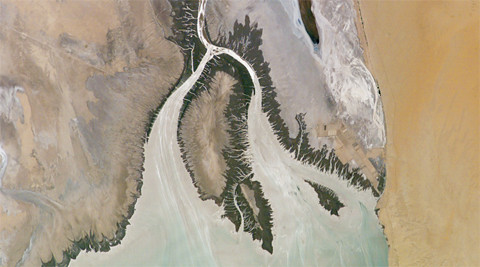
Courtesy NASA, the Colorado River Delta, with Cienega de Santa Clara in the upper right

Courtesy NASA, the Colorado River Delta, with Cienega de Santa Clara in the upper right

The Cienega is at the end of the Welton-Mohawk drain, which was built to drain off brackish ag runoff from the Yuma area, to keep it from sullying the Colorado River. Where the drain ends in Mexico, a remarkable wetland has developed which has become one of the best wildlife habitats in the Lower Colorado.

Similarly, nature has apparently gone gangbusters in the Owens Valley as a result of a project that was nominally about adding enough water to keep down dust left after LA began siphoning away water a century ago for urban use, according to this KABC story:

The wind and dust made Owens Lake the largest single source of air pollution in the United States. However, that changed over the last ten years. Huge pipes, hundreds of smaller bubblers and thousands of tiny drippers, allow water to spread out across the vast expanse of Owens Lake. As a result, acres of green grass have sprouted on the lakebed and migratory birds have returned to the ponds. But all the water, roads and dikes are used for the sole purpose of keeping the dust down.

There are some really interesting water policy issues entangled here. In the Lower Colorado, a rich debate is underway about how to keep the Cienega alive given a plan to put the brackish water now flowing its way to other use. The Bureau of Reclamation has plans to restart the Yuma Desalting Plant and cleaning up said brackish water to put to what are considered, in U.S. water law, “beneficial uses”. That means drinking and growing food. In-stream flows and habitat are not considered “beneficial” under the law.

I’ll have more on the Cienega in coming months. I’m hoping to get down there for a writing project I’m working on, to visit both the Cienega itself and also the farms on both sides of the border that put water to what we more traditionally call “beneficial use.” In the meantime, I’m hoping to sneak off at lunch to the little pond by my office and check out the redwing blackbirds.

It’s Vegas, Baby

I don’t know if anyone else reads this stuff, or if we’re just talking to one another, but a quartet of the waterbloggers piled on a today on the Vegas (Nev.) water situation. The back story involves Southern Nevada water impresario Pat Mulroy, who wants to bring water across the state to feed her growing city’s growingness.

First there’s Zetland:

Why didn’t she raise prices and balance supply and demand in Vegas? Because she’s pro-growth (developers), pro-engineering (the third straw into Lake Mead and pipeline will cost ratepayers a LOT), and pro-power (for herself).

If she raised prices 5 years ago, her job would have been boring. No headlines. Just quiet competence.

Emily Green, who has the history, riffs off of Zetland:

But from the beginning, Mulroy has argued doom for Southern Nevada if her pipeline isn’t built. “You’re going to live Amman, Jordan. You’re going to get water once a week,” was the latest outburst, made in demanding that her board at the Southern Nevada Water Authority give her an up or down vote on the project next week.

“I”ve been to Amman — it DOES have water in the fire hydrants and 24/7 water pressure, so she’s full of sh*t,” writes Zetland.

Over at the work blog, I’m acting all relieved that New Mexico is upstream from Vegas:

Brad Udall, who does western water policy research out of the University of Colorado, likes to quote an old western water saying: “I’d rather be upstream with a shovel and a ditch than downstream with a decree.”

At times like these, we New Mexicans can be glad we’re upstream from Las Vegas, Nevada. Next week, the board of the Southern Nevada Water Authority, which provides Vegas with water, has been asked to take an up-or-down vote on whether to build a massive pipeline to important groundwater from a rural area area 300 miles away.

To sum it all up, the scholarly Michael Campana.