Texas Drought

I’m in the midst of a story for the newspaper about drought and climate change that looks at the importance of temperature. It is not simply whether more or less rain falls, but also how much evaporation there is. This is the critical message from Richard Seager’s 2007 paper about the permanent Dust Bowl.

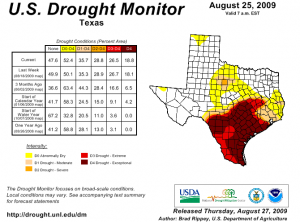
Texas conditions from Drought Monitor

Texas conditions from Drought Monitor

That is also the message from this week’s discussion of current conditions in Texas from the Drought Monitor:

Historic drought continued to grip southern Texas, where San Antonio closed in on its driest two-year period on record.  From August 1954 – September 1956, San Antonio—entrenched in an area of exceptional drought (D4)—received precipitation totaling 30.23 inches.  During the current drought, only 24.78 inches (38 percent of normal) fell from September 1, 2007 – August 25, 2009.  In other words, San Antonio would need 5.45 inches of rain during the last six days of August to prevent a record-low, two-year total.  In addition, San Antonio’s tally of 100-degree days continued to climb.  San Antonio’s former 1998 annual record of 36 days with triple-digit heat was broken long ago; through August 25, there have been 56 days with highs of 100 degrees F or greater.  Elsewhere in southern Texas, locations such as Corpus Christi and Victoria endured a 79th consecutive day (June 8 – August 25) with above-normal temperatures.

8-?-2

Don DeLillo has a great line in “Underwold” describing how, at a night baseball game, under the lights, “the players seem completely separate from the night around them.”

Something in excess of a quarter of a century ago, Lissa and I went to baseball games while we were falling in love, and we’ve been going ever since. It’s an odd thing, because neither of us are huge sports fans. We just love going to ballgames together.

We lived in South Pasadena, which is just up the freeway from Dodger Stadium, and Lissa had this great secret parking space that I won’t tell you about, because we might go back. I thought she was so cool, because she had a secret Dodger Stadium parking space. We’d go early enough to park there for free, because we didn’t have a lot of money, and we’d walk in and sit in the way upper deck behind home plate, the red seats, and scarf hot dogs for dinner. Or we’d sit in the better seats when I had a crack at the free tickets I sometimes got at work.

When we were moving to Albuquerque, we left Nora (she was two) with Lissa’s sister Ginnie and flew in for a weekend to find an apartment. We’d nailed it down by Saturday night, so Sunday afternoon we went out to Duke stadium to catch a ballgame. If you’ve never seen baseball in Albuquerque, you’re missing one of the sport’s great treats. The stadium faces the Sandia Mountains, and you can watch baseball or just sit and gaze quietly into the desert. Back then, the Dukes were the Dodgers’ farm team, so there was a sweet transition in our baseball life.

We end up at the ballpark all the time these days, not because we’re huge fans of what are now known as the Albuquerque Isotopes, but because we love the idle pace of a night watching those players, separate from the night around them. The ‘Topes, our team today, is the Dodger farm team again, so a certain symmetry has been restored.

Minor league baseball is different from major league ball, but it has a joy all its own. The players are often very good, but sometimes not quite. There’s a quirky unpredictability about it.

Saturday night we watched the ‘Topes play the Nashville Sounds. In the fourth, the ‘Topes’ first two hitters, second baseman Luis Maza and third baseman Hector Luna, both singled. Left fielder Dee Brown came to the plate with runners on first and second and hit a long drive to deep center field.

Standing at second, Maza froze, waiting to make sure the center fielder would not catch the ball. Luna, a base behind him, had no such caution, and broke immediately, so that by the time the ball fell safely just beyond the Nashville center fielder’s grasp, Luna had caught up to the runner ahead of him, and the two-person train took off, Luna rounding third base just a couple of strides behind Maza.

It was one of those baseball plays that seems to play out in slow motion, where you’re not quite sure where to look – Maza and Luna barreling for home, the throw coming in to the relay man (The shortstop? I’m still not sure.) who turns and fires to home.

The throw beat the two runners by a good ten feet, so you’ve got what I can only assume was a bemused Nashville catcher standing there while not one but two baserunners bore down on him. All he had to do was hang onto to the ball, apply tag one and tag two, which he did. The strangest double play I’ve ever seen in my many years of watching baseball.

I’m not sure how to properly score it, but I’ve got an “8-?-2” for both Maza and Luna on my score sheet. It was, for sure, one of the most entertaining plays I’ve ever seen, but I probably say that every time we go out to the ballpark.

I was Twittering later with fellow scribe Steve Terrell, who it turns out was also at the game, about the play.

Me: “It’s the charm of Triple A ball. Some great baseball, plus endless surprise.”

Said Terrell: “AAA ball is the punk rock of baseball.”

We sing “Take Me Out to the Ballgame” and do the YMCA dance with the Village People (“the Gay Song“!). We cheer the latest addition to AAA schtick, a little girl named Sophie who sweeps off the bases once a night between innings and swats the home plate umpire on the butt with her broom while Cyndi Lauper sings “Girls Just Wanna Have Fun” over the PA. It was a hit in 1983, the year Lissa and I fell in love.

Charismatic Megafauna

I’m sure there are a lot of things suffering right now because of the Texas drought. Few are as charismatic, though (sorry Michael), as the whooping crane:

A drought in Texas severely affected the whooping crane’s foods of blue crabs and berries. Corn feeders were set up to supplement the cranes’ diets, but only about half of them used the feeders. And wetlands and prairie have been making way for cornfields along parts of the flock’s flyway, which runs from northern Canada through Montana and the Dakotas, New Mexico, Nebraska, Oklahoma and Kansas.

(Image courtesy National Biological Information Infrastructure)

In Memory

My newspaper column today, an expansion of something I wrote several years ago, on what happens when you don’t have health insurance (sub. or ad or something req.):

Consider this, published by a team of U.S. health care researchers in 2004: “Lack of health insurance causes roughly 18,000 unnecessary deaths every year in the United States.”

That was five years ago. The quiet tragedy associated with a lack of health insurance has continued, the numbers growing in the half-decade since a team from the Institute of Medicine, our leading national health care think tank, published that statistic.

Perhaps 18,000 is too abstract to get your head around. To make this more concrete, let me introduce you to Virginia Heineman.

Severely asthmatic, chronically ill, and as a result chronically underemployed, Virginia — “Ginnie” to those of us who loved her — lived on society’s margins.

She was my wife Lissa’s beloved younger sister. She was one of 2002’s 18,000 unnecessary deaths.

In the Long Emergency, Will I Be Able to Buy Bike Tires?


The Ghost Mall

Originally uploaded by heinemanfleck.

Wandering on my bike Thursday morning, I ended up at “the ghost mall,” the old Winrock Center a few miles from my house. It’s one of those enclosed shopping malls circa the ’60s, when air conditioning and indoor shopping was all the rage.

It’s now largely empty, discarded in favor of new shopping trends despite the fact that it was perfectly useful if you needed to buy a t-shirt or tennies or play those new-fangled electronic games at the video arcade.

It’s a testament to our affluence that we can throw away something with such heft and permanence and continued usefulness. But it occurs to me that it’s a good little conceptual practice ground for thinking about life in the long emergency – peak oil and the like.

When it was still a working mall, I went for a bike ride around it one Christmas day, reasoning that was the only time I’d ever get to race around its ring road without having to deal with traffic. These days, most any day will do. I was feeling all smug and satisfied Thursday morning as I rode around the mall, thinking that, in the long emergency, when all around us is collapsing, I’ll still be able to ride my bike to get around.

But where will I get tires?

Time Trials


Time Trials

Originally uploaded by heinemanfleck.

This is where I’ve been spending weekend mornings for the month of August (mostly Saturdays, one Sunday) – out along the Interstate 25 frontage road north of Bernalillo, New Mexico, where my bike racing team puts on its annual time trial series. I’ve been working the start line. The last two weeks I got to be the guy who says “five four three two one go” every 30 seconds. Lissa comes too, helping run the registration table. (Sorry for crappy photo – cell phone.)

What Kind of Drought is South Texas Having?

There are supply droughts, where the amount of rain falling from the sky drops precipitously, and the amount of water evaporating from plants and transpiring from their leaves, rises. And there are demand droughts, where the main problem is not in the supply of water nature offers, but in the way we use it.

The current drought in Texas, as this story shows, is both:

Even as the steady, very visible drop of Lakes Travis and Buchanan has gained notoriety, the well water that many people in the Hill Country rely on from underground aquifers has also been sucked dry.

The issue is exacerbated, water specialists say, by the rapidly increasing number of pumps, like straws into a tall glass of Coke, that reach into the aquifers beneath the booming areas of northern Hays and western Travis counties.

Caring About Water

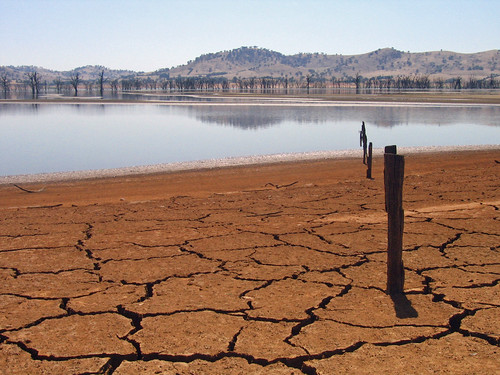
licensed under creative commons, courtesy suburbanbloke

licensed under creative commons, courtesy suburbanbloke

When an organization dedicated to the world’s water problems conducts a survey that concludes people care a lot about the world’s water problems, it’s good to accept the results with some caution. That caveat notwithstanding, the results of this survey are nevertheless not surprising:

The survey, commissioned by Circle of Blue and conducted by Toronto and London-based GlobeScan was made public in Stockholm, Sweden, on August 18 during World Water Week. It found that people around the world view the fresh water crisis as the planet’s top environmental problem.

The fierce impediments to clean water and sanitation, and the millions of premature deaths from water-related disease are seen as having a greater influence on quality of life and the planet than air pollution, species extinction, depletion of natural resources, loss of habitat and climate change.