When Roadrunners Attack


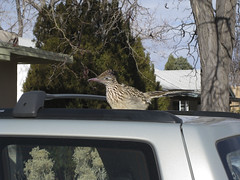
Roadrunner

Originally uploaded by heinemanfleck.

We had a ringside seat this afternoon when Speedy, our neighborhood roadrunner (seen here atop our car last December) stalked across our front yard, eyeing a mourning dove. Speedy has the moves of a cat on the hunt – furtive, able to hold still. He hid behind plants, darting from one bit of cover to the next. When he finally got with range he charged, leaping into the air as the dove took flight.

He must have missed by an inch or two, but the dove got away. Others may have not been so lucky. In the same part of the yard earlier this year, I found a pile of feathers.

On High-Probability, High-Consequence Events

My friends in the nuclear weapons community have, over the years, helped me understand the tools for thinking about low-probability, high-consequence events, like a warhead accidentally going off. You really don’t want that to happen, so even though averaged across all possible futures the average badness might be relatively low, it’s worth spending some time and energy thinking through ways of reducing the probability of the high-consequence event.

But if the chance of the truly horrific event is somewhere betwen 57 and 95 percent over the next four decades? Holy crap. If you’ve seen that coming and haven’t already started doing an awful lot to try to drive that number down, your system for solving societal problems is seriously fucked up.

57 to 95 percent is the estimated probability of the levees in California’s San Joaquin-Sacramento Delta failing between now and 2050, according to a new report that Rober Service talks about in yesterday’s Science magazine (subscription). Put another way, there’s at least a 57 percent chance that the system that delivers water to half of all Californians will stop delivering water to half of all Californians:

By 2050, the chance of widespread levee failures is as high as 95%, due to runoff from the northern Sierras, which is predicted to be more concentrated in the late winter and early spring, and the increasing risk of earthquake, according to a report last summer by the Public Policy Institute of California (PPIC). If that occurs, salt water from the San Francisco Bay would rush in to fill the voids, dramatically increasing the salinity of water in the delta, possibly making it undrinkable. Adding sea-level rise to the equation–as climate models predict–brings the date of levee failures closer. “It will happen,” says Ellen Hanek, a PPIC economist in San Francisco.

update: Of possible interest to those who follow discussions of journalism and science, when I first wrote this post, I took Service’s word for the 95 percent figure he used in his article without taking careful note of the “as high as” qualifier he used. When I reread the post and noticed the qualifier, I went and found the original PPIC report and found that they actually say this:

[T]he best possible failure probability under rapid rates of sea level rise, high seismic risk and increasing inflows is approximated by the island with least current combined risk of failure from flooding and earthquakes at 2 percent per year, for a cumulative probability of failure of 57 percent by 2050. For the high end of risk, we used the current estimated combined flood and earthquake annual failure probability of the western Delta islands of approximately 7 percent per year, or a cumulative probability of failure of 95 percent by 2050.

So 57 and 95 percent reasonably bracket the risk as estimated by PPIC, and don’t materially change the “holy crap” tone of my reaction. (And I haven’t read the whole report, just found the section that explained their risk numbers in brief.)

The Tree Rings Tale

Coming November 2009, from the University of New Mexico Press, The Tree Rings Tale: Understanding Our Changing Climate, by John Fleck.

It’s the story of western weather and climate, told through the work of a series of vignettes about some of my favorite scientists, written for middle school-aged kids. A little climate change, a lot of dendrochronology, not much actual use of the word “dendrochronology”. I don’t think you can pre-order it yet, but it’s not too early to add it to your preliminary Christmas lists for all the kiddos in your lives. You can read it yourself if you want.

Can I confess that I ran around the house squealing with excitement when I saw that it had appeared on Amazon?

Stuff I Wrote Elsewhere: Sandpile Edition

On Joshua Cooper Ramo’s Age of the Unthinkable:

Instead of tanks and planes and armed battalions, we face “adaptive microthreats and ideas,” like improvised explosive devices made of cheap cell-phone components.
Because of such thinking, Ramo writes, “no major power has been able to defeat an insurgency anywhere in the world” since World War II.
“People are trying to explain the world using models that just don’t work,” Ramo said this week from New York, where he will make the rounds of television appearances to promote the book.

Elephant Diaries: “between systems”

One of the occupational hazards of being a journalist (at least the way I do it) is an embarassing lack of original ideas. My job is to entertain, understand, sort and pass judgment on the ideas of others, then explain the ones that meet some sort of preliminary test of usefulness and/or relevance. Ideas of my own is not a habit of mind I have developed over the years.

That doesn’t mean there are not journalists who can also be innovators. But I am not one of them. I had a conversation the other day with a friend, a good writer and smart contributor to the infosphere who is a non-journalist trying to figure out where he might fit into the new ecosystem, and I realized I had pretty much nothing to say beyond what won’t work, which is not a terribly helpful approach to the problem.

This is a long introduction to Jay Rosen doing what I described above as journalism, which is to collect a lot of really smart and really inconclusive writing done by others over the last month about the future of my industry:

I don’t know what will replace the newspaper journalism we have relied on. It’s a terrible loss for the public when people who bought the public service dream lose their jobs providing that service, and realizing that dream. I do not look forward to explaining to my students the contractions in the job market and why they’re likely to continue for the near term. It feels grim to have to say: “There is no business model in news right now. We’re between systems.”

Elephant Diaries: Measuring the Effect

This paper, a study of the effect of the closure of the Cincinnati Post on elections, got a good ride in the metamedia blogosphere a few weeks back when it came out, but I just got around to reading it. Interesting stuff, and you can see why it was popular with we inkstained scribes:

The Cincinnati Post published its last edition on New Year’s Eve 2007, leaving the Cincinnati Enquirer as the only daily newspaper in the market. The next year, fewer candidates ran for municipal office in the suburbs most reliant on the Post, incumbents became more likely to win re-election, and voter turnout fell.

I’d love to see some clever data maven look at Albuquerque in the same way since the Tribune closed.

The authors conclude the paper with a bit of poetry that recalls the Albuquerque Tribune’s lighthouse:

The logo of the E.W. Scripps Co., printed on the front page of all its newspapers, is a lighthouse. This paper describes what happened when one of Scripps’ lights went out. The Cincinnati Post was a relatively small newspaper, with circulation of only 27,000 when it closed. Nonetheless, its absence appears to have made local elections less competitive along several dimensions: incumbent advantage, voter turnout and the number of candidates for office.

Imagine One of the World’s Largest Cities, Without Running Water

Daniel Hernandez, on Mexico City:

Reserves of the city’s largely imported water supplies from the Cutzamala plant are at their lowest in years. Hoping to prevent a larger disaster, for three days a month, the municipal water utility has decided to run the city’s supply at 50% its normal flow. March 14 was the first time this measure was taken — and from what I’m seeing and hearing, the water hasn’t been back on yet.

Navajo Water Bill Passes

Everybody’s calling the big omnibus public lands bill that passed the House yesterday a wilderness bill, but we water wonks know better, right:

Legislation to settle a long-standing dispute over the Navajo Nation’s rights to water from the San Juan River won final congressional approval Wednesday.

The legislation acknowledges the Navajo Nation’s right to 600,000 acre-feet per year of water from the San Juan — an amount equivalent to about six times the city of Albuquerque’s annual water use.

The bill formally ratifies a deal between New Mexico officials and the Navajo Nation worked out in 2005 intended to end legal uncertainty over the Navajo Nation’s legal entitlement to San Juan water. It now goes to the White House, where the president is expected to sign it next week.


Elephant Diaries: How Important is Andy Revkin’s Blog?

Last Sunday night, I read an excellent New York Times story via the Web about Steven Chu’s introduction to the ways of Washington. I cover the Department of Energy at my day job, and the DOE is a major employer in New Mexico, so I made a note of the story to include a link to the piece in my Monday morning links roundup on the work blog.

When I got to the office Monday and plucked my copy of the Times out of my mailbox, I noticed that the Chu piece was on the front page of the Times. “Made the front page,” I said to myself.

Why did that matter? Why did I care about the fact that the Times chose to use a piece of its most precious real estate to feature John Broder’s story about Steven Chu?

In the comments on a recent post here, a number of people offered variations on the point made most explicitly by David Zetland:

Paper is EXPENSIVE (time, editorial, etc.), so things in the PAPER (even if you read them online) are “better” as far as the signal to readers of what to read…

Chris Dunford, Kim Hannula and Keith Kloor made variations of this same point (I love my blog commenters!), but it was Zetland who captured the key piece of jargon I needed (I loves my jargon ’cause it gives me stuff to look up, and words to sound smart.): signaling.

The classic econ textbook example of signaling is a college degree, which signals the job-worthiness of an individual. Huge debate about how truly valuable that degree is in many fields in terms of actual worker productivity, but it continues to be used as a hiring decision shortcut.

Just like the trouble taken to get a college degree, all the trouble spent packaging up all that information, printing it up, driving it around town and throwing it on people’s driveways is no longer essential to the actual transmission of information. But it sends a signal.

What does this have to do with DotEarth, the blog run by Andy Revkin at the New York Times?

Chris Dunford said this in the comments on my last post (“Post” here is the Washington Post, subject of my last missive):

Anything printed in a major newspaper has more of it than anything posted in any blog.

There are a lot of reasons for this, but one of them is surely the feeling that “Someone important at the Post has looked at this and judged it worthy of its very limited and very valuable space.” There’s a journalistic professionalism that’s associated, rightly or wrongly, with major newspapers and magazines that simply is not associated with blogs and such.

So what’s the signaling associated with DotEarth? As a journalist trying to understand how to function in the new mixed environment where some of my work gets the “print signal” and some lives only in the ether, I view Revkin’s approach as the model: a platform that feeds into his print work, and off of his print work.

What signaling, if any, is associated with DotEarth’s presence at NYTimes.com? Does it get some of the gravitas to which Dunford is referring? Is that part of the signal? Or does the signal only exist on paper?

A related question, as Kim Hannula notes in her comments on the previous post: is there signaling associated with the move of her (terrific) blog to ScienceBlogs, which is affiliated with Seed magazine? Which is printed on paper?