
The Incredible Shrinking Lake Mead

Lake Mead

Lake Mead

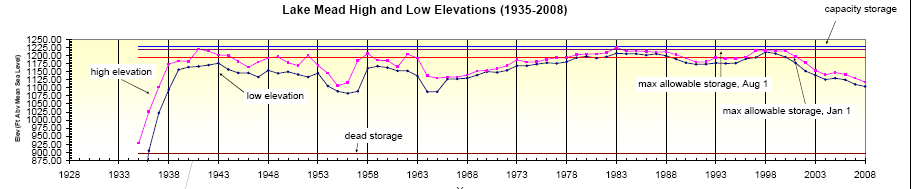
Henry Brean, a reporter for the Las Vegas Review-Journal, caught something remarkable in the latest monthly reservoir operations plan published by the Bureau of Reclamation’s Lower Colorado River region office. By next month, Lake Mead will drop below 1,100 feet above sea level in surface elevation – the first time it has dropped below that level since the mid-1960s. Brean writes:

And the decline won’t stop there. By July, the reservoir on the Nevada-Arizona border is projected to shrink more than 13 feet from its current level of 1,105 feet above sea level.

That’s more than 8 feet lower than forecasters were predicting just one month ago. The news has water managers and marina operators scrambling to deal with the immediate effects and bracing for what could come next if drought conditions don’t improve along the Colorado River.

“We have to hope we have a decent spring. Otherwise we’re headed for uncharted territory,” said J.C. Davis, spokesman for the Southern Nevada Water Authority.

Click through on the graph above (which comes from the Bureau) to see the history. For most of the last five decades, the lake level was either climbing, or was topped at nearly full. But since about 1999-2000, there has been a steady decline.

I just got a box in the mail yesterday with the big fat book versions of the environmental analysis done for the 2007 “interim guidelines,” which attempt to set out operational plans for shortage sharing. As Brean notes, the first trigger comes 30 feet below the current levels on Lake Mead. The current 24-month operating plan suggests Mead will still be 15 feet above the trigger level at the end of the current water year. I wonder what next winter will be like?

Southern California Cutbacks: A Market Mechanism

I only know what I read in the paper these days about the Metropolitan Water District, Southern California’s giant water wholesaler. But it sure looks from this LA Times story as though the Met is trying to use market mechanisms to impose a 10 percent reduction in deliveries:

The Metropolitan Water District, which imports water from the Sacramento-San Joaquin delta and the Colorado River and sells it to local water districts, will achieve the reductions by imposing penalty rates. Local utilities that use more than their allocation will have to pay more.

Am I understanding this correctly, David?

Easter

My newspaper colleagues Marla Brose and Olivier Uyttebrouck did a lovely package over the weekend about a group of Franciscans here in Albuquerque celebrating Easter. Especially check out Marla’s slide show (story’s also linked from that page.)


Tree Death and Climate Change

A team at the University of Arizona has a neat piece of work in PNAS this week isolating the temperature variable in the tree mortality we’re seeing in the West. The scientists put piñon trees from northern New Mexico (I’m so parochial) into Biosphere 2 down by Phoenix, using the facility’s ability to control temperature to understand the role of temperature in drought-induced piñon dieoff. Their results should not be surprising. The warmer it is, the more likely for a given moisture deficit that the trees will die. Given the forecasts for the coming century, I don’t have to connect the dots for you.

This builds on a couple of key papers over the last few years, including one by Breshears et al. in PNAS and the van Mantgem et al. paper from earlier this year in Science.

More at the work blog, and I’ll have a story in the morning paper.

Western Water’s Paradox of Thrift

When I install a low-flow toilet, I use less water each time I flush. In the arid West, this is a good thing, right? Maybe. Maybe not.

In Albuquerque, essentially every gallon I flush, after treatment at our sewage plant, ends up in the river, available for downstream users. It’s called “return flow credit”, and serves not only as a debit on the water accounting side wherever the water is withdrawn, but also as a credit in the river.

Such is the counterintuitive being faced in Las Vegas now as “graywater” systems are being discussed, and being opposed by the very people you might think would want to encourage such efficiencies. From the Las Vegas Sun:

The Southern Nevada Water Authority wants that system preserved because it allows Las Vegas to consume more than its annual 300,000-acre-foot allotment from the Colorado River. Water returned to the lake converts to credits that the Water Authority can use to pump more water from the lake.

But some homeowners, builders and environmentalists watching this continuous loop wonder: Why not shorten the distance water travels by allowing homes to keep and recycle the water they use — what’s known as graywater? Water from sinks, showers and washing machines could be reused to more efficiently and cheaply water lawns or other landscaping, they say….

The water authority, after studying the idea, decided this year to make it official policy to oppose it.

Cochiti


IMG_0252

Originally uploaded by heinemanfleck.

That’s the Rio Grande you see there – the entire Rio Grande, as it leaves Cochiti Dam 40 river miles north of Albuquerque. It was flowing at about 1,000 cubic feet per second today when Lissa and I drove by during a Sunday wander.

Cochiti, completed in the early 1970s, is the primary flood control dam blocking high spring flows from the middle Rio Grande Valley, where Albuquerque is located.

View Cochiti in a larger map

It’s an earthen dam, built across a narrow point where the Rio Grande leaves the volcanic uplands of northern New Mexico and enters the broad valley where most of the state’s population lives.

Lissa and I drove up the back roads, dirt a good part of the way, that track the river through the Indian pueblos that fill the valley for the first 20 or so miles south of the dam. The interstate has carved a more practical route between Albuquerque and Santa Fe. Much of the quiet bottomland is missed, which is just as well for the place, I suspect. We saw kestrels and meadowlarks and a throng of turkey vultures flying against a stiff wind so they were really just hovering in place. Right after I took the picture above, a trio of cormorants flew down to land on the flat water just below the outlet falls.

We also could have sworn we saw an Aplomado falcon, but that couldn’t be, could it? Nah.

Aaron Million’s Water Plan

Aaron Million and his Wyoming-Colorado water pipeline idea have been around a while. They’re still here. I’m not inclined to pay a whole lot of credence to his idea of piping gobs of water from Wyoming to meet the demand in growing Front Range cities. But he’s still at it, having persuaded the feds to do an environmental study of his idea, as a story this weekend from Ben Neary at the AP points out:

Critics say it’s impossible to evaluate the project without knowing who the end users are. And if Million has reached any firm deals to supply water, he’s not saying.

Million says the privately funded pipeline could deliver water to Colorado within five years at an estimated cost of $3 billion or less. He said he anticipates no trouble raising the money.

Million says the pipeline could carry up to 250,000 acre feet of water a year. That’s more than Denver Water supplies annually to the metro Denver area.