In Defense of Walter Sullivan

When I was trying to learn the craft of writing about the earth, a geologist who was serving as my guide said I had to read Walter Sullivan’s Continents in Motion. The book was a revelation to me – for the skill with which Sullivan explained the science of plate tectonics, but more importantly for the nuance with which he explained how science works: the fits and starts, the struggle to find data, the even greater struggle to find theory to structure and think about what that data is telling us.

Walter Sullivan

Walter Sullivan

Which is why I was so saddened to see the glib trashing of Sullivan’s work by a know-nothing columnist today in one of those east coast dailies, out by Baltimore. The columnist accused Sullivan, the New York Times science writer who is in many ways the pioneer of our craft, of being “a megaphone for the alarmed” for his coverage of climate in a May 1975 article:

the New York Times was — as it is today in a contrary crusade — a megaphone for the alarmed, as when (May 21, 1975) it reported that “a major cooling of the climate” was “widely considered inevitable” because it was “well established” that the Northern Hemisphere’s climate “has been getting cooler since about 1950.”

How could Walter Sullivan have gotten it so wrong?

The answer is, he didn’t. Watch those selective quotes, there, Mr. Columnist!

Here, in fact, is what Sullivan actually wrote. We’ll start, shall we, wtih the first sentence:

The world’s climate is changing. Of that scientists are firmly convinced. But in what direction and why are subjects of deepening debate.

You really don’t need to go beyond that to realize Mr. Columnist has misquoted the late Walter Sullivan, who died in 1996 and is therefore not around to defend himself. But read on, because Sullivan’s great. He goes on to capture, in a piece better than any I have read, the rich texture of the science of the day:

Lack of agreement as to the factors that control climate change make it particularly difficult to assess current trends. Of major importance, therefore, is the debate as to the cause of such changes and the role of human activity in bringing them about.

Among the issues discussed: solar energy variations that could contribute to the ebb and flow of ice ages, new understanding of ice ages and the possibility of cooling because of aerosol pollution, but also the possible confounding factor of increasing greenhouse gases:

Carbon dioxide in the air acts like glass in a greenhouse. It permits solar energy to reach the earth as visible light, but it impedes the escape of that energy into space in the form of heat radiation (at infrared wave lengths).

I spent a great deal of time recently studying climate science during that time period (see here for the result). If newspaper journalism is the first draft of history, Sullivan’s work needs very little editing. It is anything but a megaphone of global cooling alarm, but rather a rich account of the complex science of the day.


Elephant Diaries: add the Chron to your list

The San Francisco Chronicle has been one of the newspaper industry’s great web successes.  Its on line audience is among the largest in the country. By the end of the year, it could cease to exist. Just a reminder, this is not about figuring out how to get news delivery right on the web. The Chron has done that. It’s about figuring out how to make money by creating and then delivering news on the web.

Seen on the bike

Over the last couple of days’ riding:

  • A pair of crows harassing a hawk.
  • Two guys up in a cherry-picker using a high-pressure hose to clean pigeon shit off of the Blakes Lotaburger sign.
  • A couple of old hippies with a shopping cart. Asked us where we were going. “Up in the mountains,” we told them. “Stay vertical!” the girl said with a cheerful lilt in her voice.
  • Snow by the side of the road, melting.

Water Vapor Feedback

Climate wonks with a key to get through Science’s gate should check out Andy Dessler’s excellent discussion in today’s issue of the water vapor feedback. For those who don’t, here’s the nut graph:

[A]lthough there continues to be some uncertainty about its exact magnitude, the water vapor feedback is virtually certain to be strongly positive, with most evidence supporting a magnitude of 1.5 to 2.0 W/m2/K, sufficient to roughly double the warming that would otherwise occur. To date, observational records are too short to pin down the exact size of the water vapor feedback in response to long-term warming from anthropogenic greenhouse gases. However, it seems unlikely that the water vapor feedback in response to long-term warming would behave differently from that observed in response to shorter-time scale climate variations. There remain many uncertainties in our simulations of the climate, but evidence for the water vapor feedback–and the large future climate warming it implies–is now strong.

Elephant Diaries: The Railroad Metaphor

There’s a cliche that keeps popping up in the discussion of newspapers’ futures that links the fate of my business today with railroads of old. Railroads, the argument goes, lost out to the trucking industry because they thought they were in the railroad business, rather than the transportation business. Newspapers, by analogy, are failing because they think they’re in the newspaper business, rather than the news business.

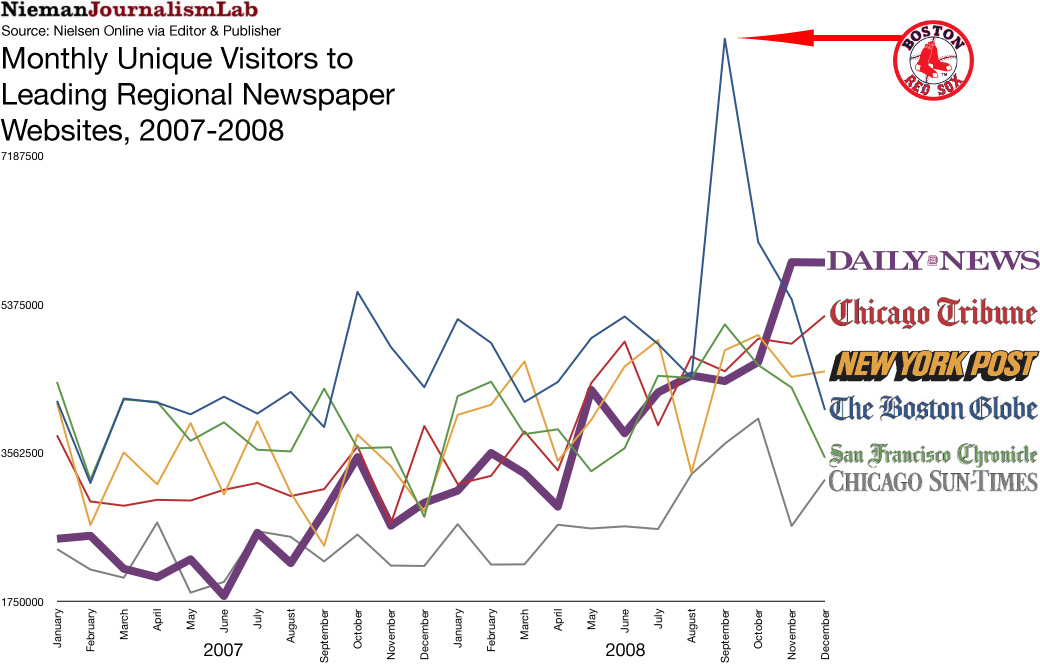
This graph, from Zachary Seward at Nieman, shows how wrong that argument is:

Regional newspaper circulation

Regional newspaper circulation

Note the rising trend. By most any measure, newspapers are being enormously successful in attracting web readers. We all have huge audiences. Newspapers in general were among the earliest and most aggressive adopters of the Internet as a new means to deliver information to their customers. The problem is not the use of the web to deliver the news, but rather the revenue model that goes with it. Ad revenue has not followed.

Our mistake was to think we were in the news delivery business, rather than the ad delivery business.