Communicating Science

Matthew Nisbet nails the New York Times’ hanging curve ball in his analysis of the problems of the collision between science and journalism, quoting Andrew Revkin’s fabulous line about “the tyranny of the news peg.” The context is a piece by the always provocative Gary Taubes about the problems of epidemiological research.

I’ve given a talk several times of late to scientists (I’ll be giving it up in Los Alamos in October – more on that later) where I try to highlight the difference between the public understanding of science – a fixed body of textbook knowledge – versus the murky way it happens out at the edge where scientists are actually learning new things. I view this misunderstanding as fundamental to a lot that goes on in the collision between science and politics. The latest frewfraw over the GISS temperature record is a classic example – a minor refinement that scientists view as part of the normal course of events. To those with the textbook model in mind, it suggests that science must have gotten it wrong. “But I thought last week they told me coffee was good for me!”

Revkin’s “tyranny of the news peg” suggests that journalists take the latest new bit of knowledge in a study published today in Science and treat it as a new fixed milepost ready for inclusion in the next edition of the textbooks, rather than a vague signpost pointing in an uncertain direction. Contingency is lost. To quote Nisbet:

One reason health studies might appear so confusing is because of what fellow NY Times reporter Andrew Revkin describes as the “tyranny of the news peg.”

As Revkin details in his excellent chapter at the Field Guide for Science Writers, one problem in the communication of uncertain science is that university research officers and journalists overwhelmingly define what’s news in science as the release of a new scientific study. Everyone benefits from this negotiation of newsworthiness, as universities compete for prestige and future funding dollars while journalists file dramatic narratives on deadline and with easier effort than required in a more thematic backgrounder.

Water in the Desert: Arizona Road Trip Edition


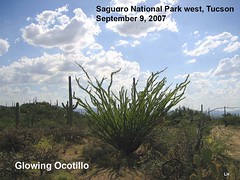
Ocotillo

Originally uploaded by heinemanfleck.

Lissa and I just back from a lovely weeks’ trip around Arizona. The main purpose was a visit to the University of Arizona and environs in Tucson for a project we’re working on. We spent a delightful day at the Laboratory of Tree Ring Research, made a pilgrimage to Tumamoc Hill to learn about packrat middens, and I got my first real taste from Julie Cole of how corals are used in paleoclimate reconstructions. As always, a huge thanks to all the scientists who are always so generous with their time and energy helping me understand what they do.

We had some play time, too, wandering through Saguaro National Park. I love desert ecosystems deeply, but probably the most fun for me of the entire trip was vicarious – watching Lissa have absolutely batshit crazy fun taking cactus pictures.

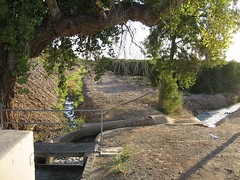
Some water stuff, too. I don’t know the Arizona water story very well, but found Phoenix absolutely fascinating. It’s a city that really didn’t take off until the invention of air conditioning in the 1950s, but it has taken off now in a really big way. My favorite water stop was the little Park of the Canals in Mesa (sorry, can’t find a good web page describing it). It preserves old canals dug by the Hohokam, who lived there before the Europeans arrived. Then in the late 1870s, Mormon settlers dug a lateral off of the Salt River and ran water seemingly uphill onto the mesa (hence the town’s name), digging out and reusing old Hohokam canals.

Mesa claims to be the largest suburb in the United States, and I believe it. But up on the north end of town, in a lowland along the dry riverbed of the Salt, we still find old citrus groves irrigated by lateral ditches taking water from the giant concrete lined canals built by the 20th-century descendents of the Hohokam and the Mormons. Like a throwback to my Southern California youth.

“permanent drought”

What happens when what used to be abnormally dry becomes the new normal?

Drought will become a redundant term as Australia plans for a permanently drier future, according to the nation’s urban water industries chief.

And climate experts yesterday predicted the present drought would continue, signalling a cruel summer for farmers and sparking fears of higher food prices.

“The urban water industry has decided the inflows of the past will never return,” Water Services Association of Australia executive director Ross Young said. “We are trying to avoid the term ‘drought’ and saying this is the new reality.”

Water in the Desert: Embudo Edition


Embudo

Originally uploaded by heinemanfleck.

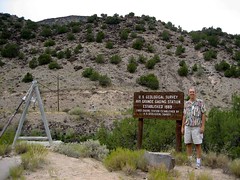
Driving up to Taos last weekend to see art, Lissa and I stopped at Embudo in the Rio Grande Gorge to see the oldest continuously operated stream gage in the United States. The river was running about 450 cfs while we were there – not a lot of water, but higher than normal for this time of year.

It’s a great bit of Western water history. It was established in 1889, three years after a devastating drought had the effect of quite focusing the minds of those who had thought rain really did follow the plow and we could build farms out beyond the 100th meridian with reckless abandon.


View Larger Map

Dry Down the River

This week’s drought tour of America takes us to Cape Girardeau, Missouri, where they just completed the driest August on record. It is an old river town, with its downtown opening onto a bend in the Mississippi River. For those interested in Western lore, it’s where John Wesley Powell spent a summer early in his military career, preparing the plans to defend the vital high ground above the river. I married into an old Cape Girardeau family, so I’ve always been interested in the place. Farms spread back up from the river, but they’re not doing so well right now:

For nonirrigated land, “it’s really been a pretty devastating summer,” said Brad Rippey, a meteorologist with the USDA.

Any rainfall at this point would be too late for the summer crops, Rippey said.

Water in the San Luis Valley

Staci Matlock has a nice story in the New Mexican about water problems in the San Luis Valley, on the upper Rio Grande in Colorado:

Until five years ago, most people thought water in the upper one-third of the San Luis Valley was hydrologically disconnected from the river. It was called a closed basin — no surface or groundwater flowed to the Rio Grande. Farmers and ranchers pumped away while fighting off recent attempts by wealthy investors to sell millions of gallons of water from the valley across the mountains to Denver and downstream to Santa Fe and Albuquerque.

Then came the crushing drought of 2002, Whitten said. Water began flowing from the Rio Grande backward, into the underground aquifer, and river flows decreased. In the basin, surface water from streams and creeks dried up as producers kept pumping. “North of the river, it became a losing system, and the aquifer declined,” said Whitten, a board member of the Rio Grande Water Conservation District.

Stuff I Wrote Elsewhere

On water and growth:

We live in the fastest growing part of the country. It is also the driest. We don’t seem to be doing a very good job of linking those two issues, according to experts gathered for a two-day symposium on water and growth.
“We don’t adequately combine planning for growth and planning for water,” said Peter Gleick, president of the Pacific Institute in Oakland, Calif.
“The people responsible for making the decisions about building new homes are typically not the people who make decisions about water,” Gleick said.

Thinking About Future Climate

This paper by Martin Beniston on recent temperature extremes is a great example of the sort of exercise we need at the regional scale to help societies think about climate change. Switzerland has been hotter than Hades lately (bonkers 2003, record July 2006, near record winter 2006-07). Attribution is tricky, but Beniston neatly sidesteps the attribution problem and looks merely at how Switzerland’s recent experience fits into what the models say. The result is that the sort of temperatures they’ve been experiencing are the sort of temperatures suggested by the models under greenhouse warming. So, whatever the cause, we can learn from them:

By analyzing the impacts that these extreme conditions currently impose on environmental (e.g., the cryosphere, hydrological systems, and the biosphere) and socio-economic systems (e.g., human health, agriculture, hydropower), analogies with the future can be drawn for timely decision-making in terms of risk-reduction and adaptation strategies.