
Steve B, in the comments, points to an AP story about a new study in Science Friday by Fu et al. on what they say is evidence that the jet stream is creeping poleward. They only hint at the implications in the paper, noting that “the poleward shift of the jet streams and the associated subtropical dry zone, if it continues, could have important societal implications.” Umm, yeah, speaking as someone living on the margins of an area that would likely get drier, I would say that would be an understatement. But it’s a very short time series (1979-2005), so caution is in order.
Bird of Paradise II
Mom sends along this note in response to my post last week about my favorite bird of paradise from our house in California:
I didn’t know that you remembered it so fondly. Did you know that that plant was Grandpa’s gift to me on the Mother’s Day just after you were born–the grandson who carried his name.
Sweet.
Stuff I Typed Elsewhere
I wasn’t sure what to expect, but I was incredibly pleased with the questions we got today for the drought chat over at the ABQJournal web site. My favorite bit:
Amanda:
Are we able to predict when there will be a serious problem with NM’s water supply?John Fleck:
The short answer is “no.”The longer answer depends on two separate problems.
The first is the uncertainty associated with supply. Climate scientists cannot yet predict when droughts will happen, or how many years they will last. What they can say with certainty is that droughts that last a decade or more have happened repeatedly in the past, and there’s no reason to think they won’t happen in the future.
The second part of the problem is our steadily increasing water demand as population grows. That’s also hard to predict, but the trend there is clear. There are more and more us, and we’re using more water.
The message from archaeologists is that, in the past, societies that didn’t pay attention to the first part – climate’s ups and downs – had serious problems if they grew substantially during the wet parts of our inevitable climate cycles and didn’t pay attention to the fact that, sooner or later, it’s going to get dry again.
Drought Chat
I’m the guinea pig for an on-line chat experiment at the office. My chosen topic is drought science, of course. Join us tomorrow (Thurs. 5/25) at 1:00 p.m. MDT, or send in your questions early.
The Last Word
My employer kindly pays for a subscription to New Scientist, which has become my favorite curl-up reading, not least because the Brits seem to have mastered the amusement offered by their native tongue. My favorite bit is the last couple of pages, including the hilarious Feedback and The Last Word.
The latter is a feature in which readers pose questions and then readers write in and answer them. This seems, from a journalist’s perspective, an ideal approach, having one’s readers do all one’s work for one. No doubt a subtle touch is required to pick and choose among both questions and answers, but the results are a delight.
Now they’ve packaged the whole kit (or at least a big lot of the last ten years’ worth) in a book: Does Anything Eat Wasps? Why do people have eyebrows?
Route 66 Bridge

A favorite photo of the old Route 66 bridge, over the Rio Puerco (the river of pigs) west of Albuquerque. It’s closed to traffic, but has been preserved as a bizarro tourist attraction. You can walk out on it and see that there’s no water in the Rio Puerco. There’s almost never any water in the Rio Puerco, unless you hit it the day of the occasional storm.
It’s a desert.
Marlins Minors
In honor of Drew Niles’ 8th-inning home run this afternoon, I’ve added Marlins Minors to my Planet. (Hat tip Miguel.)
More Stuff I Wrote Elsewhere
Very late to the party, I finally got around to assembling what we know about that May 4 streak in the sky.
Stuff I Wrote Elsewhere
Attacking in a bicycle race— riding off the front of a pack of cyclists, heading into the wind— is either a fool’s errand or the sign of a champion, or both.
Tony Geller said he’ll always remember his riding buddy, Bill McLain, as “the guy who attacks all the time, any time.”
Out in front by himself or herself, a rider has to work harder against the wind.Protected in a pack, a rider expends less effort. But a race can’t be won from the middle of the pack. So in the mid-1990s, when he raced the old “Tuesday Night Crits”— short weekly contests among local racers, McLain would bolt from the pack as soon as he could to see who was strong enough to go with him.
His attitude, Geller recalled, was that if you were a strong rider, it was your obligation to attack, to push the race. And if you were a weak rider, you had nothing to lose.
“He would be off the front in the first lap or two,” said Geller.
But when McLain died May 6 of complications from melanoma at age 48, the tributes that piled up on the nmcycling.org Web site weren’t about his skills on the bike. They were about the contributions he made, large and small, to his community.
Even if you’re not a cyclist, it’s really worth reading the tributes to Bill over at the NMCycling forum. They’re beautiful.
Bird of Paradise
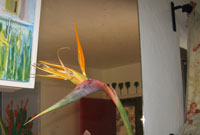 The house I grew up in had a beautiful bird of paradise in the front yard. I took it, like much that surrounds us as children, for granted (water to the fish), but in retrospect I recognize it as the most beautiful plant I’ve known.
Last Monday, at Albuquerque High School’s graduation, each student was handed a bird of paradise, the class flower of the graduates of 2006. The flowers seemed somehow unwieldy piled up in on a table to the left of the stage, neat and orderly but not quite matched, very much like the rows of students in their green caps and green gowns – neat and orderly, but not at all matched.
I did not expect the emotions I felt as I watched Nora pick up her flower, and the bird of paradise is the least of the thing. But I will let it stand in for something richer and more complex and difficult to articulate, and say simply that it adds a fond touch.