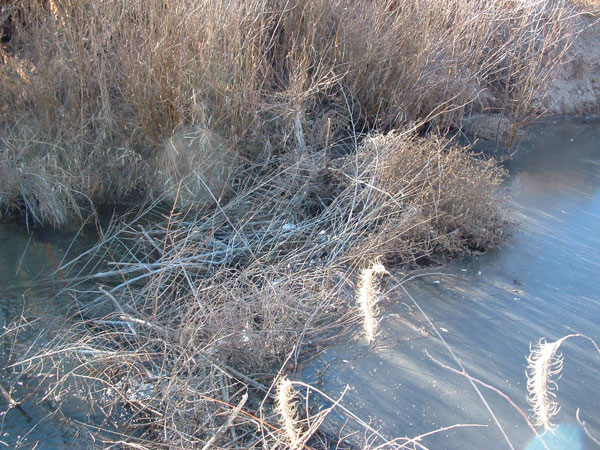
It is a beaver dam

As I’ve mentioned before, the coolest aspect of my job is having carte blanche to call up smart people and make them explain stuff too me. Today’s case in point is Paul Polechla, the University of New Mexico’s aquatic mammals expert. When I saw what I thought might be a beaver dam a couple of weeks ago in the bosque, I followed a trail of bread crumbs to Paul’s door. We ended up making the short trek Thursday morning, and Paul confirmed that they are beaver dams – two of ’em in a few hundred yards of bosque drainage ditch, right in the middle of the city.

beaver dam in the bosqu

The sticks that I thought had been too neatly cut were, in fact, the beavers’ work. Paul showed me the teeth marks, and they’re amazing – incredibly neat work. And the dam was amazingly sturdy. It looked like a flimsy stick pile to me, but Paul just walked right across it.

More on Xu and Peiser

Benny Peiser, in the comments below, suggests I am misleading my readers and asks that I set the record straight. So let me quote from both Benny’s CCNet email and the Xu et al. paper.

First Benny’s CCnet subject line:

NEW STUDY: “SOLAR ACTIVITY IS PRIMARY DRIVING FORCE OF CLIMATE CHANGE”

Now Xu et al., which includes several variants on that quote. I’ll try to get them all. First:

Our study reveals that quasy-100-yr fluctuations of solar activity are possibly the primary driving force of Chinese temperatures during the past 6000 years. (emphasis added)

Then later:

Comparisons between temperature variations and solar activities indicate that both temperature trends on centennial/millennial timescales and climatic events are related to solar variability, suggesting that solar variability is possibly a primary driving force that influences temperatures. (emphasis added)

And again:

Quasi-100-year fluctuations of solar activity may be the primary driving force of temperature during the past 6000 years in China. (emphasis added)

Benny, in his comments, suggests that in his subject line he was “simply quoting the authors themselves.” But he wasn’t. The authors used qualifying words. Benny dropped them from his subject line.

Benny asks me, “How do you know what I was thinking?” My answer is that I drew an inference based on three things: first, your decision to drop those words from your headline, second, your failure to point out that the study had no relevance to the warming of the past century, and third your well-documented skepticism of the consensus view regarding the anthropogenic component of current warming.

My apologies if I inferred incorrectly. Perhaps, Benny, you might clarify what significance you think this paper does have, if any, for our understanding of changes in global climate over the past century?

Plants and Drought

There are essentially two ways societies can respond to drought.

One is societal adaption – stored water and food (or water and food trading), limits on growth during wet times, or mobility to move from dry places to wet places.

The other is to just ignore reality (or not understand the reality) and then get screwed when things dry up.

Mobility seems to have been the preferred option in pre-Anasazi Four Corners cultures, for example – moving to higher, wetter country when things got dry. The growing season was shorter, so it was sub-optimal, but the tradeoff worked. Populations tended to stay small, as well. The Anasazi opted for food trading, spreading their risk across a larger area. This worked , but failed when drought hit the whole region simultaneously. The population was too large for the mobility option to work – they already lived everywhere.

The post-Anasazi Puebloans followed by the Spanish and Mormon immigrants, followed by Arthur Powell Davis and the U.S. government, developed ever more sophistiticated water storage and diversion technologies. Today, we live (and farm) essentially everywhere and we have stored water and we have complex food trading networks.

All this is rambling prelude to a great plant metaphor in a new paper by a team of geneticists led by Patrick Achard at the John Innes Centre in Norwich, UK.

Continue reading ‘Plants and Drought’ »

Fact-Checking Benny Peiser

Benny Peiser last week sent ’round a note on his CCNet list about a study just published by Hai Xu and colleagues from the Chinese Academy of Sciences on the solar-climate link. “New study – Solar Activity is Primary Driving Force of Climate Change” was Benny’s subject line.

The paper wasn’t on line for free, so it took me a few days to swing by the university library and pick up a copy. It was worth it – a very interesting paper, suggesting some tantalizing long-term climate-solar links. But it doesn’t say what Benny and the other climate skeptics who have been so approvingly linking to it seem to think it says.

Xu and his colleagues used oxygen isotopes in peat bogs as a temperature proxy for the last 6,000 years at two sites in China. They compared this with models of solar output over the last 6,000 years and found that “temperature events … correspond well to solar perterubations during the last 6,000 years.” The problem, when I picked up the paper, is that the time scale did not appear fine enough to tease out the temperature increase of the last 100 years, and Xu et al., in the paper’s text, were silent on the question. So I wrote him and asked if he felt their work supported a solar explanation for the warming of the last 100 years. His response:

As you have noticed, because the time resolution of peat deposition (in our study) is not high enough to discuss the dynamic of temperatures on interannual/interdecadal scales, we did not address the cause of the ongoing global warming in the past century.

The paper is “Temperature responses to quasi-100-yr solar variability during the past 6000 years based on delta 18 O of peat cellulose in Hongyuan, eastern Qinghai-Tibet plateau, China,” by Hai Xua, Yetang Hong, Qinghua Lin, Yongxuan Zhu, Bing Hong and Hongbo Jiang, Palaeogeography, Palaeoclimatology, Palaeoecology, Volume 230, Issues 1-2 , 17 January 2006, Pages 155-164

Piltz in Eos

Rick Piltz, the guy who left the U.S. Climate Change Science Program in a highly visible way last summer, has a piece in the Dec. 27 issue of the American Geophysical Union’s Eos, calling for a “Second U.S. National Climate Change Assessment.”

Piltz argues that the National Assessment, completed in 2000, was “a pioneering experiment in stakeholder engagement and societal relevance” that has been abandoned in favor of a process “in which drafts by lead authors will undergo final review at a political level prior to being published as government documents.” In addition to complaining about a lack of independence, Piltz complains that the work just plain isn’t getting done:

These prospective reports do not amount to an integrated effort to effectively inform society and policy-makers responsible for dealing with the climate change problem…. In addition, the convoluted bureaucratic process under which these reports are being developed has led to lengthy delays in even the early stages of designing and drafting them.

Only one of 21 planned reports has even been released in draft form, Piltz complains:

The whole enterprise has become bogged down.

Although a great effort may be expended over a period of yeras by a large number of scientific expert authors and reviewers to produce these reports, the process seems designed to `run out the clock’ on eight years of this administration and about $16 billion in funding for research without even coming close to producing a coherent body of assessment work on anthropogenically-influenced climate change and its implications for national policy-making and planning.

Piltz calls for “a second U.S. National Climate Change Assessment … based on advances since the 1990s in understanding the climate system and potential ecological and societal impacts of climate change in the United States.” And he calls for the institutionalization of the process, “i.e. an ongoing dialogue between scientists, policy-makers, and other stakeholders, with periodically updated, scientifically-based assessments.”

Emanuel in the Times

Interesting interview with hurricane guy Kerry Emanuel in today’s New York Times.

Q. There are scientists who say of fossil fuel consumption and global warming, We may not have all the evidence yet, but we ought to be acting as if the worst could happen. Do you agree?

A. It’s always struck me as odd that this country hasn’t put far more resources into research on alternative energy. Europeans are. France has managed to go 85 percent nuclear in its electrical generation. And the Europeans have gotten together to fund a major nuclear fusion project. It almost offends my pride as a U.S. scientist that we’ve fallen down so badly in this competition.

Building Rising

I’ve been living Lissa’s construction adventures vicariously for months, so Sunday she was persuaded to take my parents and I to the job site down near Corona where she’s helping build a house. It was great seeing Lissa in her work environment, which I never really get to do.

Lissa at job site

It’s a gorgeous straw bale home set in the piñon and juniper with a view out the kitchen window that is to die for, or that will be to die for once there’s a window and a sink. The landscape around it is magnificent – arid cattle country that made ordering a hamburger for lunch at El Corral in Corona seem right.