
Kevin Vranes has noticed liberals noticing “peak oil”. I think he’s on to something interesting here.
Nature and the Press
It’s an odd day when I find myself agreeing with Benny Peiser on a climate change question, but his post Thursday to his CCNet list, in which he blasted media of coverage of the Nature paper on possible changes in the thermohaline circulation, seems on point.
In fact, as I’ll point out below, there’s been some good coverage – including good skepticism in the New York Times from one of the RealClimate crew. But lots of the coverage has been very bad, highlighting a problem with the system by which results get hyped by virtue of their presence in Nature.
Continue reading ‘Nature and the Press’ »
Becoming a World Class City
Via Rich Burridge, an interesting experiment: how many Taco Bells within 10 miles of you?
With their store locator, I found just 15. Rich found 23 around his house, but a little searching found as many as 51 (Hollywood and Manhattan). 15? That’s pathetic. Albuquerque can do better. All we need to become a world class city is more Taco Bells, eh?
update: For better or worse, with Starbucks the number is 22. That compares to 54 Starbucks in Rich’s 10-mile ‘hood, 128 within 10 miles of Hollywood and a staggering 210 within 10 miles of Rich’s chosen Manhattan zip code.
Outliers in Nature
A great comment from James Annan on the meta-issues about yesterday’s Nature paper on the possibility that the thermohaline circulation may be slowing:
Their(Nature’s) deliberate policy to select only the most “exciting” results, which are then picked up and amplified by the press, pretty much guarantees that the outliers are given a prominence that substantially overstates their true significance.
Tracy Puts in an Appearance
Nora offers this helpful contribution to the discussion, a sort of visual aid:
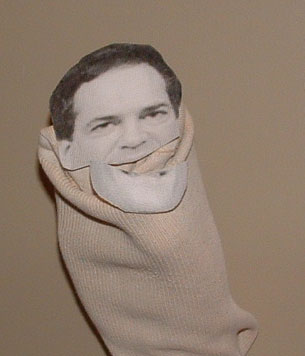
I told her I thought it bore a striking resemblance to Tracy Spenser. Though there are other possibilities.
I Am Urinestain!
The ever-thoughtful Michael Fumento is back at it, this time calling me a “a human sock puppet”. Thanks, Michael! I’d been at somewhat of a loss for an idea for next year’s Halloween costume. I was thinking of dressing up as Tracy Spenser, but this is much better.
Pacific Decadal Oscillation
I’m not sure I quite understand what the Pacific Decadal Oscillation is, but here’s a new paper suggesting it’s sort of nothing at all. Or, more precisely, that it’s really a combination of other things, not a thing in and of itself.
(climate and drought wonks go ahead and click through – the rest of you can move along, nothing really to see here)
Drought’s Back
From the CLIMAS folks at the University of Arizona:
Drought – Moderate drought to abnormally dry conditions persist in southeastern and northeastern Arizona, and have expanded eastward to include most of New Mexico.
* Pasture and range land conditions continue to degrade in Arizona and improve slightly in New Mexico.
* Drought conditions are much improved from last year, but the large Colorado River reservoirs and Elephant Butte Reservoir in New Mexico remain below average.
Temperature – Since the start of the water year, and over the last 30 days, temperatures over most of the Southwest have been above average.
Precipitation – Since the start of the water year, most of the Southwest has been drier than average.
Climate Forecasts – Models indicate increased chances of above-average temperatures in the Southwest through May of 2006, but there are no forecasted precipitation anomalies for the region.
El Niño – ENSO-neutral conditions are most likely to exist during the next six to nine months.
The Bottom Line – Drought is likely to persist along some parts of the Arizona-New Mexico border. Hydrological drought continues to affect some large reservoir levels in the Southwest.
Check out especially the big reservoirs on the Colorado (Powell and Mead) which despite a wet 2004-05 are still well below average. New Mexico’s reservoirs also are in sorry shape despite coming off an unusually wet year. In other words, the big storage systems in the southwest are heading into the 2005-06 water year in pretty lousy shape.
Snowpack is currently lousy (the CLIMAS chart here is easy to read, more up-to-date stuff from the Western Regional Climate Center is here. Don’t sweat this yet. It’s quite early in the year for this measure – you can make this up in a hurry with one or two good dumps. Last weekend’s “storm” is not what I’m talking about. Chamita (my favorite SNOTEL site for no particular reason except that I love its name) got less than an inch of snow.
(You can watch snowpack in real time at the NRCS’s New Mexico SNOTEL page. Click on one of the attractive “pushpins” on the map for site data. I trust this more than the self-reported ski area numbers you often hear on the TV news or, ahem, read in the newspaper.)
Stuff I Wrote Elsewhere
In which I get to dabble in the great issues of the day (sub. req.), involving aluminum tubes and the like:
Wilson said in an interview that analysts from Sandia and Los Alamos National Laboratory were part of a team of Department of Energy nuclear experts who concluded that a key piece of evidence— high-strength aluminum tubes Iraq wanted to buy— were probably not intended for nuclear weapons manufacturing.
According to the March report from the independent Weapons of Mass Destruction Commission, the tubes were more likely intended for use in non-nuclear battlefield rockets.
In contradiction to the conclusion by the nation’s nuclear weapons experts, President Bush told the United Nations Security Council in September 2002, “Iraq has made several attempts to buy high-strength aluminum tubes used to enrich uranium for a nuclear weapon.”
More Google Fun
Favorite current searches: largest pineapple and man dinosaur coexist. As I’ve mentioned before, if one writes about a topic sufficiently obscure, Google stardom awaits.