
Societal Complexity

On our October trip, Lissa and I visited the Anasazi Heritage Center outside Cortez in southeastern Colorado. It’s a neat museum, built to record, preserve and provide public access to excavations done before the nearby McPhee Reservoir was filled. Adjacent to the museum, there’s a small pueblo room block that’s been excavated and then stabilized for visitors to see.

This morning I was reading an amusing discussion of the site by Joseph Tainter in the introduction to Evolving Complexity and Environmental Risk in the Prehistoric Southwest. Tainter points out the relative complexity of two structures – a small pueblo room block “consisting of a few rooms, and once home to a handful of people.” Next to it is the museum, “a great edifice, many times the size of the little pueblo…. It exists because our national government commissioned it to be built, and pays each year for a permanent staff, energy to heat and cool the building, and a fleet of vehicles.” Then he adds:

Indeed, the energy we have spent to excavate these small pueblos, analyze and curate their remains, attend scientific conferences, publish interpretations and theories, and tell the public what we have learned may well exceed what the prehistoric Puebloans themselves consumed in their lives.

I personally say it’s energy well spent.
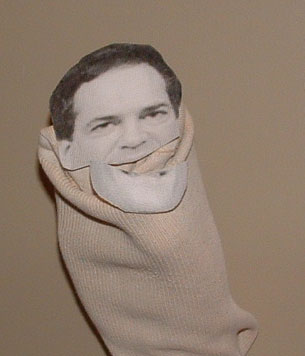
The Strange Case of Michael Fumento

There’s this strange sort of schoolyard bully pleasure in taunting Michael Fumento. I wonder, though, if we’re the bullies, or if he is. I sorta feel like the skinny guy, taking pleasure in the bully’s comeuppance. But I dunno. Maybe we’re being the bullies. Should I feel bad, picking on poor Michael?

The thing is, Fumento is, at times, a quite talented journalist. But then, over and over again, he shows himself to be a complete tool.
Continue reading ‘The Strange Case of Michael Fumento’ »

Zelicoff on the Flu

I meant to blog this when it came out a couple of weeks back: Al Zelicoff’s take-down in the Albuquerque Tribune on “bird flu mania”

So, are the fears justified for Washington’s preparations against the spread of this new “killer” influenza to humans? The short answer is no. The threat is extremely remote.

It’s not that Al doesn’t think there are legitimate threats out there. He does. And he also argues, I think persuasively, that we’re not doing some of the fundamental things we could to keep our guard up. He’s pushing a relatively low-cost solution involving “syndrome surveillance,” in which sentinel doctors and nurses report briefly and in real time on the stuff that’s coming through their doors, allowing a sudden uptick in, say, respiratory infections, to be quickly noticed.

I’ve testified four times on Capitol Hill about it, including before Sen. Bill Frist, president of the Senate and its only physician. He applauded its use and numerous successes. As Frist himself has noted in his book, “Every Moment Counts,” should a bioterrorism attack occur or another novel disease reach our shores, we are hopelessly hamstrung by our lack of situational awareness of disease patterns in animals and humans.

Nature and the Press

It’s an odd day when I find myself agreeing with Benny Peiser on a climate change question, but his post Thursday to his CCNet list, in which he blasted media of coverage of the Nature paper on possible changes in the thermohaline circulation, seems on point.

In fact, as I’ll point out below, there’s been some good coverage – including good skepticism in the New York Times from one of the RealClimate crew. But lots of the coverage has been very bad, highlighting a problem with the system by which results get hyped by virtue of their presence in Nature.
Continue reading ‘Nature and the Press’ »

Becoming a World Class City

Via Rich Burridge, an interesting experiment: how many Taco Bells within 10 miles of you?

With their store locator, I found just 15. Rich found 23 around his house, but a little searching found as many as 51 (Hollywood and Manhattan). 15? That’s pathetic. Albuquerque can do better. All we need to become a world class city is more Taco Bells, eh?

update: For better or worse, with Starbucks the number is 22. That compares to 54 Starbucks in Rich’s 10-mile ‘hood, 128 within 10 miles of Hollywood and a staggering 210 within 10 miles of Rich’s chosen Manhattan zip code.

Outliers in Nature

A great comment from James Annan on the meta-issues about yesterday’s Nature paper on the possibility that the thermohaline circulation may be slowing:

Their(Nature’s) deliberate policy to select only the most “exciting” results, which are then picked up and amplified by the press, pretty much guarantees that the outliers are given a prominence that substantially overstates their true significance.

Pacific Decadal Oscillation

I’m not sure I quite understand what the Pacific Decadal Oscillation is, but here’s a new paper suggesting it’s sort of nothing at all. Or, more precisely, that it’s really a combination of other things, not a thing in and of itself.

(climate and drought wonks go ahead and click through – the rest of you can move along, nothing really to see here)

Continue reading ‘Pacific Decadal Oscillation’ »