
Changing Snowpack

A paper in Nature by Tim Barnett at Scripps and Jenny Adam and Dennis Lettenmaier at the University of Washington suggests climate change problems for folks who depend on snowpack for their water supplies:

All currently available climate models predict a near-surface warming trend under the influence of rising levels of greenhouse gases in the atmosphere…. In a warmer world, less winter precipitation falls as snow and the melting of winter snow occurs earlier in spring. Even without any changes in precipitation intensity, both of these effects lead to a shift in peak river runoff to winter and early spring, away from summer and autumn when demand is highest. Where storage capacities are not sufficient, much of the winter runoff will immediately be lost to the oceans. With more than one-sixth of the Earth’s population relying on glaciers and seasonal snow packs for their water supply, the consequences of these hydrological changes for future water availability—predicted with high confidence and already diagnosed in some regions—are likely to be severe.

For those of us in the western U.S.:

There is not enough reservoir storage capacity over most of the West to handle this shift in maximum runoff and so most of the ‘early water’ will be passed on to the oceans. These hydrological changes have considerable impacts on water availability.

The one exception, they note, is the Colorado River basin, where the massive multi-year storage behind the big dams is a sufficient buffer against the early snowmelt timing problem. But the Washington team, in Climatic Change last year, published results of modelling studies suggesting that, independent of snomelt timing, overall Colorado Basin runoff could be significantly less in a warmed world.

Redefining Science

I’m in the midst of Chris Mooney’s book, and I must admit that while I think he has assembled a masterful catalog of science misuse, the discomfort I’ve felt about his thesis remains – that the Right is not alone in its misuse of science and any useful discussion of the issue needs to recognize this broader issue. I was reminded of that this morning by Dennis Overbye’s piece in the New York Times this morning:

Once it was the left who wanted to redefine science.

In the early 1990’s, writers like the Czech playwright and former president Vaclav Havel and the French philosopher Bruno Latour proclaimed “the end of objectivity.” The laws of science were constructed rather than discovered, some academics said; science was just another way of looking at the world, a servant of corporate and military interests. Everybody had a claim on truth.

The right defended the traditional notion of science back then. Now it is the right that is trying to change it.

Until we recognize the broader forces at work here on both Left and Right – the willingness of both to select and understand science in ways that fits their individual values and policy choices – we’re not going to make any progress on this issue.

Scientization

Ross McKitrick and Steve McIntryre have taken Roger Pielke Jr. up on his offer that they spell out their arguments about “why those of us not involved in the hockey stick fight should care about the continuing battles.”

Neither offers any argument whatsoever regarding how this might influence my thinking about what policy choices I (or we as a whole) face. It’s classic Sarewitz scientization:

Scientific uncertainty, which so often occupies a central place in environmental controversies, can be understood not as a lack of scientific understanding but as the lack of coherence among competing scientific understandings, amplified by the various political, cultural, and institutional contexts within which science is carried out.

Stuff I Wrote Elsewhere

On continued funding (sub. req.) for some nuclear weapons research programs that have not performed up to snuff:

Members of Congress last week called for an independent investigation into a Los Alamos National Laboratory nuclear weapons project that is 18 years behind schedule and more than $250 million over budget.

But funding for the project and others with similar troubles will continue, drawing criticism from watchdogs who say there has been no accountability for the nuclear weapons program’s problems.

“They’re rewarded for their failures,” said Greg Mello of the Albuquerque-based Los Alamos Study Group.

(More back story here.)

nu descendant en escalier

My favorite painting showed up amidst a fascinating package on human creativity in the Oct. 29 New Scientist (sub. req.)

Nude Descending a Staircase

Historian and philosopher of science Arthur Miller says this:

Marcel Duchamp had read some works on relativity and the influence is obvious in his Nude Descending a Staircase.

I want to believe this. I’m not sure I do, but I want to. It’s such a terrific painting on so many levels, not the least of which is comic. So another level of meaning is unnecessary. But it’s a fun possibility.

Von Storch Revisited

Given my personal feeling that variability is the climate change bugaboo that matters the most, I spent a lot of time thinking and asking about last year’s Science paper by Hans von Storch about variability in the paleo record. Now there’s a new paper in Journal of Climate by Mann, Rutherford, Wahl and Amman that sheds some new light on the issue.

Continue reading ‘Von Storch Revisited’ »

Global Warming Has Its Winners, Too

Global warming has its winners as well as losers:

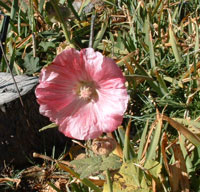
hollyhock

That’s a hollyhock in the front garden, still blooming away two weeks after the average first fall freeze date in Albuquerque. Overnight lows for November in Albuquerque this month have averaged 42 F, 7 1/2 degrees above average. Daytime highs are 8 degrees above average.

Obviously I’d be an idiot to hang anything on a single fortnight’s data, but this is consistent with a long term trend, with a “growing season” (last spring frost to first fall frost) averaging two weeks longer here than it used to. Good for the garden, eh?

update 6:30 p.m.: I almost forgot half the reason for this post, which is that the National Weather Service is forecasting a freeze Wednesday morning.

(click through for the fine print)
Continue reading ‘Global Warming Has Its Winners, Too’ »

105.1

With a couple of fun longish rides this weekend, including a lovely trek through the bosque yesterday with Jaime, I had my first 100-mile week since last March, when the knee drama began.

bike mileage graph

It’s not all about the numbers, of course. It’s also about three casual hours on the bike chatting with my pal, and the golden leaves down in the bosque. But the numbers also are part of the fun, and the numerical milestone matters. Green dots are weekly miles, black line is a four-week rolling average.