Sudden Transitions

I find myself scratching my head over the latest debate between the RealClimate crew and Roger Pielke Sr. regarding the definition and use of “chaos” (non-linear sensitive dependence on initial conditions) in weather and climate modelling.

As often is the case in debates like this, both sides are correct in the point they’re making, differing not on the technical issue but the choice of emphasis. (I can’t help but note the irony here that, in arguing over “chaos,” the disputants are engaging in exactly the sort of “proxy argument” that Roger Pielke The Younger complains about so articulately.)

William and James at RealClimate argue that weather is chaotic and climate (as defined as weather averaged over time) is not. Roger argues (in the RC comments and also his own blog) that such a definition of climate fails to capture an important characteristic: “Observations show chaotic behavior of the climate system on all time scales, including sudden regime transitions.”

I don’t disagree with either group here. Given their definition, which is useful for some purposes, James and William are correct. It just so happens that for me, as a consumer of climate science, Roger’s definition is more useful. I recognize the GCMs’ globally averaged long-term rising trends under greenhouse emissions as important, but the sort of abrupt transitions that the models don’t yet capture are far more important to me, because (see drought posts below), it’s variability that kills ya, not long term trends. From Roger in the comments at RC:

In terms of how we are altering the climate, it is these sudden transitions that we need to understand, rather than focus so much of our resources on assessments of the global averaged temperature trend.

Megadrought

While we’re on the subject of droughts, Ed Cook and his colleagues and Lamont-Doherty have a new review paper (preprint, 10 meg pdf) of North American drought that makes some relevant points about the differences between what happens here and the current African drought/famine I mentioned below.

Point one is the distinction between the effects of the Dust Bowl of the ’30s and the Southwest drought of the 1950s:

The 11-year 1950’s Southwest drought was likewise extreme, with it being centered primarily over Texas and New Mexico. The environmental impact of the Southwest drought was severe, but it had less socioeconomic impact than the Dust Bowl drought because of irrigation, improved agricultural practices, better governmental support, and a much stronger underlying economy.

Point two relates to my comment about a society’s resilience on all relevant time scales. In this case, “relevant” could mean on much longer time scales than we’re currently prepared for:

For example, the 16th century megadrought identified by Stahle et al. (2000) is now seen to have affected large areas of North America, especially in the West and northern Mexico, and was much more prolonged than any of the 20th century droughts. The drought reconstructions also provide clear evidence for a much drier climate across the West and Great Plains during Medieval times, a drought that lasted with few interruptions for a few hundred years and which greatly taxed both hunter-gatherer and agriculturalist populations (Jones et al., 1999). Such “no analog” megadroughts are scary because the modern-day agricultural and hydrologic systems that depend upon adequate water supplies to produce and function may not have the resilience to survive much beyond the observed “worst case scenario” droughts of the past 100-150 years, e.g., the Dust Bowl drought.

Drought and Its Impacts

Michael Wines had a terrific story in Wednesday’s New York Times on famine in Africa that evokes a point Mickey Glantz makes in his book Climate Affairs. First Glantz:

Closer scrutiny of most famine situations uncovers a multistressed political environment, of which drought was but one factor.

Now Wines:

War wrecked Mozambique’s economy; socialism and plunging copper prices reduced Zambia to penury; Zimbabwe’s economy collapsed after the government seized its richest farms, which were owned by whites.

In Malawi, 20 years of shifting political rule and economic policies have turned an already poor nation into a basket case. The AIDS pandemic – the rate of infection is about 15 percent among all adults, but perhaps 25 percent in Chikwawa – has cut down family breadwinners and left 900,000 children without one or both parents.

Most Malawians survive on plots of a couple of acres, often lacking even oxen for plowing. Irrigation is unheard of, leaving them dependent on good rains for survival.

Lately, rains have been spotty. There were severe hunger crises in 2002 and 2003, and this year’s disaster was brought on when good rains in late 2004 dried up in 2005, just as the corn crop was ripening.

The underlying climate message here is that meteorological “drought” is a normal phenomenon, and the bad shit comes down when it’s overlayed on societies that don’t have the resiliency, for whatever reason, to cope with the bottom quartile of their normal variability – on all time scales.

Youth, Death and an Anthem to a Life I Never Lived

I’ve been listening to Lowell George off and on lately, and I keep flipping around to Willin’, which has always been an anthem of sorts to me. But of what?

If anthems are defining sacred texts, then Willin’ must be about as far from my life as a text could be, the words of a dogged but slightly reckless survivor, far removed from my cautious middle class existence:

I’ve been from Tucson to Tucumcari,
Tehachapi to Tonopah.
I’ve driven every kind of rig that’s ever been made,
Driven the back roads so I wouldn’t get weighed.

On a long strange trip once, when I was much younger, I stopped to pee and get gas in a small town called Rome, Ore. Small town doesn’t really capture Rome – I remember the gas station, and a house behind it and a couple of mobile homes and that’s it, out in the high dry eastern part of the state. The toilet was wedged in a corner of the restroom so that if you sat on it, your knees hit the wall. And there, right above where your knees would hit, in black pen on bare plywood, was this graffiti:

I love this place called Rome.

South from Rome, across the desert of Nevada, we eventually got to Tonopah. I was out of school and out of work, and I really didn’t know what the next thing was going to be. But I was 22 with camping gear and a pretty girl beside me – it was her car – and I don’t really remember this, but I imagine I had a song stuck in my head:

And I was out on the road, late at night,
Seen my pretty Alice, in every headlight.
Alice. Dallas Alice.

The first time I heard that song – likely not the first time I heard it, but the first time I really heard it – was upstairs in the Whitman College student union building ballroom. Gary Vaughn sang it, and I believed him when he said he’d be OK if we just gave him weed, whites and wine. Gary had charm and the air of long-haired rock singer recklessness about him that – what does Capt. Renault say in Casablanca? “Rick is the sort of man who, if I was a woman, I would be in love with Rick.”

Years later, I ended up camped with Gary on a bluff in Baja overlooking the Pacific on a night so dark and clear that I am sure we could see the edge of the universe.

Baked by the sun
Every time I go to Mexico.
And I’m still….

This must sound very Kerouac, and that’s the romantic notion I had when I was 22 peeing in that restroom in Rome – “to prove that no matter how you travel, how ‘successful’ your tour, or fore-shortened, you always learn something….” I was going to be a writer. (Not “I was a writer,” but “I was going to be….”) Here I am two decades later, and I am a writer, and it turns out to have been a very different thing than I had imagined. Not in a bad way, just different.

I’ve been kicked be the wind, robbed by the sleet
Had my head stoved in but I’m still on my feet and I’m willin’, oh I’m willin’

There’s a point where Interstate 10 – the Christopher Columbus Intercontinental Highway – spills out onto the Pacific Coast Highway in a big sweeping curve, Santa Monica, California, with a parkway of palm trees and homeless people and the vast Pacific Ocean to the west. Glance back over your shoulder, and there is the Santa Monica Pier, an amalgam of earnest midwestern tourists and beach scum. At night, you can go out to the end of the pier and watch the waves come in, dim broken white lines of foam. That was where my novel was going to be set – an apartment upstairs from the carousel on the pier; the bumper cars; the street kids.

My problem was that I never really figured out how to make stuff up. But the world seems content to offer up things that are far more than I could ever have imagined, so journalism seems a good fit, just sort of standing back and letting it all be, writing a bit down occasionally for posterity, noticing stuff that I think is worth sharing.

It’s a much more modest way of writing, with far less angst (this is a good thing) than the writer’s life I imagined, all Kerouac and dark archetypes. It’s less about me and more about the things the words circumscribe.

Gary’s gone, died last summer. He and has family had just built a place outside Missoula. I still treasure my fantasy of youth, think of it fondly, but real life is far more sad and painful and important than anything I could possibly have made up.

And if you give me: weed, whites, and wine
and you show me a sign
I’ll be willin’, to be movin’

Boslough’s Pi

Albuquerque scientist Mark Boslough’s famous pi hoax resurfaces, this time morphed on OhmyNews:

Crawford Texas – Mathematicians and educators across the nation were stunned and infuriated after President signed a bill into law yesterday redefining pi, a mathematical constant used around the world. The bill to change the value of pi to exactly three was introduced without fanfare by Tom Delay (R, Texas), and rapidly gained support after a letter-writing campaign by members of the Solomon Society, a traditional values group.

The law took the mathematical community by surprise. “It would have been nice if they had consulted with someone who actually uses pi,” said Marshall Borgman, a professor at the Massachusetts Institute of Technology (MIT) . According to Bergman, pi is a Greek letter that signifies the ratio of the circumference of a circle to its diameter. It is often used by engineers to calculate missile trajectories.

(Hat tip Dave)

An Albuquerque Weather Wonk Treasure

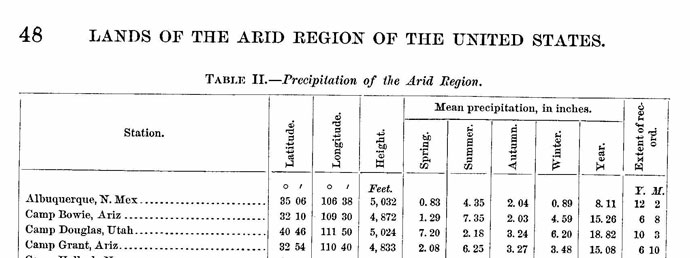
Here’s a fun little bit of business to warm a weather wonk’s heart:

image from Powell's Arid Lands

That’s from John Wesley Powell’s 1878-79 Report on the lands of the arid region of the United States, and is the earliest climatic data from Albuquerque that I have ever run across. The data was collected by Charles Schott of the Smithsonian, who had been publishing national precipitation tables. He hurried up his new set of data, processing the western states first, so they could be included in Powell’s report. When I have some more time, I’ll blog more about the report. It’s a remarkable document in its insight into the problems of living in an arid land.

Compared to the current data, it’s a strikingly reasonable number for annual precipitation, given that it’s based on just a dozen years’ record. The seasonal distribution’s a bit out of whack, so the match for annual precipitation no doubt is just dumb luck.

I’ve read elsewhere that there was weather data collected here beginning in 1850. I’ll have to see if I can track it down.

The Hatmaker

Aaron’s delightful tale of being laid off:

I don’t know where I’m headed, but it could be practically anywhere. I could visit my brother in Bolivia. I could move to my grandmother’s farm in Ivy, VA, and raise pet goats, write freelance, sell vegetables at the farmer’s market. I could get the bird flu or drink myself to death, or go to Korea and clone myself and teach the clone to like kimchee. I could devote myself full-time to volunteer work or to stalking my ex-girlfriend. I could move to California and grow oily dreadlocks and live out of a van.

Technology Changing the World?

Via HP, link to a fascinating piece on Steve Jobs.:

Jobs doesn’t believe that technology is going to change the world. ‘This stuff doesn’t change the world. It really doesn’t … Technologies can make it easier, can let us touch people we might not otherwise. But it’s a disservice to constantly put things in a radical new light ” that it’s going to change everything. Things don’t have to change the world to be important.’

Sanitary water supplies. Refrigerated food storage. Maybe those were technologies that changed the world, but this computerized gizmo stuff? Nah.

The last piece of technology he bought that “really delighted him”?

‘I actually bought a bicycle recently. It’s just … wonderful.’

With that I think I’ll go for a ride.

Writing for Love

Via Luis, a trail of bread crumbs leads to Paul Graham:

Actually, the fad is the word “blog,” at least the way the print media now use it. What they mean by “blogger” is not someone who publishes in a weblog format, but anyone who publishes online. That’s going to become a problem as the Web becomes the default medium for publication. So I’d like to suggest an alternative word for someone who publishes online. How about “writer?”

Those in the print media who dismiss the writing online because of its low average quality are missing an important point: no one reads the average blog. In the old world of channels, it meant something to talk about average quality, because that’s what you were getting whether you liked it or not. But now you can read any writer you want. So the average quality of writing online isn’t what the print media are competing against. They’re competing against the best writing online. And, like Microsoft, they’re losing.

I don’t think Graham is right that the web will become the default medium for publication. (See paper – fine technology.) But there is much more good writing out there, and all the good “amateur” stuff (in the best sense of the word in which Graham uses it) has a passion that we’ve got to match if we’re going to compete.

See the Duke City Fix for an example of what I mean.