
A Single Global Number

David Appell’s not around to do this, so I guess it’s my job to point out that October 2005 was the second-warmest globally in history. The three warmest Octobers in history have come in the last three years. It’s not that I think that a single global number is useless. I agree with Roger Pielke Sr. that it misses a lot of what’s important, but that does not mean it’s unimportant, especially as one tool in explaining to the public the change that’s underway.

For those of you living in Albuquerque, October temperatures were just a hair above average overall, but the devil is in the details. Daytime highs were cooler than average, while overnight lows were the fifth warmest in history, continuing a trend of remarkably warm overnight temperatures. I haven’t run the numbers yet (Danger! Danger! Journalist doing math!), but I’ll be surprised if 2005 doesn’t end up the warmest, in terms of overnight temps, in the city’s history. Our diurnal temperature range is shrinking. (Albuquerque 2005 numbers from the National Weather Service, long-term data from the Western Regional Climate Center.)

Water Vapor Feedbacks in Europe

Given the recent discussions here and elsewhere about the suitability (or lack thereof) of globally averaged surface temperature as a measure of anthropogenic climate change, I note a paper by Swiss climate researcher Rolf Philipona and colleagues that found a positive water vapor feedback responsible for excess warming in Europe:
Continue reading ‘Water Vapor Feedbacks in Europe’ »

What Did the President Know, and When Did He Know It?

Roger Pielke Jr. links to an absolutely wacky press release from Dennis Kucinich documenting his request for

all documents (including minutes and memos) in his possession relating to the effects of climate change on the coastal regions of the United States produced by the National Aeronautics and Space Administration, the National Weather Service, the National Science Foundation, the National Oceanic and Atmospheric Administration, the National Assessment Synthesis Team, and the US Geological Survey.

Says Kucinich:

“The American public deserve to know what the President knew about the effects climate change would have, and will continue to have, on our coasts.”

One imagines a hard working House staffer in the bowels of the capitol late one Saturday night, grinding through boxes of federal documents when he stumbles upon the smoking gun. “The President must have known!” Is this any way to have a national discussion about science policy?

West Side School Growth

A pretty important story from Elaine D. Briseño in today’s Rio Rancho Journal (sub. req.):

Enrollment numbers for the 40th day of school show Rio Rancho needed more than a thousand new desks.

Officials expect it will need thousands more in years to come.

Enrollment figures released by Rio Rancho Public Schools show a surge of new students this year, as they have every year since Rio Rancho Public Schools declared its independence from Albuquerque Public Schools in 1994.

The numbers also indicate the rate of growth is speeding up. Last year, the district grew by about 6 percent. Enrollment numbers jumped 8.6 percent this year.

On Graveyards

Sister Lisa should appreciate this:

It’s a loss, I think, that we no longer have graveyards beside our houses of worship; it was a part of the sense of community we have lost in the American church.

Easy-Do Parties, Electrically

By popular demand*, the Easy-Do Parties lady has been returned to my blog rail.

Her tip for the day: “Stay within the limitations of your home – don’t invite more guests than you can serve comfortably. Several small parties are usually more successful than one big whing ding. And remember – men are more at ease with their feet under the table.”

Words to live by. And remember – Live better… electrically.

* OK, only two people asked for her back. But they’re both blood relatives.

More Cheap Shit From China

As I’ve written before, my grasp on global economics is a bit uneven, but here’s another data point:

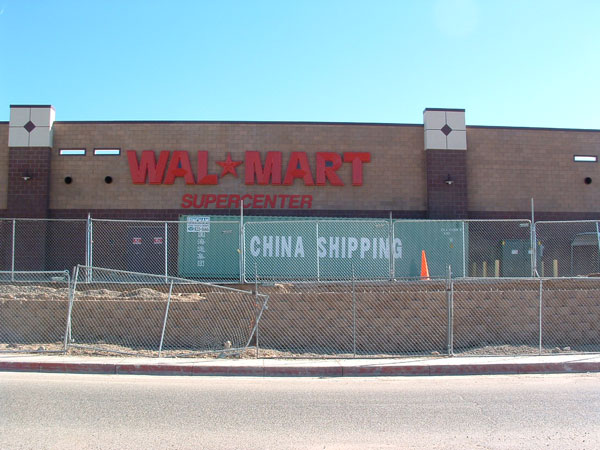
shipping container behind Walmart

The geometry of my neigbhorhood requires me, when riding my bike homeward from the northwest, to either brave ugly traffic, go the long way ’round, or cut through a network of alleys behind Wal-Mart and the furniture stores. So for years, I’ve been cutting through the alleys. A few years back, I noticed shipping containers like these, sprouting in the alley behind the old Wal-Mart on Carlisle. I figured they didn’t have enough storage space inside. The same thing has been happening lately behind the row of furniture stores down the block on Menaul. But when they tore down the old Wal-Mart in favor of the new Uber-Wal-Mart, I was sure they’d have enough space inside.

No. The thing is, as the picture above suggests, they’re making so much cheap shit in China for the U.S. market that we don’t have anywhere to put it all. There are currently 27 of these shipping containers out behind the new Wal-Mart. Now, I’ve not been inside it yet, but I can’t imagine its shelves are empty. In fact, I imagine them brimming with blenders and Hello Kitty lunchboxes and country music CDs and such. But the problem, as evidenced by all the crap out back, is that y’all are not buying fast enough.

C’mon. We’ve got to all do our part, before this great nation is overrun by shipping containers out behind America’s stores. Buy.

Sticker Wars

Johnny_Mango called it the best tree in Albuquerque. Up along the north diversion channel bike trail, it’s a sweet spot of shade with a lovely log bench. But for the last couple of years, it has been the site of a strange struggle.

banana peel stickers on a bench

For a long time, the bench sprouted banana peel stickers. Someone was stopping there for a snack and carefully arranging the stickers in geometric designs on the bench. Then one day I rode by and saw no stickers. Someone had carefully scraped them all off. Then I saw some more stickers appear. Again, they were scraped off.

I’m not sure if it’s a detente that we’ve currently got, or what. On the back side of the bench there are currently 10 stickers (or were, rather, as of yesterday afternoon), two groups of five arranged in little crosses.

Sudden Transitions

I find myself scratching my head over the latest debate between the RealClimate crew and Roger Pielke Sr. regarding the definition and use of “chaos” (non-linear sensitive dependence on initial conditions) in weather and climate modelling.

As often is the case in debates like this, both sides are correct in the point they’re making, differing not on the technical issue but the choice of emphasis. (I can’t help but note the irony here that, in arguing over “chaos,” the disputants are engaging in exactly the sort of “proxy argument” that Roger Pielke The Younger complains about so articulately.)

William and James at RealClimate argue that weather is chaotic and climate (as defined as weather averaged over time) is not. Roger argues (in the RC comments and also his own blog) that such a definition of climate fails to capture an important characteristic: “Observations show chaotic behavior of the climate system on all time scales, including sudden regime transitions.”

I don’t disagree with either group here. Given their definition, which is useful for some purposes, James and William are correct. It just so happens that for me, as a consumer of climate science, Roger’s definition is more useful. I recognize the GCMs’ globally averaged long-term rising trends under greenhouse emissions as important, but the sort of abrupt transitions that the models don’t yet capture are far more important to me, because (see drought posts below), it’s variability that kills ya, not long term trends. From Roger in the comments at RC:

In terms of how we are altering the climate, it is these sudden transitions that we need to understand, rather than focus so much of our resources on assessments of the global averaged temperature trend.