Cycling Gnomes

I’m happy to welcome the reader who found inkstain after searching on cyclist gnome. I’m not working on or writing about GNOME much these days, in part because I’m spending so much time on the bike, but you’re welcome to sit and have a cup of coffee. Enjoy. Readers who visited Inkstain also might enjoy underwater cyclist swerves to avoid garden gnome.

Other fun search strings in the logs include “dakota 3.9 firing order” – something to do with auto mechanics, as near as I can tell – and “clean dishwasher tang”.

Clean Air

I grew up in inland Southern California, a childhood in the 1960s blessed with significant air pollution. Warm summer afternoons playing outside (or, later, running with my cross country and track buddies), our lungs would ache. But we’d do it anyway. Heck, we were kids. The fact that a measuring station a couple of blocks from my house recorded the region’s worst air quality one year was, for us, a point of pride.

That’s one of the reasons we moved to Albuquerque – we didn’t want our daughter growing up in that. Now comes a new study that “found the risk of death rose by 11 to 17 percent from the cleanest parts of Los Angeles to the most polluted areas of Riverside and San Bernardino counties to the east.” (Hat tip Coco.)

The Coarseness of Discourse

I’ve recently made the blogoworld acquaintence of a character called Lubo? Motl, a string theorist at Harvard who has decided he has sufficient expertise to weigh in on the issue of climate change.

There is nothing wrong with doing this. All of us are entitled to have opinions on important public policy questions, and he should be thus praised for taking a stand. But he does it in a way that illustrates much that is wrong with political discourse. Here’s my favorite recent example, on the blog of British climate researcher William Connolley:

Sorry to be candid, but as far as this debate goes, all of you are dishonest and intellectually limited political activists.

This is it, in a nutshell. Lumo thinks that if you believe that we need to reduce greenhouse gas emissions because of climate change, then you are venal, or stupid, or both.

He’s not alone in doing this. In fact, this is a style of rhetoric common to talk radio and the blogosphere, and represents a common way of thinking and talking about all sorts of political and policy debates. It’s frankly intellectually lazy. It allows one to dismiss the arguments of one’s opponents without ever having to take them seriously. But in any sufficiently interesting political or policy debate, as I discussed elsewhere recently, there are sincere and reasonable people on both sides.

That doesn’t mean that some of your opponents aren’t venal and stupid, and that you shouldn’t call them on it. But if you don’t recognize two other things, you’re missing the boat. If you don’t recognize the venal and stupid people on your own side of the debate, you’re not paying sufficient attention, because they almost certainly are there. (Note to Lumo: you need to give Michael Crichton a closer read. Note to all those enthusiastic greenhouse gas reduction advocates who emailed me Ross Gelbspan’s hurricane piece: You shouldn’t be quite so attached to Gelbspan.) And if you aren’t seeking out and trying to understand the reasonable people on the other side of the debate, you’re not thinking the question through very well.

Rumpology

This is apparently not Bart Simpson’s web site:

Just as a print of your fingerprints, palms, soles, and ears tell a story, so does your rump. The lines, crevices, and folds of your fanny…. can, to the trained eye, reveal your personality, fate, and future in luck and love.

Apparently all you need to do is send a close-up picture of your ass, along with a not insubstantial sum of money for a personal reading.

In its richest manifestations, real life is truly funnier than The Onion.

Is There Anything Google Can’t Do?

Last night I raised the question: Is there anything Google can’t do?

Yes.

Years ago, at a seminar on investigative journalism, a veteran reporter suggested that the most underrated tool for digging out information is the phone book. Everyone’s in there, more or less. For years I took that to heart. But lately Google has proven much more valuable for the same sort of thing.

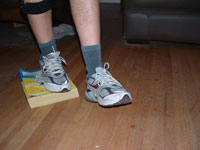
But in my recuperation from knee surgery, I’ve needed a book of a certain heft. It has to be the right height to stand on, stepping up and down over and over to strengthen my quad.

stepping on and off the phone book

Google can’t do that.

Daybook

music: Paper Tiger, the Felonious Groove Foundation. I am so tragically unhip that it was only recently that I grasped my own fondness for the funk. Plus, you’ve gotta love an album dedicated to Malcolm Gladwell and John Denver.

book: Just finished Lee’s Ferry: A Crossing on the Colorado, by Evelyn Brack Measeles. How to say this politely…. There are many times when I’m taken aback reading, thinking, “I wish I’d written that.” This was not one of those occasions. But it did give a good overview of the basic facts of John D. Lee’s establishment of the river crossing, with some fun stuff about the intersection of Lee’s and John Wesley Powell’s paths in 1872, when Powell was preparing for his second run through the Grand Canyon.

books: Been playing with Google Print, their digitized library project. There’s clearly no way to read a book this way, but it seems a potentially useful research tool. Is there anything Google can’t do? (Well, yes. More on this later.)

science: For a story I’ve been working on at work, yesterday I read the famous 1935 Einstein-Podolsky-Rosen paper. I am not a physicist, so it’s not easy going. But, equations aside, the paper’s central point is made with remarkable clarity. But there was this moment when I read one of the key paragraphs, and looked up at the author’s name. Einstein wrote this. Shivers. From his brain to mine. Insanely cool.