
Making the Pielke Point

A thoughtful reader points out, in regard to last night’s post about climate variability in the Colorado River basin, that I didn’t make what I will call the Pielke Jr. point: “the problem is not the climate change but the societal changes!” (That’s quoting my thoughtful reader (TR), not Pielke.)

TR is of course right. It’s not climate variability per se that is the problem here. The problem is twofold. First, it’s a problem that the folks who set up the system for allocation of Colorado River water didn’t understand the extremes of variability that could affect the river’s supplies. The second is that population and associated human systems have grown up around the Colorado River’s water with no clear understanding of the variability in water availability that is inevitable in the long run. We are, as a result, extremely vulnerable to the sort of severe, sustained drought that tree ring records suggest has happend in the not-so-distant past. We’re not vulnerable in the same way as the Anasazi. We son’t starve. But there could be significant societal dislocations.

One thing worth doing in this context is is to examine the difference between the hunter-gatherers who inhabited the Four Corners region before the puebloans, as compared to the Anasazi. Hunter-gatherers survived droughts worse than the ones that coincide with the end of the Anasazi culture. The short answer for why is that the hunter-gatherers had apparently read Pielke, and therefore did not max out the resources, leaving them the flexibility to respond to drought when it happened. In other words, they reduced their societal vulnerability to climate variability.

The Anasazi did not read Pielke, and died.
20-year Average

This is Delph Carpenter, speaking Nov. 12, 1922, ad the twelfth meeting of the Colorado River Commission:

The hydrographers and experts advise me that a twenty-year record on a river is adequate in its completeness and includes enough years to warrant an assumption that the average there deduced would be the average flow of the river in the future.

How wrong he was.

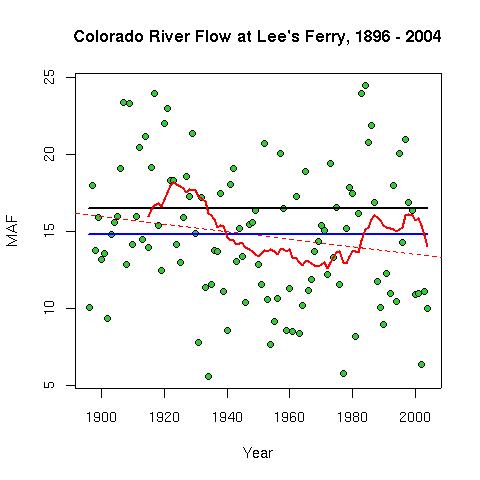
Colorado River Flow at Lee's Ferry

The green dots represent the Colorado River’s flow at Lee’s Ferry (adjusted to represent the flow if the river would have been undammed). The black line is the amount the commission assumed based on the available river data – about 20 years’ worth. The blue line is the actual long-term average since 1896. And the red jiggly line is the rolling 20-year average, positioned at the end of the 20 year interval. You can see it’s highest in the early 1920s – at about the time the commission was meeting in Santa Fe. (data from the Upper Colorado River Commission)

Carpenter and the other commissioners thought that a sufficiently long period – perhaps ten years, but certainly twenty – should be sufficient to average out the ups and downs of long-term climate cycles in the west. You can see they were quite wrong.

Black Friday

It’s like losing a friend (sub. req.):

Rowland Nurseries Inc., whose slogan is “life should be beautiful,” is calling it quits after 52 years in business.

Owners cited increased competition and skyrocketing prices for shipping and freight as reasons for the closure.

It marks the end of one of the state’s largest and longest running family-owned nursery businesses. The late Pat and Reba Rowland opened a single location in 1953, and it has since grown to encompass five Albuquerque stores, a distribution business and a wholesale plant operation.

“It has definitely been a wonderful ride with this community,” said president Michael Rowland, who grew up in his parents’ business.

Rowland’s is simply part of our lives.

As readers of this blog know, I love my garden – the ebbs and flows of the seasons, the endless surprises, its slightly untamed nature. Rowland’s has always been a part of it, full of ideas and a sense of the possibility of urban nature. We bought plants there, and garden gear, but most importantly we went there for ideas, a sort of combination art gallery and art supply store for the urban natural canvas – a sweet and eclectic place that seemed to instinctively understand my needs.

Rowland’s can’t compete with the combination of rising transport costs and big box retailers. Albuquerque gardening will not be the same.

Family Farms

From Mikaela, some fascinating data on U.S. farms:

# 15% of the farms in the U.S. produce 90% of agricultural output.
# These 15% are farms with sales over $100,000.
# 78% of all farms in the U.S. have sales less than $10,000.
# Of these farms, the average farm income is -$4,000.
# Big farms and small farms are both growing in number.
# More people are farming because they like the lifestyle and working second or third jobs to support their farming habits!

Rio Rancho Impact Fees

Of some relevance to the current discussions about development impact fees in Albuquerque, from Josh Akers in this morning’s Journal (sub. req.):

Developers could be paying more to build in Rio Rancho by the end of the year.
Rio Rancho city councilors are considering a proposal to increase impact fees charged to developers by 62 percent by January 2008.
The council had its first look at the proposal Wednesday night.
The proposal is the result of more than two years of work with two different consultants to figure out what developers should be paying for streets, parks, public safety, water and other infrastructure needs.
Developers currently pay $6,094 in impact fees to build a single family home.
Under the proposal a developer would pay $9,882 in impact fees by January 2008.
“It is a very important process and with all the growth we are having there is a large number of dollars coming from impact fees,” Palenick said. “This is a draft, a recommendation. We will listen to legitimate input and the number could change.”

More from the tribe

My tribe, doing what it does:

My colleagues who are down here are warriors. There are a half-dozen of us living in a small house on a side street Uptown. Everyone else has been cleared out.

We have a generator and water and military C-rations and Doritos and smokes and booze. After deadline, the call goes out: “Anyone for some warm brown liquor?” and we sit on the porch in the very, very still of the night and we try to laugh.

Some of these guys lost their houses — everything in them. But they’re here, telling our city’s story.

And they stink. We all stink. We stink together.

Daybook

book: “Water and the West,” by Norris Hundley, a history of the development of the Colorado River Compact. I’m trying to understand who understood what, and when, about the nature of drought and its implications in the arid southwest. (The answers may be “no one” and “never,” which would help explain the fix we seem to be in.)

more reading: Global Water Resources: Vulnerability from Climate Change and Population Growth, from Science, July 2000. Its point is that, much like the discussions of hurricanes and climate change of late, it’s growing human population, not global warming, that is the driving variable in understanding the potential future impacts of drought.

music: The Bonnie Raitt Collection. I’ve got this riff to write about Bonnie Raitt and Casablanca, and the nature of carefully executed craft. (It’s one of those blog items I’ve thought through enough times on bike rides or while driving to work that I’m always amazed that I’ve never written it down.) Suffice it to say that I can always return to this album or that movie and never be disappointed. And if I were not happily married, I might chuck it all and follow Ms. Raitt from town to town, listening to her music and hoping against all hope to bump into her in the hotel lobby.

the bike: There is a simple pleasure in washing down the bikes.

code: It’s never as simple as I think. I’ve run up against the IE/Win Unscrollable Content Bug. Must …. test …. more …. browsers….

The Return of Househenge

The equinox is 10 days hence, but this afternoon it felt as if things were most aligned.

As I was doing the dishes, a shaft of light from the setting sun shot through the back door, over the kitchen sink and into the pantry, illuminating for a brief but shining moment a jar of Solana Gold organic applesauce.

It was the return of Househenge.

Winners and Losers

So the Sahel, where people really die when drought happens, could be wetter in a globally warmed world, according to new research by a team led by Reindert J. Haarsma of the Royal Netherlands Meteorological Institute:

We hypothesize that through this mechanism greenhouse warming will cause an increase in Sahel rainfall, because the warming is expected to be more prominent over the summer continents than over the oceans. This has been confirmed using an ensemble of 62 coupled model runs forced with a business as usual scenario. The ensemble mean increase in Sahel rainfall between 1980 and 2080 is about 1?2 mm day−1 (25?50 percent) during July?September, thereby strongly reducing the probability of prolonged droughts.

Published in GRL Sept. 10.