
Bird Friends

Two fun bird sighting in the last few days.

Sunday, a flock of bushtits blew through. David Sibley describes them as “a disheveled-looking, long-tailed ball of fluff,” and I think that’s apt. There were eight of them at one point all perched on the stalk and leaf stems of a single sunflower in our front yard, picking off the aphids.

This morning, I pulled up the bike along the flood control channel after hearing the cry – Sibley uses the words “agitated” and “strident” to describe it, which is also apt – of killdeer. I had to look hard to find them, wading ankle-deep in the water on the channel’s bottom. I love the way the flood control channel is an accidental bit of nature, in between the rusty busted shopping carts and other urban detritus.
The Blog You Must Read

Three or four years ago, I heard a talk by Roger Pielke Jr. at an American Meteorological Society meeting that changed the way I think about the relationship between climate and human societies. It was about hurricanes, and he talked about Hurricane Mitch, which killed something in excess of 10,000 people in Central America – perhaps as many, by some counts, as 20,000. Roger’s simple point, as I remember it, was that the dominant variable in the equation leading to that death toll was the fact that the people in Central America were sufficiently poor that they lacked the resources to not die.

At the time, I had been rather naively thinking that the threat of more powerful hurricanes as a result of global warming was a good argument in favor of reducing greenhouse emissions. Roger’s talk convinced me that reducing societal vulnerability to the storms that will happen, warming or not, is a far more effective approach to helping people not die in hurricanes. I’ve since come to realize that, while there are good reasons to reduce greenhouse gas emissions, reducing societal vulnerabilities in a range of areas, from droughts to floods, is a far more important issue in coping with climate variability and change, both natural and human-caused.

I can’t begin to keep up at this point with the important issues being raised by this discussion, but clearly Katrina offers an opportunity to crystallize this sort of thinking. Roger’s got a blog now, and has a lot to say. Go read it.

Tramway

I rode my bike up Tramway Sunday, the first real hill I’ve climbed since since April, since I started feeling the cartilage in my knee falling apart.

Last time I climbed Tramway – a big sweeping five miles up a long alluvial fan into the foothills of the Sandias – was with a group of teammates, and my knee ached but we were having fun. And then the next Thursday, Jaime and I did a bunch of steep climbs in the foothills, and on the last one I cracked, my knee hurt so bad I had to stop. I looked up the hill, got back on and finished it that morning, up to the base of the tramway that gave the climb its name. Then there was MRI-surgery-crutches-figuring out how to walk again. My summer of self-pity.

There are few greater joys than ridin’ your bike with a bunch of friends. After we hit the top of the long Tramway hill Sunday, on the rolling boulevard back through town, Steve said, “C’mon, let’s catch Jaime.” Jaime was way ahead, but Steve patiently led me out, slowly accelerating while I sat on his wheel, always glancing back to make sure he wasn’t leading me out too fast.

Wth the help of the stoplight at Montgomery, we caught Jaime. And my knee did not hurt.

Inkstain Traffic

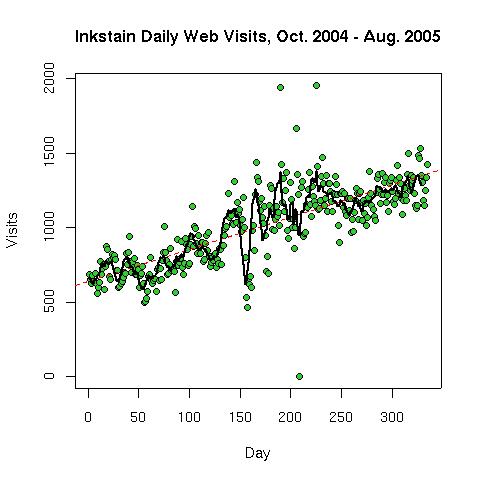
For grins, an analysis of web traffic over the last 11 months on Inkstain:

graph of Inkstain web traffic

Green dots are daily “visits,” as defined by Webalizer‘s default – essentially all requests from the same IP address separated by less than 30 minutes count as a single “visit.” (This means that people poking Inkstain for its RSS feed more frequently than every 30 minutes, like p.g.o does, show up as a small number of visits despite accounting for a large number of hits.)

The black line is a 7-day rolling average, and the red dotted line is a simple linear regression – not really statistically meaningful, but hey – this is a blog, not science!

I’m looking for some reasonable way of sorting out how many of the hits/visits are coming from bots. If one assumes they’re well-behaved and are therefore asking for “robots.txt,” then they account for something like 10 percent at most. But I’ve got to think it’s substantially higher than that.

I am happy to report that “Mozilla/5.0 (X11; U; Linux i686; en-US; rv:1.7.10) Gecko/2005” is the most common browser here, suggesting that despite my increasingly tenuous connection to the free software world as anything other than a user, the prototypical Inkstain readers are still geeks with too much time on their hands. And that perennial favorite, “Google games,” remains the most common search string by which people find their way here.

(Stats done with R.)

Record Challenge

I ushered in autumn this morning out in the cool early morning air of Moriarty, sitting along State Route 41. Across the way, a tractor and a center-pivot irrigation rig (alfalfa?) sat silent. The little planes from the Moriarty airport droned overhead. And that characteristic “thunkthunk” of time trial bikes with disk wheels kept rolling by.

The Record Challenge is one of north-central New Mexico’s little treasures, a tiny Labor Day weekend event rich with tradition. There are people who come from all over the country to ride it, and for good reason: the stretch of road from Moriarty to Estancia and back is the flattest, straightest, fastest 40 kilometer time trial course in the country. Lots of national records have been set here, including the fastest men’s and women’s 40 k’s ever ridden in this country, plus nearly every age group record.

I couldn’t ride this year, but ended up about 100 yards up from the finish line with a camp chair and a two-way radio calling out riders’ numbers as they rolled by in that painful tunnel that is the finishing stretch of a 40 k time trial.

Three new national records over the two days of racing, the most impressive being Bill Meyers, whose 26:58.57 Sunday broke his own 65+ 20K. And then, for good measure, he came out Monday and did the 40 k in 56:18.03. As Bill McLain pointed out, “The guy is 68 years old!” Ah, to grow old so gracefully.

Utter Failure

Roger Pielke Jr. on the utter failure of the federal government to be prepared to respond to Katrina:

The question that needs to be asked, and it is not too soon to begin asking, is why was the federal government so unprepared for the disaster in the face of robust scientific knowledge about the disaster at all time scales? This is especially in light of the fact that the government completely reorganized itself after 9/11 to improve the nation’s preparedness and response to catastrophes.

Tikimon

This amused me:


Tikimon toy

It’s a Tikimon “hand-activated spinner”. You push down on the top bit and the little guy in the middle with the stickey-out tongue spins around. It was the toy included with a Carl’s Junior child’s meal.