Satellites and Stuff

As an inadvertent card-carrying climate blogger (or maybe it was advertent) I feel some obligation to make note of the trio of papers published today in Science that attempt to settle nagging discrepencies between the satellite temperature record and the models. The fact that the satellite data disagrees with climate models, showing less warming in the lower troposphere than at the surface, has been one of the key arrows in the climate skeptics quiver, so this is an important bit of climate wars science.

The RealClimate people have taken a crack at it, and the LiveScience story on MSNBC captures the key climate wars significance in its headline: “Key claim against global warming evaporates.” Andrew Revkin at the New York Times also has a good explanation.

But – credit where credit is due – the most useful explanation I read this evening came from Roy Spencer at Tech Central Station. Just when I’d finished savaging Spencer over on my work blog, he’s come through with a relatively straightforward and easy-to-digest explanation. It praises papers that offer strong disagreement with Spencer’s own previous work.

It’s worth pointing out that Spencer was not so charitable last time someone questioned his reading of the satellite data. When Qiang Fu published a paper last year in Nature suggesting a problem in the satellite numbers, Spencer savaged him: “Is the quality of peer review in the popular science journals getting worse? (The answer is ‘yes.’)” Now that the new papers suggest Fu was probably right, Spencer seems to have learned his lesson. This is refreshing. I was frankly dreading my bloggerly duty reading the back and forth on the new papers, because I expected them to stake out tiresomely familiar climate wars turf, but Spencer showed me wrong.

Spencer and John Christy, his University of Alabama colleague, seem to be sticking to their line that the warming detected is nothing to worry about. Christy, in Revkin’s story, calls it “modest.” But the argument that the satellite data shows little or no warming at all should now be a thing of the past.
Come Hear Me Yammer On

Y’all in Albuquerque are invited to a talk next Tuesday evening by yours truly at Southwest Writers (click through for the when and where). It’s entitled “A Spectator to the Grand Adventure of our Time: Writing About Science.” The title’s based on a quote from Richard Feynman, except that I was doing it off the top of my head when I emailed the title of my talk to the organizer, and I got it wrong:

The work is not done for the sake of an application. It is done for the excitement of what is found out…. You cannot understand science and its relation to anything else unless you understand and appreciate the great adventure of our time. You do not live in your time unless you understand that this is a tremendous adventure and a wild and exciting thing.

(That’s Feynman from a series of lectures he gave in 1963 at the University of Washington, collected in the book The Meaning of it All.)

I’m having fun with this. I hope it works out. There’ll be some newspapering nuts and bolts in the talk, which is important context for a group of writers who will need to understand the constraints. But mostly I’m going to try to talk about the aesthetic of science – the great privilege I have to be paid to watch science happen, and the grist that provides.

As a bonus, for those who don’t fall asleep, I promise a Picasso reference. Watch and be amazed as I draw a thread through Galileo to Picasso and Voyager at Neptune (or fall on my rhetorical face trying – that may be the real fun).

Daybook

music: Greetings from Asbury Park, New Jersey. Scored a three-record set of early Springsteen for cheap yesterday. Music of my youth. Ben Hamper had a great line years ago in Mother Jones to the effect that Bruce Springsteen was a working class hero to middle class suburban kids who weren’t members of the working class. That was me.

books: Microbe: Are We Ready for the Next Plague. Full disclosure: Al Zelicoff is one of the smartest people I know, and also is very persuasive. And he’s been softening me up for a while in regards to the theme herein, which is that we need to think differently about how to watch out for the microbially unexpected. Plus he gave me the book for free. And wrote something really nice in it.

movies: Word Wars, a documentary about the really weird people who play scrabble. I mean really weird. Fun film.

rides: I don’t wanna make a big deal about this, but it is, to me, a big deal. Fifty-two days ago I had my knee cut open in an attempt to repair damage caused in a basketball game 18 years ago. I love to ride my bike, and for the last 52 days I have been unable to. I’ve been able to pedal on an indoor trainer. That’s exercise, but it’s not riding my bike. Today there was wind in my face, and the most beautiful row of sunflowers along the ditch in the far south valley, and a moment when it just seemed right to pop the chain over onto the big ring and go.

Growth and Nature

A couple of good pieces in this morning’s Journal on the intertwined issues of growth and nature in New Mexico.

Laura Banish (sub. req.) talks about a new ordinance passed by the Santa Fe city council last month requiring developers to obtain water rights before they can build large housing projects. They go out and get the water rights, conveying them to the city, so there is sure to be enough water to serve the development. Developers are freaking out. The assistant city attorney thinks water rights ought to be no different than two-by-fours – something that’s essential for the housing. “The city doesn’t go out and buy two-by-fours for new developments. It doesn’t buy asphalt. So why should it buy water?”

Downpage on the same page, Tania Soussan (sub. req.) introduces us to Cliff Crawford, the University of New Mexico biologist whose work has provided the underpinning for restoration of the bosque.

Steve Vincent

I’m not the same sort of journalist as the late Steve Vincent, so I dont want to sound like I”m arguing some sort of “band of brothers” melodrama here. He took risks for his stories. I do not. In that regard, we are playing – perhaps not a different game, but very different versions of the same game.

But I must honor his sacrifice, because he gave his life doing a very dangerous version of the same thing I try to do every day – help people understand their world.

As one of the commenters put in his blog:

It is brave to go to war with a weapon, but supremely brave to go to war with a pen and camera so the rest of us can know what is happening.

Arizona Sycamore

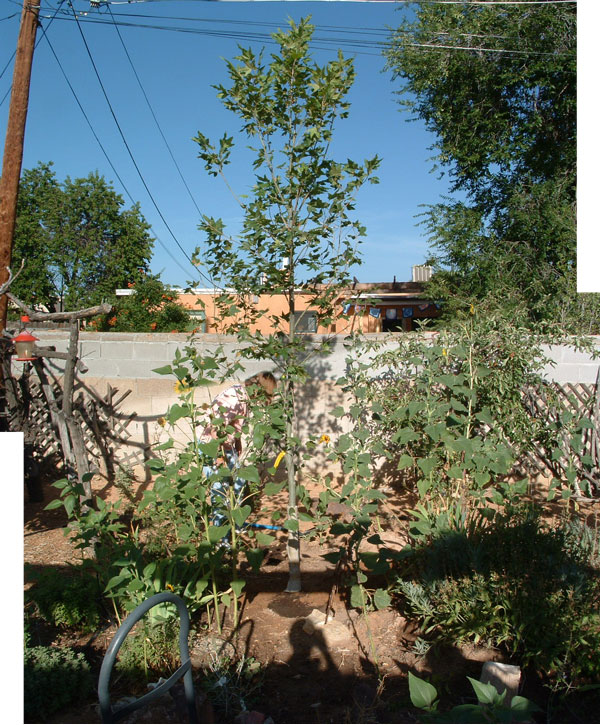
Lissa planted a lovely new Arizona sycamore (Platanus wrightii) yesterday morning. As it happens, she rather by accident planted it dead center in a line so that you can see it out the back window when you’re washing dishes.


Arizona sycamore

It’s native to riparian areas of southeastern Arizona and southwestern New Mexico. Thanks to the Institute of Natural Resource Analysis and Management biodiversity database, you can see it’s been primarily found in Hidalgo and Catron counties in New Mexico, with a few straggles elsewhere, including one in Spruce Park here in Albuquerque.

The Brace

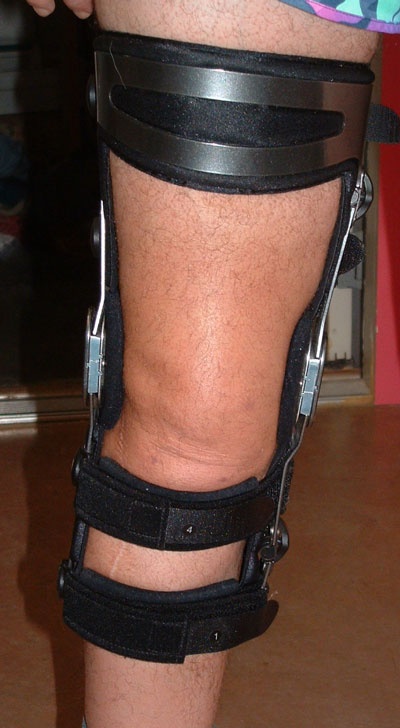
My shiny new Donjoy Lateral Unloader Brace:


knee brace

The purpose is to push the knee slightly outward, unloading the weight from the outside of the knee where stuff is damaged, carrying weight on the inside of the knee where things are in excellent chape. I’m supposed to wear it during strenuous weight-bearing activity (thankfully not needed for cycling). “Strenuous” currently includes pulling weeds, which I did this morning in the backyard for the first time in a month and a half. Or sweeping the bedroom.