Collapse of the Maya

Skipping around last night through the ubiquitous Jared Diamond’s new book, Collapse(1), I found some good discussion about something I’ve been trying to understand better: the climatological component of the collapse of the Maya. What I’ve been wondering is the extent to which they’re a case study similar to the Anasazi.

(click through for more)
Continue reading ‘Collapse of the Maya’ »

All Your Bike Rides Are Belong to Us

Somebody set up us up the bomb. Really.

For our New Year’s Day ride, we headed up Tijeras Canyon and into the Manzano Mountains up South 14. Until we had to stop, because there was a bomb in the road.

We were stopped by the ranger station at the foot of the hill when a pickup slowed and rolled down his window to say that the bomb squad had the road blocked off halfway up the hill. His purpose was to do us a favor, so we wouldn’t waste our time riding that way. But the whole point of our bike rides is miles, time in the saddle, and amusement. What could be better. A bomb!

South 14 is a big wide-shouldered highway that climbs a relatively gentle grade up through piñon woods, through road cuts of a lovely tawny limestone. It was busy enough that two more helpful drivers stopped to tell us that the road was closed ahead.

When we got to the scene of the crime, there was a county sheriff blocking the road, turning all the drivers back, and the Albuquerque Police Department bomb squad doing whatever bomb squads do. This, wisely, seems to involve a great deal of patience and very slow movement.

The story we pieced together from the cops and the TV news guy on the scene involved a 250-pound military surplus bomb, with intact detonator (x-rays were somehow involved in determining this bit), chained to a stop sign and wrapped in an American flag with anti-Bush slogans scrawled on it.

Somebody set up us the bomb good.

Sometimes a Picture Helps

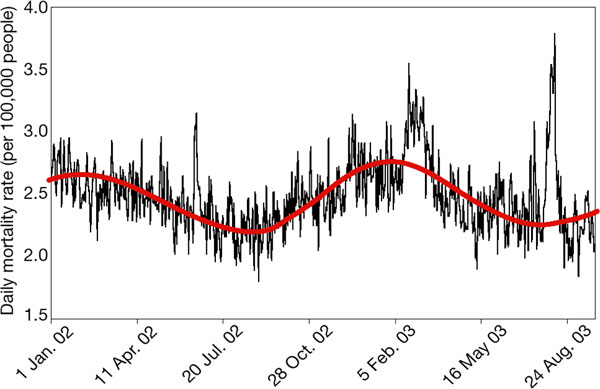
There’s a graph I’ve bumped into a couple of times recently that is absolutely breathtaking:


European 2003 mortality graph

It’s the death rate in Baden-W?rttemberg, Germany, from January 2002 through August 2003. You can see the clear annual pattern, with more deaths in winter and fewer in summer. There’s a small spike in June 2002, which is apparently from a heat wave, and a larger peak in the late winter of 2003 – an influenza outbreak. And then there’s that massive peak in the summer of 2003, which was what climate researchers have demonstrated was a statistical outlier of extreme proportions. It was real hot.

(click through for more)
Continue reading ‘Sometimes a Picture Helps’ »

The Chandler Wobble

When a colleague asked me (they always ask me – I’m “Mr. Science“) whether Sunday’s earthquake was big enough to shift Earth’s axis, I uttered an explitive related to equine excrement. I had visions of Velikovsky. But a seismologist disabused me of that notion, explaining that the effect, while small, is measurable. Now a team from JPL has done the calculations:

The change was caused by a shift of mass towards the planet’s centre, as the Indian Ocean’s heavy tectonic plate lurched underneath Indonesia’s one, say researchers at NASA’s Jet Propulsion Laboratory in Pasadena, California. This caused the globe to rotate faster, in the same way that a spinning figure-skater accelerates by tucking in her arms.

The blast literally rocked the world on its axis, add Richard Gross and his NASA colleagues. They estimate that Earth now tilts by an extra 2.5 centimetres in the wake of the jolt.

I don’t think that’s enough to trigger any Velikovskian Kraziness, but I don’t stay up late enough any more to listen to the really good talk radio, so I could be wrong.

CO2 Science No Longer Free

CO2Science, one of the most prominent of the rabidly skeptical global warming web sites, is no longer free:

For the past seven years, therefore, we have provided everything we produce free of charge to everyone, sustaining ourselves with grants and donations from numerous sources. Over the past three years, however, income from these sources has declined dramatically, and additional cuts are on the horizon.

The Idsos, who run CO2Science (and who in the past have received funding from ExxonMobile), have provided a major clearing house for information used by global warming skeptics. Googling a major climate research paper frequently brings up the Idso’s analysis on the first page of hits. That seems to be all fenced off now, behind their paid subscription wall.

Teach the Controversy

From Steve Reuland over at Panda’s Thumb:

We should never allow fake “criticisms” that have been rejected by scientists to be taught in science class for religious reasons; if the subject were astrology or Velikovskian catastrophism, Schlafly would presumably agree. But when it comes to creationism? why that?s censorship! By the same logic, opposing the teaching of Holocaust denial, UFOlogy, or whatever nutty nonsense one can come up with would also be censorship. We can reframe Holocaust denial by saying that we want to teach the evidence both for and against the Holocaust. Shouldn?t we teach the controversy about the Holocaust?

“I hope we passed the audition”

Phil Spector was a very bad man.

Let’s be clear here. The smothering wall of strings on The Long and Winding Road ranks well down on the list of history’s great crimes against humanity. No one died. But a crime it is.

Daughter Nora was looking for “Please Please Me” for a Christmas present for me. When she couldn’t find it, she asked me to suggest another record I’d like. I asked for “Let It Be.”

When the “Let It Be — Naked” was released a couple of years back, Paul McCartney said, “That was the thing about the Beatles, we were always a great little band.” I agree, and I’ve always been fond of their music. I especially love the very early stuff, which is why I asked for “Please Please Me.” It’s fun. “Let It Be” is that way too, at least in part, a lot of the pretension pulled back off, a bunch of guys goofing in the basement with their guitars.

And then came Spector, creating something appropriate for background music while you’re shopping for frozen peas.

I knew what I was getting into when I asked Nora for the album. When I was a teenager, my friend Danny Hogle had this fabulous collection of Beatles bootlegs, among them a bunch of stuff from the Let It Be sessions. There was Paul pecking out the chords for “Let It Be” for the band for the first time. And his naked version of the Long and Winding Road, sans Spector, sans the Wall of Sound.

It’s a lovely little ballad, sad and sweet and pretty, just Paul and the piano.

The “Naked” re-release has it the way Paul sang it, but there are other problems with that album. The clowning on “Get Back,” up on the Apple Studios roof with Billy Preston, has always been a favorite bit of business, and they cut it out of the version they included. So the original “Let It Be” is, on balance, my favorite of the two. But such a tradeoff. I suppose I’ll have to acquire both, and make my own mix-and-match CD.

And I still need Please Please Me.

K

From Alan Schwarz’s The Numbers Game: Baseball’s Lifelong Fascination with Statistics:

To spread the gospel, Chadwick invented his own personal scoring form in the hope that it would become standard. The grid extended nine players deep and nine innings wide, each box housing a player’s at-bat as he came up in turn. Each outcome was coded with either numbers, for the fielder who handled the ball, or letters, to denote a fly ball or the like. (Many of those letters were chosen as the last of the events they connoted, such as “D” for catch on bound, “L” for fouball and “K” for struck out, the last of which has survived to delight generations of kids as they first learn to score.)

The thing about the scoresheet, as I learned to do it (part from my Mom and part from my friend Jim Timmermann) is the way two things stand out in a glance at the complex hieroglyphics – the runs scored and the big bold K’s. Obviously at the end of the day it is the former that matter. But I love good pitching, so I like it that the latter also stand out in a tradition dating to Henry Chadwick in the 1850s.

And no, “K” doesn’t stand for Koufax.

When he wrote his name in capital letters in the record books, that “K” stands out even more than the O-U-F-A-X.