Rest

I’m using Joel Friel’s Cyclist’s Training Bible to plan my training for the coming year, rather than my usual technique, which essentially involves riding whatever the hell I feel like today.

Friel’s big on resting. For the over-40 set such as myself, his first step in mapping out a year of training is to set aside every third week for rest, so I’ve been doing that.

It’s remarkable. This is a rest week, so I took Monday and Tuesday completely off, and have been doing light cycling and a little bit of lifting at the gym since. This morning, when I sat down on the bike at the gym, my legs felt so fresh and ready to go, they were like a dog straining at the leash. I let ’em go a few times, just for fun. They were happy.

Inflatable Promotional Items

A number of important developments in the area of inflatable promotional items….

Deflated Sponge Bob Found on Side of Road:

SpongeBob SquarePants, missing from a Beaver County Burger King since Thanksgiving, was found lying on the side of a Beaver County road earlier this month.

He had been stabbed twice and was covered with dirt and mud, said Frank Bell, vice president of programming for Froggy radio stations in Pittsburgh.

And in Southern California, a jihad of some sort against der Weinerschnitzel’s inflatable turkeys:

“Why else would they get me to take down my Halloween ghosts at Halloween and now the trees?” he said. “It’s so bad, I didn’t even put up my blow-up turkeys at Thanksgiving.”

I don’t know how much more clear the framers could have been when they wrote, “The right of the people to keep and bear Inflatable Promotional Items, shall not be infringed.”

update: If we here in the United States don’t deal with this problem, others are waiting in the wings.

RealClimate, Quark Soup and the Climate Blog Wars

One of my favorite blogs is David Appell’s Quark Soup. I started reading it a year ago, when he was doing yeoman’s work on Stephen McIntyre and Ross McKitrick’s effort to debunk Mann, Bradley and Hughes’ “hockey stick” paleoclimatic reconstruction.

I’m hooked on the comments section of David’s blog. But I’m beginning to think it’s a less-than-useful addiction, in ways that may shed some light on the continuously unpleasant and ultimately unresolvable nature of what I (apparently somewhat unoriginally) have come to call “the climate wars.” I think the climate comment wars in David’s blog also may highlight an interesting problem that is endemic to the arena, which the climate scientists over at the new RealClimate blog already appear to be confronting.

(More below the fold.)
Continue reading ‘RealClimate, Quark Soup and the Climate Blog Wars’ »

Practical Astronomy

Jaime pointed out with some enthusiasm yesterday morning that the winter solstice – the shortest day of the year – comes Tuesday. (Specifically, it’s at 5:42 a.m. our time if I’ve done the UT-MST calculation correctly.)

For everyday life in our secular society, this is of little import. We’ve got no celebration tied tightly to the day. But when Jaime made the observation, the sun had just popped over the mountains, and the temperature was still hovering in the high 20s, and we were on bikes. For the early morning cyclist, the notion that the day will start lengthening soon is cause for celebration.

(Update: That’s the high 20s Fahrenheit. Apologies to my more progressive metric readers.)

Steven Milloy on Climate

Steven Milloy, proprietor of a site called JunkScience.com, has earned something of a reputation for tackling what he calls “Junk Science.” Lately, you can find his work on the Fox News web site, including his latest climate change screed. What you won’t find mentioned there is the remarkable tale laid out by Sheldon Rampton and John Stauber about how Big Tobacco helped launch Milloy’s career as a science debunker. And we all know about Big Tobacco’s long-standing interest in ensuring that the best science is used to bolster public policy. More recently, Milloy has served as a registered lobbyist for the American Petroleum Institute, which might seem relevant for a news organization such as Fox to disclose to its readers.

In today’s episode, we see Milloy plying his trade, using the work of Ohio State climate researcher Lonnie Thompson to argue, essentially, “Hey, climate change happens all the time. What’s the big deal?”

Specifically, he quotes Thompson as follows, in an apparent attempt to use Thompson’s words to bolster his argument that our understanding of climate is not good enough to support the claim that greenhouse gases are a bad thing:

?Any prudent person would agree that we don?t yet understand the complexities with the climate system,? said Thompson.

Now let’s look at the entire quote, helpfully linked for us by Ray over at RealClimate:

“The climate system is remarkably sensitive to natural variability,” he said. “It?s likely that it is equally sensitive to effects brought on by human activity, changes like increased greenhouse gases, altered land-use policies and fossil-fuel dependence.

“Any prudent person would agree that we don?t yet understand the complexities with the climate system and, since we don?t, we should be extremely cautious in how much we ?tweak? the system,” he said.

Rather different, don’ t you think?

(The RealClimate crew considers some of Milloy’s other climate writing here.)

The Birds

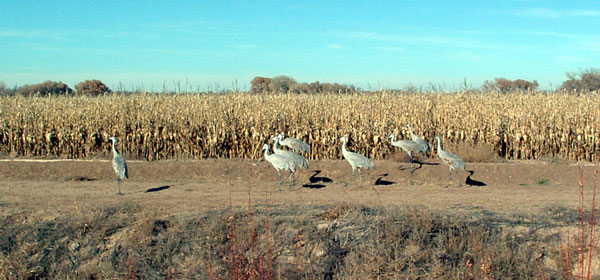
Lissa and I drove down to the Bosque del Apache today to see the birds.
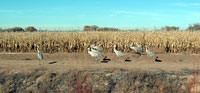

Sandhill cranes

We saw, in no particular order, Sandhill cranes, a sparrow hawk (now apparently to more correctly be called the American kestrel), a golden eagle, a bunch of American coots, a Northern Pintail duck, a few red-tailed hawks, and more than a few snow geese.

And a great blue heron.

page from Peterson's Guide to Western Birds

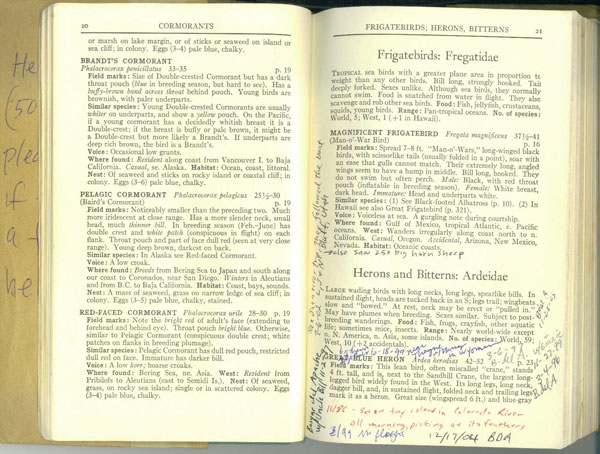
That’s a page from our old family heirloom copy of Roger Tory Peterson’s Field Guide to Western Birds.

We are by no means serious birders, but we always take our Peterson on trips, and when we see a bird we can identify, we jot a note in the margin. It has thus become a sort of narrowly defined family diary.

The oldest entry seems to be under the great blue heron: “11/86 – sat on tiny island in Colorado River all morning, picking at its feathers.” Lissa and I were camped on the Arizona side of the river down south, near the Mexican border. The “island,” as I remember it, was little more than a rock big enough to snag some driftwood. The heron just sat.

We’ve since seen the big herons in Wyoming, near Thayne; on the San Juan River downstream from Sand Island where they kept following our boat; at the Bosque del Apache with Lissa’s late sister Ginnie. That last is particularly precious now.

We have a couple of whooping crane listings (a handful used to winter in New Mexico with the sandhill crane flock), including the time my sister and I saw one in flight.

And then my favorite listing, under “mallard”: “Coyote kills a female mallard at Bosque del Apache 11-3-97 N, L, J and Uncle Bill.” The flock of ducks was at the edge of a field, and we watched as the coyote crept up on them. The ducks fluttered and moved away as the coyote moved toward them, uneasy. Finally the coyote bolted, the ducks took to the air in a flurry, and the coyote got the slowest one. Evolution in action.

We’ve got the new Sibley Guide to Birds now, which is a terrific book. We write in it now too. But we still tote along the Peterson’s, and we still scrawl in the margins.

The Problem with Consensus

My climate science blogging brethren have been typing up a storm about Naomi Oreskes’ Dec. 3 Science essay on the consensus about climate change, and amidst all the noise I missed Roger Pielke Jr.’s thoughtful take (he’s quoting here in his blog from a 2001 Nature paper):

Consider once again global climate change. For many years, policy debate has centred on the degree of certainty that decision-makers ought to attach to competing visions of the future climate. Lost in this doomed enterprise is the point that climate will certainly have an increasingly strong effect on the environment and society, simply because of growing vulnerability related to factors such as population, wealth and use of land. If a goal of climate policy is to reduce the effects of climate on the environment and society, then effective action need not wait until we are more certain about details.

Seen in this light, efforts to reduce uncertainty via ‘consensus science’ – such as scientific assessments – are misplaced. Consensus science can provide only an illusion of certainty. When consensus is substituted for a diversity of perspectives, it may in fact unnecessarily constrain decision-makers’ options. Take for example weather forecasters, who are learning that the value to society of their forecasts is enhanced when decision-makers are provided with predictions in probabilistic rather than categorical fashion and decisions are made in full view of uncertainty. As a general principle, science and technology will contribute more effectively to society’s needs when decision-makers base their expectations on a full distribution of outcomes, and then make choices in the face of the resulting – perhaps considerable – uncertainty.

Exhibit B

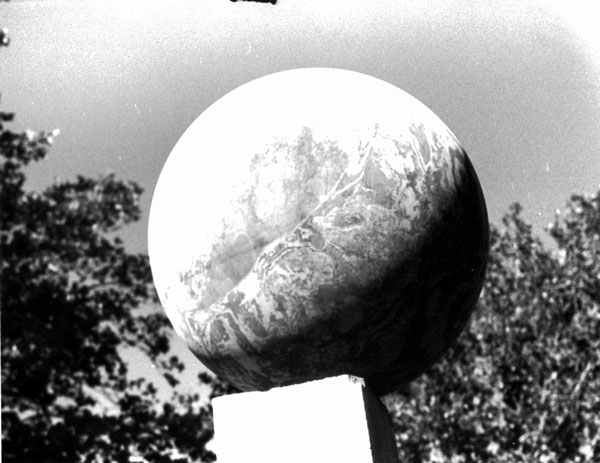
Daughter Nora today made a print of this photograph of the first missing bowling ball. Label it Exhibit B:


Missing Bowling Ball

If you have seen this bowling ball, please notify the authorities.