
Just a reminder – friend of GNOME and friend of mine dcm is riding the MS 150 next weeked. Good guy, good reason, good cause, give if you can. details here.
Google Mail
What is it the black marketeer says in Casablanca to the man trying to round up some cash to make it to America? “Gmail accounts are a drug on the market. Everybody sells Gmail accounts. There are Gmail accounts everywhere.” Oh wait, no, he was tallking about diamonds.
But, as dcm points out, “they just keep on coming.” Check ’em out on ebay – their price has plummetted. Used to cost five bucks, now it looks like you can easily pick one up for under a dollar.
Anyway, I’ve got some, for free, if you’re the one last person out there who wants one but doesn’t have it yet.
update: All gone. Interesting geographic distribution of the people who contacted me, suggesting hypotheses involving graph theory and U.S. hegemony. More later when I’ve thought it through.
Action Figure
I had to stop and go back when I saw this little guy in the middle of the street:

I think if I hadn’t gotten to him when I did, the outcome might have been much worse. I don’t know his name. If you recognize him, let me know.
update: He’s a Cobra infantryman (thanks, Vidar!)
Moriarty
There are two clear ways to look at today’s bicycle race.
It was a terrific race, and pretty much sucked completely.
Bill McLain, the impresario, put on a great race. It’s incredibly smooth and well organized, and Bill also throws in little touches that make it special – a catered picnic in the park after the race, a fun medal ceremony, nice-looking printed certificates for every rider who finishes (with your time emblazoned on the certificate down to the 100th of a second). This year he had a big cake in celebration of the race’s 20th anniversary. There were folks from all over the country who came to race.
But I’ve got to be frank – the time emblazoned on my certificate was a profound disappointment. I could blame the wind, I suppose, but what really happened is that I choked.
It’s a 40k time trial, straight out and back. The wind was light when I started, a cross/tailwind, mostly from the right (west) with a little behind. I couldn’t really get a feel for it, though, and didn’t realize how strong it was until I made the turn.
Wham. Right in my face. Over the first half of the course, I hadn’t really realized how much the wind had picked up, and when I turned to head back into it, it just left me demoralized. My speed was 22.4 miles per hour at the turn, which was a bit slower than my target but reasonable. I’d kept my heart rate locked into my target range and was riding comfortably. But when that headwind hit me it took the spirit out of me.
I remember reading a description of the difference between running a good marathon and a bad one – the bad one hurts just as much, but lasts a lot longer. That’s the way I felt today.
Damaged Fruit
A provocative image: “beachfront roads littered with coconuts, avocados and tree limbs”
Taking Responsibility
It’s hard to imagine the intellectual and emotional pressure facing the person at the National Hurricane Center responsible for making the forecasts. Vast sums of money and lives literally hang on their words. So it’s interesting to note that if you look at the bottom of each advisory, the forecasters always sign their name.
Hurricanes, Variability and Climate Change
Since this has come up repeatedly in the recent discussions of hurricanes and global climate change, I think it’s worth revisiting the issue of extreme events and the extent to which it’s reasonable to attribute them to global climate change.
David Appell articulates this well over at Technology Review:
The right way to describe these kind of events seems to be that they “are consistent with” the consequences of global climate change, because no storm outside of The Day After Tomorrow can definitely be ascribed to a warmer world. It?s a peculiar phrase, but the best scientists are likely to ever be able to do.
As has been discussed here and elsewhere, hurricanes are not a terribly good example – the connection between greenhouse climate change and more or stronger hurricanes is tenuous at best.
But there are situations in which it’s reasonable to make strong assertions about the connection between a single event and the predictions made by the greenhouse warming hypothesis. David’s right on the epistemological point – the best science can do is assert consistency with the hypothesis. But there are situations in which the consistency, even in the case of a single event or cluster of events – can get mighty strong.
Europe’s 2003 heat wave is a good case in point. I’ve written about this before (and also here), but it’s worth revisiting.
Most weather and climate phenomena tend to be normally distributed, along a typical bell-shaped curve with most cases falling near the middle and fewer cases out along the more extreme tails.
When you have an extreme event, it’s useful to not only look at how much it differs from the norm (say, for example, how many degrees warmer than average it is), but where it fits along that curve. If it’s so far outside the curve that it doesn’t make sense, then you’re in all likelihood onto something interesting in statistical terms. (Well, to be careful, the most likely thing is that you’ve got bad data, but once you’ve ruled that out then things get interesting.)
That’s what Christoph Sch?r and colleagues did with the European summer of 2003, publishing their data in January in Nature (Nature \ 427, 332 – 336 (22 January 2004); doi:10.1038/nature02300). They concluded that the only way to make sense of this single extreme event – the hot summer of 2003 – was in the context of greenhouse climate models that predict not only increased warming, but also a substanial widening of the bell curve.
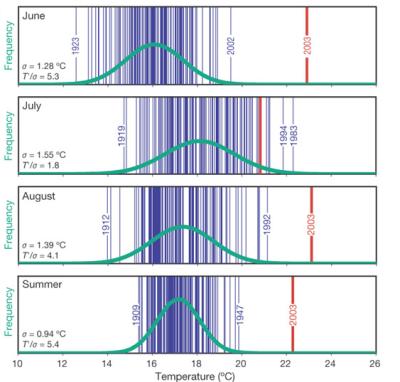
We find that an event like that of summer 2003 is statistically extremely unlikely, even when the observed warming is taken into account. We propose that a regime with an increased variability of temperatures (in addition to increases in mean temperature) may be able to account for summer 2003. To test this proposal, we simulate possible future European climate with a regional climate model in a scenario with increased atmospheric greenhouse-gas concentrations, and find that temperature variability increases by up to 100%, with maximum changes in central and eastern Europe.
In other words, it not only could be expected to get warmer, but also more events at either extreme – a wider standard distribution – should be expected.
That makes the summer of 2003 a great example of a single climatological event that’s, to paraphrase David’s careful wording, “frighteningly consistent with the consequences of global climate change.”
More Science Blogging
David Appell, whose Quark Soup is on my daily must-read list, is going to be doing some blogging over at Technology Review. Check it out.
Ivan?
Think of Charley and Frances as blocking backs. Watch Ivan.
More on Hurricanes
Seth Borenstein at Knight-Ridder has, it seems to me, done this just about right. He’s got a recap of hurricane data since 1995, which captures intense hurricane years subsequent to the IPCC data I cited earlier. He also notes with some care the plausible “natural variability” argument:
Hurricanes go through multidecade cycles of many storms and few storms, Gray said in his most recent forecast. In the 1950s and 1960s, there were a lot of storms, then few from 1970 to 1994. Gray theorized that it’s based on changes of temperature and salinity in the ocean on a massive scale that then changes atmospheric conditions.
This is not some fringe climate contrarian he’s quoting here, but William Gray, dean of the hurricane forecasters. The money line:
Why it’s been so busy lately is widely debated. Some experts point to global warming; others say it’s just part of natural cycles.
That seems like about the right way to pitch this one.