The Escalade

I don’t like to whine here, so I’ll make this brief.

On a long ride yesterday on on the west side of town, our little trio of cyclists was honked at only twice. In both cases, there were two lanes in our direction – the drivers had an entire lane of their own. Our sin, what apparently drew their ire, was that we had inconvenienced them by forcing them to change lanes. They didn’t even have to slow down. All they had to do was change lanes. Both were driving big ol’ SUV’s. I’m sure that’s just coincidence.

On the bright side, lots of cars passed us politely, without honking. And there was one other honk, a big semi out on a lonely stretch of two-lane. He honked politely when he was still about a half mile away, a quick two-blast toot on his big air horn so we would know he was coming.

On a related note, I have quite literally never seen a muddy Hummer. There are a bunch around town these days, but they all seem real clean. What’s up with that?

Cranes

Drove down to the Bosque del Apache today to see the birds. Mom and Dad joined us:
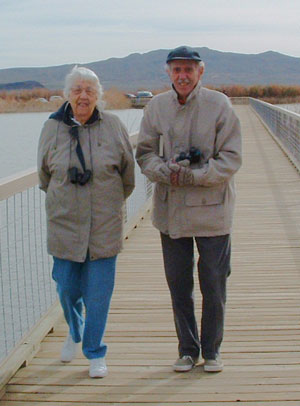
Picture of Mom and Dad
picture by Lissa Heineman

The chief attraction is sandhill cranes:
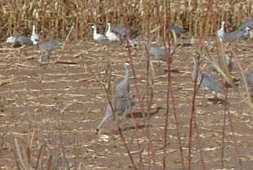
Picture of cranes and geese
picture by Me

It was a pretty cold day, as you can tell by Mom and Dad’s bundleosity in the picture above, but much of the bird-watching at the Bosque del Apache can be done from the comfort of a heated car, a network of dirt roads winding through an artificial wetland created by humans to save birds.

I’m in the midst of reading Michael Pollan’s The Botany of Desire, which plays with the premise that domesticated plants – the apple and tulip, for example – have been engaged for years in a sort of coevolution with us, exploiting our desire for the sweet and pretty to extend the reach of their genomes. In that framework, the sandill crane is pretty interesting. It’s a magnificent bird that we’ve gone to great trouble at the Bosque del Apache and elsewhere to save, pulling it back from near extinction in the 1930s. We’re often less successful saving less attractive creatures from extinction, I think. Pollan’s on to something.

Though there’s an interesting sidebar to be worked out here involving spandrels and the snow goose. I wish I could find a better link on Google to explain spandrels so I don’t have to, but it’s an analogy from a 1979 paper by Stephen Jay Gould and Richard Lewontin. They point to the spandrels in San Marcos Cathedral in Venice, gorgeous painted architectural features created in these weird corner bits left over in the space where two arches meet. It’s hard to visualize, but the Gould-Lewontin point is that there wasn’t a great plan to create these cool spaces, just a clever use of a bit of architectural leftovers. The evolutionary metaphor is that sometimes features are just an evolutionary exploitation of junk, scraps – like jaw bones becoming the bits in the inner ear.

So what does this have to do wiith Pollan, sweet apples, cranes and snow geese? You can use the Pollan theme to explain the cranes – big majestic birds who have evolutionarily exploited our fondness for big majestic birds. We grow corn for them, and build great refuges. But the snow geese? They’re exploiting a spandrel. They’re a pest, vastly overpopulated as they hang in farmer Brown’s field. Coyotes are exploiting spandrels, too. While the wolf has seen its range drop almost to nothing, coyotes have expanded in the presence of European humans’ spread across the Americas. And tumbleweeds. Man, those suckers have found a spandrel. When we cut down the stuff that was in their way, they rolled from the Dakotas all across this great land of ours, exploiting our spandrel.

There’s some work required here to sort out the details, but I think there’s a fun piece in here somewhere if I can think a bit harder about it.

That’s as maybe, of course, because the main deal was that we had a great day today, Lissa, Mom and Dad and I looking at magnificent birds and shivering against the wind.


Running for the Turkey

Turkey run bib

Two great things I saw today at the annual Albuquerque Turkey 5k.

The first was a teenage girl, obviously quite fast, no doubt on her high school cross country team, dawdling with her dad. He kept told her to go ahead, that he didn’t want to slow her down, but she just smiled and hung back with him.

The other was another pair, dad and teenage son. At the starting line, I saw them winding a tether around their hands, and I realized the kid was blind. They ran together, obviously had done this a million times, smoothly and easily, and they were fast. They kicked my butt.

I ran pretty fast for an old guy, 24:48, faster than I’ve run it in five years. This is my 11th turkey run, and the little chart I keep of all my races is a healthy record of my gentle physical decline into middle age.

Bibliographies

I wrote a little DTD of my own over the weekend to use for biblliographic information I’m starting to collect for my book. I needed something to structure the data, and emacs/psgml/DTD seems like a good starting point, since it’s a tool chain I already use and am comfortable with. Perhaps this is a wheel I’m reinventing, but my structure is parsimonious (author, journal, date, title and room for open-ended notes), so it should be easy enough to move it into some other data storage bin if and when I decided on making a change. And thanks to python/libxml/libxslt, dealing with the data is relatively easy.

Suggestions for bibliographic dialects of XML and related software are welcome.

The underlying issue I’m grappling with is a need to adapt my work style. Writing newspaper stories, I can just blunder ahead. Both literaly and metaphorically, I can easily keep up to 10 bits of knowledge in a heap (either in my brain or physically, via notebooks or research papers on my desk) and find whatever I need. Beyond 10, though, it gets increasingly difficult to rummage around and find stuff in a way that’s quick enough to keep up with the writing. I regularly bang up against the limitations of this technique when writing longer newspaper stories. It obviously will fail completely when trying to write a book.

More Anonymous Sources

So the military has released James Yee, the Guantanamo chaplain who media stories had suggested has become somehow complicit with the Muslim terrorists being held there. But wait! I thought the stories said Yee had become sympathetic with the terrorists, and was keeping classified information on his computer. We’d better go back and check on that, see who it was who mislead us. Oh no! We can’t. The stories were based on information from anonymous sources.

Wildfires

Spent some time this evening with an old paper by Tom Swetnam and Julio Betancourt on climate variability and its effects on ecosystems in the southwest. It was published in the Journal of Climate in 1998, which I don’t think is on line, though there seems to be a short version here. Reading it years ago marked the first time I really got the linkage between decadal climate variability, drought, and widespread wildfire.

Here’s the part that got my attention:
Continue reading ‘Wildfires’ »

Groundhog Day

William Grims on leaving the restaurant beat at the New York Times:

The downside is that you have to do that again and again and again. It?s like ?Groundhog Day.? You wake up the next day having eaten a four-star meal, you must go out and eat another four-star meal. And you get up the next day and you have to go out and eat another four-star meal…. And on top of it nobody feels sorry for you. It?s impossible to gain sympathy.

Oh, The Humanity

From the Nov. 17 Sacramento Bee:

On Oct. 19th, while piloting the super-freighter The Grande Tetons down the Columbia River, Capt. Jackson collapsed from a heart attack and fell on the ship’s control mechanisms, causing the ship to lose control and careen across the river. The massive ship then plowed into the combination Sardine Canning & Dynamite Factory on the wharf resulting in a huge explosion and raining sardines all over the town. A radio announcer nearby was heard to cry out, ‘oh the humanity -‘.

Details here.