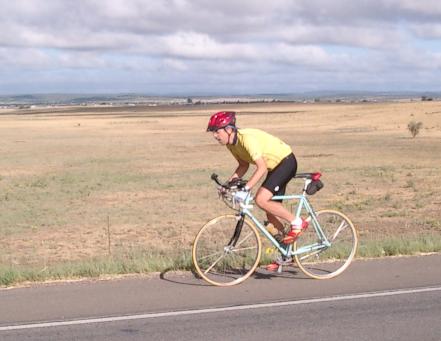
Thanks to Lou Metzger, who was out at Moriarity two weeks ago with a camera, I’ve got a snap of me time trialing:
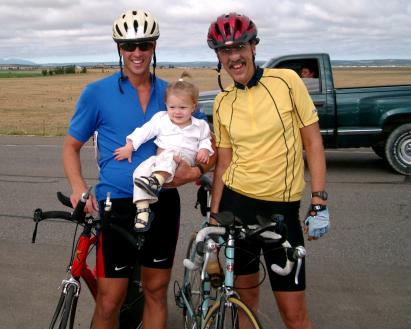
And this, of Jaime, Gianna and I (Gianna’s the cute one, Jaime’s the handsome one, that leaves you to figure out which one’s me….)

Thanks to Lou Metzger, who was out at Moriarity two weeks ago with a camera, I’ve got a snap of me time trialing:
And this, of Jaime, Gianna and I (Gianna’s the cute one, Jaime’s the handsome one, that leaves you to figure out which one’s me….)
From the CIA:
We regret we are unable to process and provide certificates of congratulations to the fine young Americans who have become Eagle Scouts. We have curtailed some activities in order for us to concentrate on the War on Terrorism.
From the user’s manual to the Shimano Flight Deck cyclocomputer (a sort of handlebar speedometer gizmo):
WARNING: Be careful not to pay excessive attention to the computer data while riding, otherwise you might have an accident.
Lissa’s back garden has really come into its own this summer.
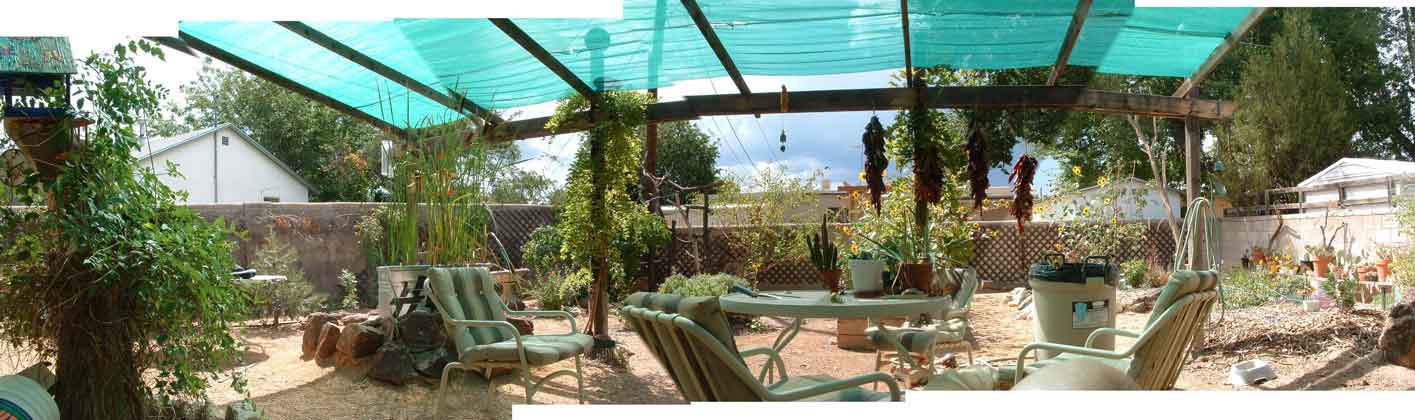
The panorama above (click for a bigger image) is five shots electronically stitched together so you can get a feel for the joy of it all.
The sunflowers have been a show, and the raised bed we built several years ago has an abundance of zinnias that just keep on blooming. Over on the mound on the right, a California poppy is finally taking hold, and L’s been persistent in raising some tomatoes for my breakfasts. Yumm.
The shiny thing on the left with the cattails growing out of it is our pond. Birds love it, as do we.
In which Jeff visits the fish market, reminding me that there is far more to good journalism these days than the paid tripe myself and my colleagues often dish out:
The Fish Markets are a short walk from our place, which is very handy for Sunday lunches. Everyone else seems to feel the same way, because it’s always busy. There are the rough old fishermen in beanies and flannies, snarling at the New Money fishermen, who look remarkably similar to the land-lubber Country Road set finishing off their lobster-champagne brunches; there are the European tourists valiantly trying to enjoy their meals, tortured by a fear that they could be eating their death, with their tour guide saving his commission by reassuring them that Australian seafood doesn’t kill; there are the American tourists frowning at the messy floors and lack of have-a-nice-day service; there are the Japanese university students serving sashimi, lending an authenticity to the process marred only by the speed of their knife-clumsy typing hands and shy apologies; there are the punters carrying armfuls of fresh seafood, chasing their children over the slippery carpark; the families out on the dock sitting around bright plastic tables overflowing with mussels, calamari, chips and Coke; and the forlorn B-list TV personalities watching as their crowds shift to welcome a local movie star. There’s also fish.
This is a piece I’ve wanted to do for a long time:
John Geissman bounded up the steep side of the volcanic knoll, leaving a trail of geologists panting behind him.
A tough half-mile climb above the valley floor, in a clump of oak, Geissman found what he was looking for? a piece of scientific history.
On this 1,000-foot high mound of volcanic rock in the summer of 1964, geologists found the final piece of a puzzle that changed the way we view our planet.
Geissman dropped his pack and circled a small outcrop of the rock that nearly four decades ago proved the theory of plate tectonics? that the continents move beneath our feet.
And I get paid for doing that. Remarkable privilege.
Mark your calendars. Dave Barry notes that Sept. 19 is Talk Like a Pirate Day. Avast!
I am some distance into Einstein in Berlin, an entwined parallel history of Einstein’s scientifically formative years and the city in which he spent a good portion of them. The book in concept is intriguing – tell the story of Germany’s revolution between the world wars through the lens of Einstein’s science. And tell the story of Einstein’s science through the lens of Germany’s revolution between the world wars.
It’s ambitious and intriguing conceptually and a little uneven in execution thus far, but as I don’t know enough about either subject, and because I am intrigued by the author’s attempt at a rather difficult bookish entwining, I’m sticking with it.
“There comes a time when there is just too much choice.”
– Telsa Gwynne
Thanks to the beauties of Garnome and a free Labor Day morning, I’ve finally got myself switched over to GNOME 2.4 as my regular day-to-day desktop rather than just a sand box to play in. (Well, technically it’s still sandboxed so I can switch back to regular Ximian, but it looks like the last annoyances are worked out so I won’t need to.)
Watching the build, as make traffic flew by on the terminal screen all morning, I was struck by the absolutely remarkable volume of human effort involved in this project. All for free, shared with whoever wants it. Humbling.