A Little Help From Your Friends

It was another one of those little moments in Monday’s Tour de France.

If you’re paying attention, you’ve no doubt seen the remarkable photo on Velonews of Beloki sliding on the pavement as Armstrong veers around him. Look at three things – the tension in Armstrong’s jaw, in his forearms as he grips the brakes. And look at the girl on the right in the sun bonnet.

No doubt you’ve also seen the video of Armstrong going cyclocross across the field, too, carrying his bike down the hill and remounting as the little peloton whips by him. But there’s a little moment there that I almost missed, save for looking closely at the replay, as Tyler Hamilton reaches out to his old team leader as he rolls past. Here’s how Hamilton explained it:

I’ve never seen anything like what he did. The guy just keeps making bike racing history. We could see him crossing the field as we made our way around the switch back. When he darted back into the road I couldn’t believe what I was watching him do.

I instinctively threw out my arm to try and give him a push to help get him up to speed, but then I realized I had reached out with my right arm, which is the side with my collarbone fractures. At the last second, I pulled my hand away. I don’t think I would have been much help to him anyway. He seemed to have the situation under control.

Pretty great sport, no?

drought

Droughts are such uncertain things that it is folly to be too precise when saying when one starts or ends. But I will entertain the folly by being extremely precise. The southwest’s first great drought of the 21st century began Sept. 1, 1999.

I know because that is the day I put up a rain gauge in my backyard. I was doing a story for the newspaper about an extraordinarily wet August that year when I made the acquaintence of Robert DeBlassie, who lives in Albuquerque’s south valley and keeps rainfall stats as a volunteer for the National Weather Service. In the course of the conversation, DeBlassie asked where I lived. When I told him, he pointed out that the weather service didn’t have a volunteer observer in that neighborhood, and asked if I’d be interested. When I said yes, he didn’t hesitate, driving out that afternoon to the newspaper with a rain gauge.

I mounted it out in the backyard, got my booklet of official U.S. Department of Commerce form WS B-91’s, and waited.

I got rain the first three days, but September 1999 was a little below average. October was a lot below average. During November, not a drop fell.

In the nearly four years since I started keeping track, we’ve had seven months with significantly above-average precipitation and 24 months with significantly below-average precipitation.

So for my money, the drought starts there.

Yeoman’s Work

While the rest of us are off madly hacking away on GNOME 2.4, the remarkable Kjartan Maraas once again seems to be cheerfully minding the store on our behalf. I think this bears some praise. He did a GNOME 2.2 bugfix release last week, wiping the dust off of the old code to ensure that the things that are fixed in cvs get to travel out unto the world and live among real people. This is not glamorous work, but Kjartan has been doing it for years. Yo.

GNOME 2.4 Diaries

Trying to make the most of my sick days, I’ve been poking around in the GNOME 2.4 docs build infrastructure. Gedit is done, I took a look around gnome-session and figured out what old cruft can be removed, and I’m now in the midst of gnome-applets. They’re the cruftiest of all, which is why I’ve procrastinated so long. If my quick automated analysis is correct, there are 138 docs in the package (including translations), and each has a Makefile.am that needs updating. I’m working on a script now that should do it all in bulk, though given my modest skills it’s always a tradeoff – how long does it take to figure out how to make the script work, versus how long it takes to do it all by hand.

I suppose no matter what, script is still cooler, and the Right Way(tm).

Sick as a Dog

Where does that cliche come from? My dog never gets particularly sick, and least not like I feel now.

I’ve had this fantasy for a number of years that all the exercise I do keeps my immune system in tip-top shape. That’s why, the theory goes, when I get a cold it’s always mild and quick. I don’t remember the last time I’ve missed work – maybe that memorable evening during the 1998 election season when we all got food poisoning at work from the take-out-meal they brought in to the newsroom. That was hilarious. Election feed Tuesday, and half the staff was out by Thursday.

Today I had to kill a trip to Phoenix I’d been really looking forward to for a workshop tomorrow on communicating about climate. I waited until the last minute to pull the plug on the trip, hoping I would recover. Oh well. Sometimes you’ve gotta just suck it up and admit you’re sick.

L’s taking good care of me. Gotta love love at time like this.

Boucle

The great bicycle race has started again, and I will be at least a little distracted by it for the next three weeks.

This has become one of my favorite times of year, each morning a little adventure as I live vicariously through the boys riding the roads of France. Mom and Dad have cable, so I watch with them, carefully picking the days likely to be the most important.

It is the mountains that matter, both because that is where the Tour de France is won and lost, and also because that is where the human drama lies, as the boys push their bikes up impossible slopes through tunnels of wild fans.

That is where we first really met young Lance in the summer of 1999, when the fresh and endearing novelty of a plucky cancer survivor survivor turned into something else on the slopes of the Galibier, high in the Alps.

”I think before today there were some questions about my abilities in the mountains, so I think it was important to show that the team and I are strong in the mountains,” he said after his easy victory over five climbs and 213.5 kilometers (132.5 miles) from France to Sestriere, Italy.

The American leader of the U.S. Postal Service team said he had surprised even himself with his show of strength. Not an overwhelming climber in earlier years, he has worked at his power and lost a few pounds to help get over peaks.

I wrote a couple of years ago about what that tour meant to me. I have talked before about why I am a cycling fan, about the dignity and elegance of the sport, but I was forever bonded to the thing when cancer boy rolled off the line at the 1999 prologue and showed us all something deeply special. Apologies for redundancy, but it bears repeating:

survival

If I were a sportswriter, here is what I would write.

I got interested in cycling during the 1995 Tour de France. Jimmie, a crusty old-fashioned road bike rider, sat next to me at work, and began teaching me the lore of the race, the tactics and the strategy. 1995 was the year Fabio Casartelli died in a wicked descent, and I came to understand the Tour’s grace and elegance the following day, when the Tour’s riders rode the stage silently together, eschewing racing in Casartelli’s honor. They allowed Casartelli’s teammates to ride to the front for each of the stage’s bonuses, collecting the prize money for his family.

And then the following day, a young rider named Lance Armstrong, a teammate of Casartelli’s, rode a ferocious sprint victory for the win, raising his arms and his face to the sky as he crossed the line.

I lost track of young Lance, and paid little attention in the following years as he battled cancer.

And then, on the day of the 1999 prologue at Puy du Fou, Lissa and Nora were travelling and I sat alone at home watching the Tour on television.

I had no notion of Armstrong as a contender. I cared about names like Zulle, people I’d grown to understand as the great champions of the stage race. Armstrong I understood simply as the man who had survived cancer, not as a sporting figure.

When he won, I wept.

“It’s a long way from Indianapolis to Puy du Fou,” Armstrong said after the race. Indianapolis is where he endured the ugliness and devastation that is the best medical science can offer cancer patients today. That became my email signoff quote.

I wept because he stood there at the start line for my wife Lissa, who survived cancer. When I saw the pictures they showed on TV of a wasted Lance Armstrong in a hospital bed, I saw my Lissa. Every time I see those pictures of him (they show them again and again, year after year now) I clutch. I took no picture of Lissa in that hospital bed.

Surviving cancer requires no courage and yet all courage. One has no choice. One simply does what one must do. Lissa survived it with all the courage she had, much she did not know she had, and all life after it is, for us, icing. She now can see Nora grow up.

Whatever Lance Armstrong has done since is icing. Winning that dinky little prologue at Puy du Fou – no, simply riding in it – will always stand for me as the towering achievement, just as every birthday for Lissa is.

I imagine him able to power up the climbs of Sestriere or L’Alpe d’Huez beyond anything Ullrich or the others can do because he is not riding against them. He is riding to beat back something bigger. Perhaps this is a romantic notion, or me projecting, but that is what I see when I see him jump out of the saddle and fly up the hills.

Armstrong passes five years of survival this year, one of the statistically arbitrary markers of “cure” the doctors give patients.

Lissa has passed 10 years, and I rarely think about her cancer any more, except to occasionally thank her for not dying.

But every summer now, the Tour reminds me of the power of survival.

I wrote that two years ago. It seems as though they don’t show the old pictures of Cancer Lance very often any more, and they don’t talk about the cancer, but the bike. In many ways it now is about the bike. But I will never forget. I had that emotional clutch again this year as I saw him roll out of the start house under the Eiffel tower yesterday, cancer boy in the yellow jersey.

I no longer idolize Armstrong. He seems in many ways an unpleasant man. But he is a great bike rider and his committment to cancer survivorship makes me willing to forgive much. There are other voices to be answered in the bike race this year, Ullrich especially, and the brash Simoni and the impishly enthusiastic Hamilton. I hope they give the Texan pause.

So I will be perched in front of Mom and Dad’s television set many days over the next three weeks, but especially on Sunday, as the boys push their bikes up the Galibier and L’Alpe d’Huez.

Independence

I’ll admit I was a little nervous about Martin and Lynn’s annual Fourth of July party this year, what with Martin being dead and all.

See, it was really Martin’a party, and the man lived – and died – large and majestic, a big funny charming guy who dominated the little shaded patio every Fourth of July, overseeng barbecue and telling his stories and being the sort of lovable human glue that made people return to his party on the Fourth year after year.

The last couple of years were tough for Martin – his heart slowly failing him, an oxygen line trailing him around the garden – but he was still the same commanding presence at his parties. Only he would sit in one spot, and we would come to him, and his friends took up the solemn task of barbecue while he continued to hold court.

Martin died this spring, and Lynn’s been having a tough time, but she decided about a week ago to go ahead with the barbecue. All the same faces were there, people I don’t really know except for once a year. There was the usual big spread of food – Larry’s salsa, a big fruit salad, deviled eggs, chips and diet Coke and I even ate a hamburger. It’s a Fourth of July barbecue! It was good. I’m glad Lynn decided to continue.

GNOME 2.4 Diaries

So I finally seem to have overcome whatever auto* voodoo was standing in the way of my GNOME 2.3.x build. My solution was thus:

  1. Try many random solutions with no real idea of what I’m doing.
  2. Whine about how I don’t wanna be a hacker, I just wanna work on docs.
  3. Ignore the problem for weeks.
  4. Panic when I realize the release date is so close.
  5. Find that in the interim, my problem has magically gone.

This doesn’t mean I’ve got a working setup yet, but I’ve now got a terminal window open and building stuff at all times, and I’m in that state where I’ll leave it running churning through the build scripts when I go out, hoping the magic will be done when I get back.

I got the “here’s what we need to do” mail out to the list Tuesday, hinting broadly at the grunt work required. Little useful response so far, except the usual “I’d like to do docs for the flubberwidget” from a newcomer, followed by the, “We’re already doing them, sorry,” from the Sun people. And now that I can (sorta) build stuff, I got started redoing the docs build infrastructure using Malcolm’s new white magic.

Update:
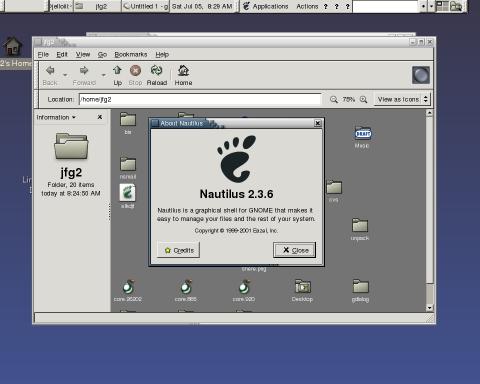
Got a working G2.3.x to show y’all:

GNOME 2.3.x screen shot

War, Peace and the Ongoing National Debate

Ben Fritz over at Spinsanity wrote an excellent piece last week about the frustrating nature of the ongoing national debate over weapons of mass destruction and the war in Iraq. He points out how each side in this feud is essentially sidestepping the important questions raised by the other:


Did the president lie? Was the war unjustified? These two questions are both in play right now, but many conservatives are ignoring the first question and many liberals are ignoring the second, leaving the public with a confusing set of mismatched arguments to decipher.