
Information Ecologies

Nardi and O’Day (Information Ecologies) use, as a case study, a MOO-like environment called “Pueblo” used in an elementary school for poor students.

It sounds like the kids are just MOOing, but there is much more at work than that. When the kids use the text-based role-playing, world-building game, they’re really writing, but in a much more rich and meaningful way than the traditional “write a paper, hand it in to the teacher” model:

When participants create descriptions like the one Starlight wrote for her palace, they add to the ambiance of the virtual world. Participants are motivated to write well because of the enjoyment they give to themselves and others – they can create experiences for others who visit their creations.
As Jo Talazus, Longview’s principal, says, “This is a far cry from `put your papers in the basket on the desks.'” It is vastly different from preparing an assignment for a teacher (an audience of one) who is expected to grade the work, rather than enjoy it.

Howard Rheingold also writes about Pueblo. with some statistics to back up the success of the methodology:

Elementary school students find college-level mentors in the virtual world who show them how to build their own worlds, and encourage them to read and write expressively and skillfully. Longview students learned social skills, and they learned that college is a possible future for them. Then some of the students, most of whom are from low-income families, can help their parents learn to read and write, using the same technology. The response was so overwhelming that the project had to add higher-speed access lines and more access points.

As for practical educational impact, according to the first study, Hughes and Walters report: “Students participating in the summer program made 1.06 years gain on a standardized reading test as compared to 0.58 for those not in the program. Students who were able to access the system for 360 minutes during the fall of 1994 averaged 2.4 years of gain from 1993 to 1994 on standardized reading tests.”

This supports the value of the sort of open-ended, text-based role playing games that Nora and her friends play. And it’s a fabulous demonstration of the sort of evolution that software and computational systems are capable of if you recognize that the groups of humans using the system, rather than just the computer itself or the computer and a single user.
GNOME 2.4 Diaries

Dave Mason, one of my predecessors as head of the GNOME Documentation Project, once said something to the effect of, “I don’t want to be a hacker.”

I’m starting the arduous process of building the next GNOME, 2.4, which exists only in ugly bleeding edge, generally unworkable CVS code. I failed with the usually robust and reliable jhbuild scripts, because of some mysterious auto* tools problem. I turned to the less usable but still quite functional vicious build scripts. and had some modest success. As you can see from the picture, the fonts are an unreadable melange of lovely colors (Telsa suggested it was “impressionist”). But despite certain usability shortcomings, it’s rather a victory, since I at least was able to build it at all.

Which brings me to the theme of today’s discourse. In order to be a usable and contribuing member of the community, I need to be building the latest bleeding edge stuff. But in order to do that, I need to spend a significant portion of my available GNOME time on the building part, which leaves less time than I would like for the “contributing member of the community” part.

The problems are not completely intrinsic. The build scripts are intended to greatly simplify this stuff, and when they work smoothly I’m usually ahead of this game. But there’s an inevitable wrestling match to get the very latest stuff working, and the only real way to do the job on an ongoing basis is to bulk up and wrestle it to the ground.

Sigh. I think I’ll go for a bike ride.

Fixing Bugs

I had one of those classic free software moments this morning that reminds me of why I so strongly prefer that world to the world of commercial software.

I had recently built the latest unstable version of Gnumeric, the GNOME spreadsheet, but the first time I fired it up, it crashed unusably. I dutifully filed a bug report (users’ way of giving back to a project, and an important part of what I think of as the free software social contract). My report left Jody Goldberg, the lead developer scratching his head. He volleyed back a few questions, I answered as best I could, and the bug sat unsolved.

Last night I ran into Jody on IRC and he asked if I’d figured out anything more. I hadn’t, guilt set in, so I set in to rebuild Gnumeric a couple of different ways to see if I could learn anything. Nothing.

Then this morning, there was an email in my inbox. Jody had figured it out, and fixed it.

I’ll buy lunch for anyone who’s had service that good with shrink-wrap software they paid for.

Coach

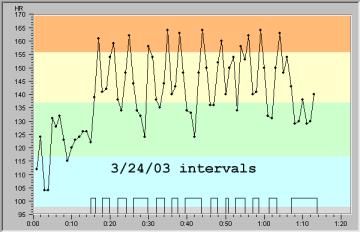
March 24, 2003 heart rate graph

I was too young to really get what Bob Loney was trying to teach us young Upland High School distance runners, but in retrospect it seems like he knew what he was doing.

He didn’t call those pain-in-the-ass quarter mile repeats “interval training” and was more interested in motivational talk than the science of lactate thresholds. But I remember the workouts well, how much I hated them – 10 quarter miles at race pace, run one, rest to catch your breath, then grab onto the next one. We’d run them in groups so we’d get a feel for racing, which was part of his motivation I’m sure. But mostly it was teaching our metabolic systems about where the lactate threshold was, what it felt like to bump up against it. If we really worked them hard (which I rarely did – I was a pretty lazy teenager) we could push that threshold up a little bit, get a little extra speed out of our legs before the lactic acid burn set in.

I’d fogotten those workouts for a long time, but they immediately popped to mind when I started riding intervals. I’m much more rigorous now, using a heart monitor to set peaks and recovery rates and time the results. But it’s amazing how close the basic interval workout matches the rhythms of Bob Loney’s workouts those many fall afternoons on the Upland High School track.

They work. There’s a hill out of Corrales that Jaime and I have been climbing on our Wednesday rides. It comes about an hour into our rides, and it’s not a long hill, but we’re usually flying on the run-up to it, so my heart rate is always near the lactate threshold before we start. Jaime invariably drops me on the first little uphill, which he did three weeks ago. But I kept hammering, and about three-quarters of the way up I caught him. This is unheard of. I never catch Jaime on a hill. My heart rate was near pegged at about 95 percent of max, but rather than blowing up there, I was able to hold it the whole way up the hill.


Blessed be thy intervals, for they will train thy heart.

Bob came to mind this morning as I ran up my heart rate again and again. He used to make us do 10. Today I managed 12.

Fascism

Maciej Stachowiak has a powerful antidote in his March 22 blog to those who would use the word “fascist” to describe Bush’s policies in Iraq. Words matter, and the experience of Maciej’s family in Poland suggests that, whatever one feels about the Bush Administration’s policies in Iraq, one should be careful in the one’s choice of words:


I know all about dictatorship, and fascism, and totalitarianism and empire. My family and my country of birth have lived through them all.

I am going to give the benefit of the doubt to people who freely toss around these kind of words in reference to America or Bush. I’m going to assume they simply don’t know what they are talking about, or have not thought through it fully. I have no great love for Bush or his policies. I think the USA Patriot Act was a cheap and unconstitutional power grab, and I am not sure his course of action leading up to the war was the wisest.

But there is no way you can compare this to real dictatorship or real empire. Iraq is not going to disappear from the map, or become a vassal state. America isn’t going to turn into a land of bread-lines or secret police knocking on your door in the middle of the night. We are not going to commit genocide or leave a whole nation laid waste. No one is going to be liberating starving prisoners from American labor camps. In fact, our military is trying its best to kill as few people as possible and to destroy as little as possible.

(Thanks to the ubiquitous Dave Mason for pointing this out.)

Spring

Sure sign of spring – Lissa and I rode bikes out past the Bueno Chile plant, past the junkyard with the line of old Volkswagen vans along its back fence, our first long ride of the spring. The winter birds you sometimes see in the farmers’ fields down there, in Albuquerque’s South Valley, are gone, replaced by carefully leveled fields awaiting their seed. The cottonwoods aren’t greening up yet, but the elms, evil invaders that they are, show signs of leaves sprouting.

The air had the soft feeling of the first sunny day after a week of rain, which is a feeling we don’t often get here. We saw ducks in the ditch splashing and flailing and trying to make new ducks, a squirrel running along the ditch bank, a load of fresh graffiti down by the elementary school – all trappings of spring.

Google Linking

Some discussion recently on the GNOME Docs List about how to best raise the Google ranking of the GNOME Users Guide. Our problem is that there are a bunch of old versions about that are out of date but still rank high. One way to raise the ranking, of course, is to link to it, which I am doing here.

Away

The New York Times had a story Thursday about how kids use instant messaging that is relevant to my current reading about Information Ecologies. The chapter I’m now reading defines the complex way in which an information ecology takes place – the interplay between the technology itself and the people who use it. The authors make the important point that the technology alone is not determinative. The authors say:


We cannot overemphasize a key point here: only the participants of an information ecology can establish the identity and place of the technologies that are found there. Indeed, this is a responsibility, not just an opportunity.

This contrasts with the luddite view (my word, not theirs) that technology is beyond our control and bends us to its amoral will.

Which brings us to Joyce Cohen’s story in Thursday’s New York Times. It’s a delightful romp about the way kids’ IM away messages have become a fundamental tool for communicating with and entertaining one another:


Away messaging, a function of instant messaging, has become something of an obsession on college campuses, providing communication, entertainment, procrastination and social life all rolled into one. “Students go online just to read their friends’ away messages,” said David Jacobson, a professor of anthropology at Brandeis University, who has taught courses examining away messages. “It’s a whole new dynamic that’s really remarkable.”

The software engineers who created the “away message” had no idea it would be used this way. These kids have bent it to their will.