Quoting Leopold and Bull

Rivers have a heritage but no beginning.

Luna Leopold and William Bull, from their classic paper “Base level, aggradation, and grade.” Proceedings of the American Philosophical Society 123.3 (1979): 168-202.

That’s the juicy pull quote, but it’s maybe too cryptic. Here’s more context:

Through geologic time even the first incipient channel system appearing on an emerging landmass changes in form, drainage network, and gradient as relief increases. There is continual modification, but at any stage the existing system is different from that which existed at a previous state, but has been influenced by that earlier stage.

(Apologies if that’s behind a paywall, I’m writing this sitting on a university campus and I can never tell when stuff like this is more broadly publicly available.)

John Fleck’s thoughts on Yorkshire hosepipe ban

Via GB News, Yorkshire Water has imposed a hosepipe ban following the region’s driest spring in 132 years:

Locals have expressed their anger to the People’s Channel as the weather remains hot, and they are unable to complete tasks such as cleaning their cars, watering their gardens, filling domestic pools, and cleaning their windows.

They have accused Yorkshire Water of not fixing leaks, poor management of reservoirs and charging the public too much.

John Fleck told GB News: “It’s just another company charging us more and providing us with less, which seems to be a trend at the moment.

He added: “Other countries, much warmer than ours, somehow always seem to manage, but then in the UK, leaks are often left unfixed for weeks. The reservoirs aren’t looked after, and we seem to go full circle between flooding in the winter to hosepipe bans in the summer.”

Building a city in the bed of a river

A concrete holding basin protected by a black wire fence, with a skyline in the background.

Catch it, pump it.

Most of Greater Downtown (Albuquerque) sits below the level of the Rio Grande, like a sort of high-desert New Orleans. Any rain that falls between the river’s east-bank levee and roughly Broadway will stay in the area until it evaporates, gets absorbed into the ground, or is otherwise dealt with.

Downtown Albuquerque News

DAN had a great pair of stories yesterday and today about the network of pumps required to manage storm water in Albuquerque’s greater downtown.

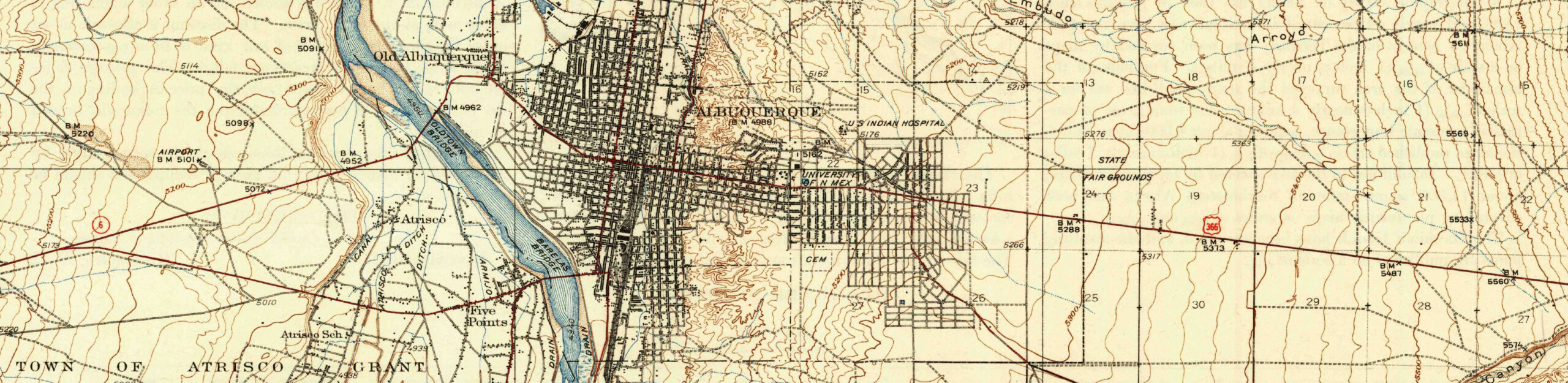
The quote above is true, in that for more than a century we have tried to pin the Rio Grande down on one side of the valley, building levees to confine the river to a narrow strip down the west side of the valley floor through the metro area.

But it might be equally true (though less helpful in a practical sense) to say that we built what would become downtown Albuquerque back in 1880 in the bed of the river, and we have spent the next century-and-a-half trying to keep the river out of said bed. We build levees, we build culverts, we build pumps, we build pipes. Because rivers are nothing if not persistent. This responsibility is ongoing.

This morning’s bike ride/walk took me down through the old Martineztown neighborhood to see the recently completed city storm water pump station #31. We dug a big hole to catch water from big rainstorms, and a pump station to lift that water up and out of the neighborhoods – “otherwise dealt with,” as DAN so charmingly put it.

The traffic chaos while this construction was going on was a delight. This was a big project – a great example of the permanent job we humans take on when we engineer a river.

Riding a bike or walking (the way I did it this morning) is a great way to get a feel for what’s going on here. Martineztown was built on the sand hills, just up out of the flood plain. Walking a thousand feet from the heart of Martineztown to pump station #31 this morning, I dropped ~10 feet in elevation.

Rivers are the sum of each raindrop and melting snowflake, heading downhill, gathering in community, seeking the low spot or, perhaps more accurately, creating the low spot. The rain/snow collective sometimes picks up sediment along the way, sometimes drops sediment along the way, making its own world in the process – making a river.

The indigenous Pueblo people who have been here from time immemorial, and the Spanish who collided with them beginning in the 1500s, generally adapted to that by building in the high spots. That’s why Martineztown is 10 feet higher, and the old Spanish village of Albuquerque was on high ground over on the west side of the valley bottom, near the river’s modern channel.

In the 1700s, the land in between was swampy river bottom, filling with water during high flows from summer melt, or the raging summer downpours. Until Manuel Martín and his family moved there in the 1850s, the place we now know as Martineztown was high ground used for sheep grazing.

Beginning in the 1880s, we (I say “we” because we are the carriers of this bit of history, we can’t avoid owning this) started building a modern city where the rain/snow collective, the Rio Grande, wanted to go, the part between Martineztown and what came to be known as “Old Town” on the high ground near the river.

I say this without judgment. Albuquerque is a wonderful city. But we now own the responsibility that comes with that choice. So we build pumps.

The batting cages and the Armijo Acequia

An irrigation ditch emerging from a culvert beneath a batting cages amusement emporium, with green trees to the left and a bicycle parked in the foreground

Things change.

One of my favorite examples of old ditches threading through our community is this spot, where the Armijo Acequia (AKA the Ranchos de Atrisco Ditch) emerges from a culvert that runs beneath the batting cages on Sunset SE near the Rio Grande.

The ditch dates to the 1700s. Baseball is more recent, batting cages more recent yet. Yet the batting cages are defunct, while the ditch endures. May it ever be so.

There’s currently 187 cubic feet per second flowing down the main channel of the Rio Grande at Central, and 61 cfs coming across the river in the Atrisco Siphon to irrigate this side of the valley, this novel ecosystem, this deeply coupled human and natural system where we’ve replaced a river that once spread across this flood plain with a network of ditches spreading the water across the valley floor.

Obligation

One of the thought experiments Bob Berrens and I posited as we worked on our book Ribbons of Green: The Rio Grande and the Making of a Modern American City (summer 2026 from UNM Press) is the question of what it might look like if a modern city wanted to create from scratch a park-like network of tree-lined trails and streams with flowing water threaded through an already existing city.

I was thinking of that again this morning as I steered the Space Ghost off of Sunset (kinda no-shouldery lousy cycling) and onto the Armijo ditch bank to find my way down valley. I’m still in “old guy recovering from a covid haze” mode, my body (and mind) got pretty beat up by my latest dance with the virus, and this was my first ride down to the river in a month.

I cut through Acequia Madre Park, a bit of concrete with planters and trees where the Barelas acequia used to run (the actual acequia route there is now an alley fenced off to keep campers away); across the railroad tracks, through downtown (“New Town”), through Aldo Leopold’s old neighborhood, back up to Old Town (“Old Town”) where restored old cars, parked on the Plaza across the street from San Felipe de Neri church, compete for attention on Sunday mornings with the glory of the Lord, and across the river to what used to be the Atrisco/Armijo headings.

As Bob and I start sketching the outline of another book (we had too much fun with Ribbons of Green not to try this again), we’ve been reading, thinking, and talking a lot about the nature of moral obligations that come with the collective action of river management at scale.

Gradually, and then suddenly, we took over management of the Rio Grande over the last three-plus centuries as we took water out of the river to grow stuff; drained swamps/wetlands to build stuff; and built levees to pin the river into a narrow strip in order to build even more stuff – to build this city we call home. This creates a fascinating and challenging set of obligations from which we cannot walk away:

  • to people upstream and downstream with whom we must share the river
  • to non-human communities, both those in what we traditionally think of as “nature” – the ribbons of green between the levees – but also the broader riparian strip beyond the levees, full of human and natural life dependent on the ditches and the river-connected shallow aquifer
  • to the past? Maybe?
  • to the future? Unquestionably.

The river’s shrinking. The flow right now at Central, our canonical point of measurement, is the lowest it’s been at this point of the year since 1972. We got a delightful burst of rain last week, which pumped the river up for a few days, but it’s back on its gonna-dry-soon-here-unless-it-rains trajectory. I was delighting last week at the burst of rain, and the rewetting, when a wise friend reminded me that drying out a river and then dumping a bit of rain down the channel for a few days until it dries again is not a great way to run an ecosystem. Pity the poor fish. Understanding the nature and extent of these obligations, sorting out a decision process that respects competing and conflicting values, is hard stuff.

Because there is less water, and there will be less wet and less green. We have to decide where, we have to, as Hanif Abdurraqib put it, determine what kind of apocalypse we’d like to have.

We’ll have to choose whether to still have the Armijo for me to ride my bike down away from the traffic and beneath the shade of ditch-fed trees: how many ditches will remain, how many trees, how much land can we still irrigate, how much can we irrigate it? What are our obligations to our neighbors downstream – our legal obligations, but more importantly our moral ones? (I am morally unsatisfied by arguments that fall back on gymnastic interpretations of what the law says to define the extent of this obligation, to defend our water against other.)  What are their obligations to us? What of the trees and birds and fish using the water along the way?

Mostly I wasn’t dwelling on this when I turned down the Armijo, I was just enjoying the shade and the sound of flowing water as each culvert dipped beneath the neighborhood streets, the joy of being back on the bike on a goofing wander after an ugly month.

It was lovely.


Quoting Hollis Robbins

Much of human history is the story of catastrophic agricultural losses. The invention of the silo in the nineteenth century reduced grain losses from 50% to just 2%. Silos transformed farming from a seasonal survival struggle into a year-round productive enterprise.…

Before silos, life was measured in losses. After silos, farmers stored grain during harvest-time price lows to sell during peak periods. Silos enabled year-round milk production. Silos enabled strategic grain reserves for communities, creating buffers against seasonal shortages. Rural economies stabilized as community grain elevators enabled everyone to work together.

The agricultural silo is in fact one of history’s most transformative innovations, solving the storage challenges that had given farmers a headache for millennia.

Hollis Robbins, You say ‘silo’ as if it were a bad thing…

I had no idea.

On Hobbies

black and white photo of two boys playing with model trains.

Walter Spangenberg, a student at Woodrow Wilson High School and his nine year-old brother on the model railroad in the attic workshop which Walter has fitted up. Esther Bubley, 1943, courtesy Library of Congress

I wonder what my life would be like if I’d stuck with model trains rather than taking up blogging. Probably less stressful.

The Colorado River “psst psst” scheme emerges into public view: the “Supply Driven” concept

Powerpoint slide with arrows and a line describing the "supply drive" concept of flows at Lee Ferry.

The potential path forward.


See note of correction/clarification below:

Arizona yesterday finally moved the super-secret idea at the heart of current Colorado River negotiations out of the shadows.

The idea is deceptively simple: base Lake Powell releases on a percentage of the three-year rolling average of the Colorado River’s estimated “natural flow” at Lee Ferry. Allocate water based not on a century-old hydrologic mistake, but rather based on what the river actually has to offer. It presents an attractive alternative to the increasingly baroque and unproductive shitshow that had taken over interstate negotiations.

Correction/clarification: It has the great virtue of each basin getting out of the other basin’s business – one clean, simple number. But establishing the right percentage remains the hard part. Make the percentage too high and the Upper Basin would have to cut users with pre post-Compact water rights, something that has forcefully been asserted to me since this blog was first posted the Upper Basin argues it has no ability to do. Make the percentage too low and Lake Powell fills up while Central Arizona goes dry.

But some of the early modeling suggests that there may be a sweet spot where a combination of Lower Basin cuts along the lines of what the Lower Basin has already been willing to offer, combined with modest Upper Basin system conservation programs, might thread a needle that could allow the crafting of a compromise. This is very good news if the negotiators and the folks back home who have been egging them on can seize this opportunity to set aside parochial smallness and think at the basin scale.

The possibility of a new approach was hinted at a CU Boulder’s Colorado River conference two weeks ago (I spent most of the conference hidden away watching and listening on Zoom through a covid haze, so it might have just been a fever dream, but I thought I heard the hints), and I’m told was a topic of some of the hallway conversations. But Tom Buschatzke’s reveal at yesterday’s meeting of the Arizona Reconsultation Committee (the closest thing we have to the much-needed C-SPAN for the Colorado River Basin) was the first public discussion of the hush-hush stuff that shouldn’t be quite so hush-hush given, y’know, 40 million of us stakeholders.

The full slide deck from the Colorado River C-SPAN Arizona Reconsultation Committee is useful. Reclamation’s Dan Bunk, for example, shared a slide slowing the latest “min probable” forecast (hilarious typo – “min problem” now corrected) showing the system tanking – dropping below minimum power pool at Powell – in winter 2026. The min probable forecast has been a useful guide lately, frankly, and the latest version is horrifying. (On any other day this would be the lead, and probably deserves its own post, but I try not to work on Wednesdays.)

We don’t have a lot of time here.

Agave season

A blooming agave stalk rises from the plant's spiky based, with a lawn and hous to the right, a sidewalk and street to the left, and trees in the distance.

Agave parryi (I think)

It’s that time of year when the family collects agave sightings around our Albuquerque neighborhood, detouring our drives and walks and bike rides to follow their progress, sharing locations and pictures whenever we’re out and about.

This one greeted me this morning as I was returning from my first tentative bike ride in a week (bad case of the crud). I looped around when I saw it, up on the sidewalk to better catch the morning sun, talked to one of the neighborhood walkers who said she’d been watching its florescence on her ambles, texted the results to L.

I’m not an expert (help out in the comments if you’ve got the knowledge), but I’m pretty sure this one is Agave parryi, commonly known as Parry’s Agave, which is common in Albuquerque gardens. The parryi variant, native from Arizona to west Texas, and south into Chihuahua and Sonora, is one of several hundred agaves – maybe 340? – that started their journey in the semi-arid Americas.

Along the way, we humans gave them a lot of help. Or perhaps they helped us?

Their domestication – because of their yummy hearts, kinda like artichokes once cooked down to a more digestible carbohydrate – goes back thousands of years in the Americas, probably pre-dating corn/maize. Some genetic variants seem to clump around the sites of settlements, suggesting people not only cultivated them but took them with them as they moved across the landscape. They’re extremely drought tolerant, which makes them a good food stuff in this arid climate. They famously (Agave tequilana) serve as a beverage base, and the fibers of their leaves can be woven into fabrics.

Fun agave fact: back a few million years, agaves share a common ancestor with asparagus.

We don’t eat or drink or wear them in my suburban Albuquerque neighborhood, at least that I know of, but maybe we could?

Parry’s is only one of the agaves found in the city’s suburban gardens. We’ve got a a couple variants of what I think are Agave americana in our yard. I’m a little confused about the native range of americana, but the book Agaves of Continental North America has them native mostly to Mexico with a few bits and bobs in south Texas and Arizona. One of our americanas, which we bought at a Tucson nursery, seems to struggle with the cold extremes of our winters, but it’s hanging on. The other is a monster of a “century plant” version we got from a friend, massive with frightening pokey bits at the end of its leaves, which when curled just so can catch the rain or the water when I give it the occasional shot from the hose.

There’s a sadness to the dramatic show the Parryis are putting on right now. They plants live 20-ish years plus or minus, and then go out in this blaze of glory, one dramatic push toward reproduction to spread seeds before they die.

But they often will send out “pups,” which with a bit of nurturing will carry on the lineage once the parent plant is gone.